You are moving from Zurich to Bern, the new apartment is furnished, and the new tenant of your previous apartment wants to take over the furnishings in just a few days. What initially sounds like a simple question quickly becomes a cost and logistics decision: Do you buy new furniture, rent a complete package or organize an interim solution with storage and later resale?
WithRenting furniture instead of buyingthe monthly amount alone is not the deciding factor. The decisive factors are the effective length of residence, the number of planned moves, the available storage space, the transport distance, the return conditions and the question of whether the piece of furniture will actually be used again after you have used it. My clear recommendation: first calculate the entire useful life. Only then do you compare renting, buying and buying used.
Why the question of renting or buying furniture in Switzerland needs to be asked again
Swiss moving practice is a bad fit for furniture that is bought for a single apartment. According to Swiss Post, around451,884 householdsmoved in 2020. That was roughly equivalent toten percent of the Swiss population. Most moves took place in the months of March, June, July and September, and in each of these months more than65,000 Relocationswere reported.Die Schweizer Umzugsstudie der Postshows a market in which living situations change regularly.
Five questions are important when deciding between renting and buying:
- How long do you stay at the location?An apartment for a few months requires a different solution than a home in which you live long-term.
- How often do you move?Frequent changes of residence not only make transport more expensive. They also increase the risk that furniture will not fit in the next apartment.
- What stage of life are you in?Students, expats, temporary workers and young households often change their needs more quickly than families with a stable living situation.
- Do you have storage space?In urban apartments, basement compartments and attic space are limited. An unsuitable sofa then quickly becomes a storage problem that requires a fee.
- Do you want to keep a specific piece of furniture?A high-quality dining table, a solid wood bed or a design classic can be bought in a more emotionally and functionally sensible way.
Estimate the actual useful life first
Many purchase comparisons only calculate Purchase price versus monthly rate. That is too short-sighted. The purchase price includes delivery, assembly, any interim storage, repairs, loss of value and the expense for subsequent sale. In addition to the rate, the rental includes delivery, return, cleaning, damage, deposit and possible fees for early termination.
A rental model is particularly suitable if you want to flexibly exchange the furnishings and the provider organizes the return professionally. The range of rental furniture and temporary furnishing solutions is visible in Swiss centers such as Bern, Zurich and Basel, but the market is not yet established across the board. A historical Swiss study even describes an attempt to rent office furniture from 2019, which was ended after a few months due to low demand.Der Statusbericht zur Schweizer Kreislaufwirtschaftmakes it clear that rental models do not automatically meet with widespread acceptance.
Practical rule:Don't buy for a hypothetical future. But don't rent for a short transitional period if return and transport are more expensive than buying a used car in good condition.
Cost comparison of renting versus buying in Switzerland
For a 3-room apartment in German-speaking Switzerland, you shouldn't look only at the furnishing package. What matters is which costs arise over the entire period of residence and what residual value remains at the end. Buying may seem more expensive at the outset, but it loses this disadvantage over a long period of use. Renting protects your initial budget, yet over a long term it is often burdened by recurring payments and the return of the items.
| Cost comparison: renting vs. buying furniture (3-room apartment, German-speaking Switzerland) | Buy | Rent |
|---|---|---|
| Acquisition or start-up costs | Here is the translation: One-off purchase price, financing if required | Recurring rental rate, possibly a deposit |
| Delivery | One-time delivery costs | Delivery at the start, collection at the end |
| Assembly | Booked as a one-off or separately | Depending on the provider, included or charged separately |
| Storage | Relevant for a move or an interim solution | Can be incurred with a provider or privately |
| Cleaning | Self-organised or before sale | Often relevant as a precondition for handover |
| Depreciation | Borne by the buyer | Included in the rental price or in the return conditions |
| Residual value | Sale or transfer possible | No ownership value, except with a repurchase option |
| Flexibility | Sale and new purchase necessary | Change possible depending on the contract |
The correct invoice reads:
Total cost of buying = purchase price + delivery + assembly + storage + repairs − resale proceeds
Total rental costs = Rental payments + Delivery + Assembly + Return transport + Cleaning + Damages + Fees
A three-year comparison can therefore tip either way. If you stay only a short time and move locations several times, renting saves you the effort of buying, transporting and later selling. If, on the other hand, you remain in the same place for several years, the purchase price is spread over a long period of use. In that case, a high-quality second-hand purchase often beats renting, because you retain a residual value in the end.
TheKosten- und Renditebetrachtung von Mieten und Kaufenis helpful as a general comparison, but it does not replace a Swiss moving cost estimate. For the initial furnishing, you should also review the individual furniture items separately instead of blindly accepting an overall package. A practical guide is provided by the overview of theKosten beim Einrichten der ersten Wohnung.
Plan for the transition, not just the stay
The change itself is a frequently overlooked cost factor. Anyone who has to sell a purchased piece of furniture after a short time may end up paying for the listing, dismantling, interim storage and another transport. With a rental solution, this sale is unnecessary, but you do have to comply with the return conditions and the condition of the piece of furniture.
The average Swiss household spent in 20245,049 francs per month for consumptionout. That corresponded48.8 per cent of gross incomeThe household budget data from the Federal Statistical Office provides a useful framework for budget planning, but it does not indicate which model is more cost-effective for your household. The decisive factor remains how long you personally intend to stay.
Correctly assessing life cycle assessment and the circular economy
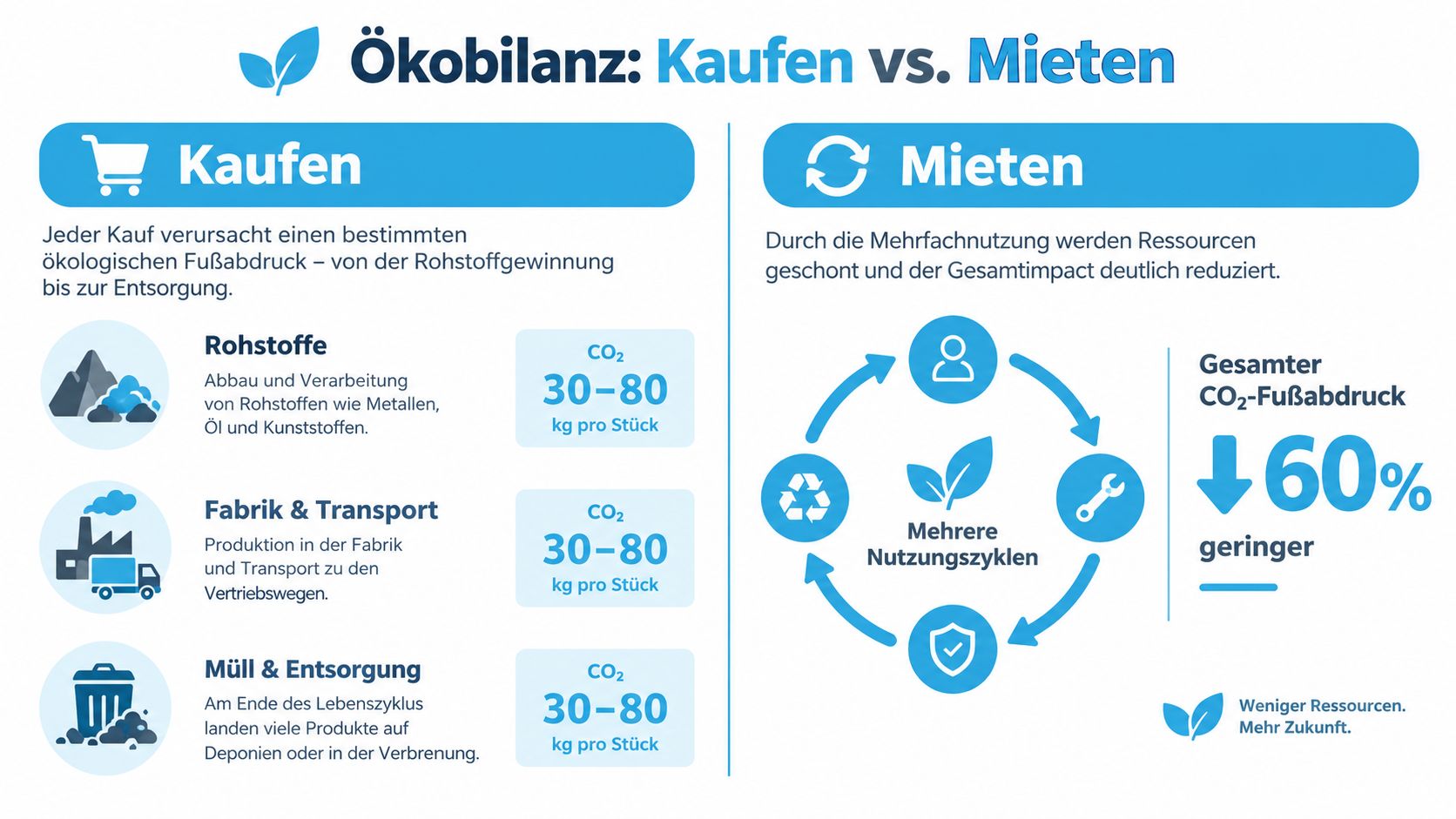
Renting furniture isn't automatically more sustainable.The ecological benefit only arises when a piece of furniture is used for a long time, repaired, refurbished and rented out again. A provider has to organise returns, quality checks, cleaning, spare parts and onward transport in such a way that several usage cycles actually take place.
In Switzerland, according to one estimate, around500,000 tonnes of furnitureas well as aroundone million mattressesinto the waste. At the same time, the amount of municipal waste per capita rose from525 kilograms in 1985on704 kilograms in 2020an increase of around34 per cent.Die Schweizer Analyse zum Möbelabfallshows the structural importance of longer use. These figures do not prove that every rental offer is more environmentally friendly. They show why take-back and reuse matter in the first place.
The decisive circular mechanisms
For furniture rental models, the Federal Office for the Environment models a service-life gain of around60 per centwhen refurbishment and several rental contracts extend the period of use. Design adjustments for better refurbishability can contribute a further10 per cent. Harvesting spare parts at end of life can reduce material requirements by around10 per cent.Die BAFU-Beurteilung von Massnahmen in der Nutzungsphasethus provides concrete checkpoints for choosing a provider.
Look out for the following characteristics:
- Modular design:Individual parts can be replaced without having to replace the entire piece of furniture.
- Repairability:The provider states repair processes and makes spare parts available.
- Documented service life:You receive information on previous use and reconditioning.
- Local return logistics:Several pieces of furniture are bundled rather than transported individually over long distances.
- High utilisation:The furniture sits unused in storage as rarely as possible between two contracts.
An INFRAS study concludes that longer use and more frequent repairs could reduce greenhouse gas emissions by aroundCHF 2 billion per yearwith additional expenditure of about143,000 tonnes of CO₂ equivalents per year. That corresponds to a reduction of roughly22 per cent.Die Zusammenfassung der INFRAS-Studieconfirms the key conclusion: it is not renting as a contractual form that improves the footprint, but longer, repairable use.
Switzerland's recycling rate of52 per centis also only a general reference value for municipal waste. It does not describe how many rental furniture items are recycled. For your specific piece of furniture, what counts is therefore whether the provider first re-rents, repairs or reconditions it. Only then comes recycling. For items no longer needed, an organisedEntsorgung von Möbeln in der Schweizhelps ensure that usable furniture does not end up in the waste prematurely.
Typical rental models and matching life situations
Furniture rental does not work as a one-size-fits-all product. A student needs a different model than a company furnishing a complete lounge for a pop-up location. So check the contract term first, then the notice period and only at the end the selection.
| Rental models in Switzerland at a glance | Term | Cost range per month (CHF) | Typical situation |
|---|---|---|---|
| Short-term subscription | Short and flexible | Depending on furniture, service and term | Studies, temporary work, interim tenancy |
| Classic long-term rental | Medium to longer commitment | Monthly rate according to package and quality | Expat stay, fixed-term project apartment |
| Rental model with buy-back option | Transition with later purchase option | Rate plus defined purchase price | Apartment handover, trial phase, uncertain needs |
| Showroom or event rental | By occasion or project | Depending on scope, duration and logistics | Pop-up, trade fair, corporate event |
| Temporary office furnishings | According to project needs | Per workstation and equipment | Temporary office expansion |
Short subscriptions for mobile phases of life
A short-term subscription suits a sofa bed, a desk or a simple dining table when the apartment is only used temporarily. Students and temporary staff benefit above all when delivery, assembly and return are included in a single process. Check the minimum rental period carefully. A seemingly flexible subscription becomes impractical if an early return does not reduce the remaining instalments.
For expats in Zurich, Geneva or Basel, a classic long-term rental is suitable when the employment contract is fixed-term and the household is not intended to be set up permanently. A bed, a dining table and an office chair can make the start easier. If the person stays longer than planned, they should compare the rental with buying second-hand. A buy-back option can simplify this switch, but it must include a clear purchase price and transparent crediting.
Events and temporary business premises
Showroom and event rental is aimed at companies, trade fairs and pop-ups. Here, appearance, punctual delivery and dismantling count for more than a long-term residual value. Providers such asOrgatech mit Mietmöbeln für Lounges und Veranstaltungenshow how such solutions can range from individual seating items to complete event furnishings.
A boarding house follows a similar logic to a furnished transitional apartment. Anyone considering this form of accommodation for employees or project staff will find a complementary overview atMonteurMiet Informationen zum BoardinghouseMaking the leap to buying makes sense as soon as the need is stable, the furnishings are individual and the planned use is long-term.
Contractual and legal points when renting furniture
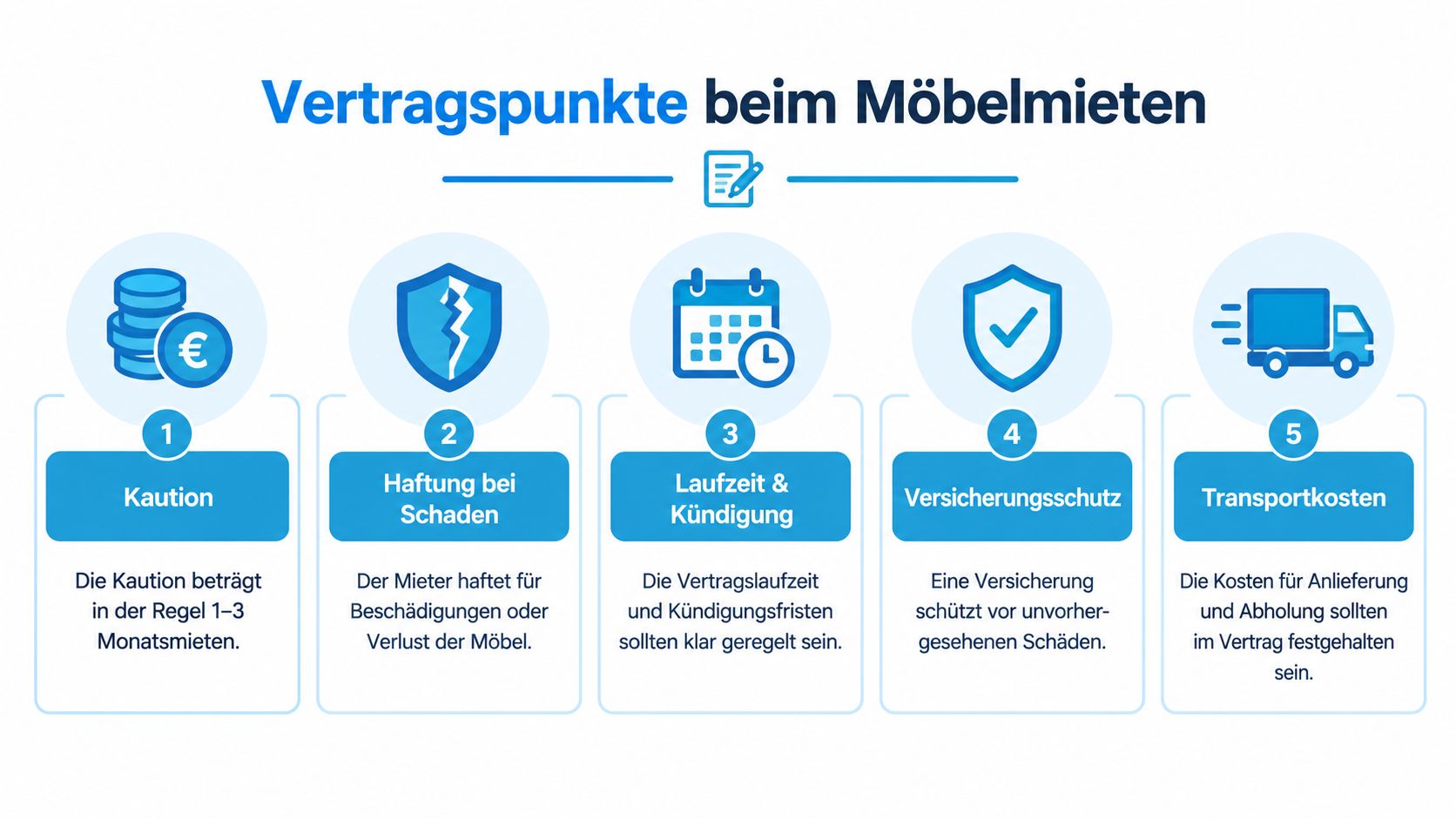
A rental contract for furniture is not a handshake on the delivery date. Read the provisions on term, termination, deposit, transport, damage and return before the first instalment falls due. Particularly important is the distinction betweennormal wear and tearand damage caused by use contrary to the contract.
The contract should clearly state which piece of furniture is delivered, what condition it is in and which services are included in the price. This includes assembly, dismantling, cleaning, repair and collection. If a clear provision is missing, disputes can arise later over whether a scratch, a stain or a damaged edge is covered by normal use.
What to check before signing
- Deposit and security:Clarify the amount, safekeeping, repayment and possible offsetting against outstanding claims. Some providers require a rental guarantee or bank guarantee instead of a deposit.
- Liability for damage:Check who is liable for damage during transport, assembly and use.
- Reporting defects:Record how quickly visible damage must be reported and through which channel the report is made.
- Term and termination:Read the minimum term, notice period, renewal and costs for early return.
- Condition on return:The contract should distinguish between cleaning, normal wear and tear and chargeable repairs.
In Switzerland, depending on how the contract is structured, the rules of the Code of Obligations apply to tenancy law. Have clauses reviewed that largely exclude liability for defects or broadly extend your liability. A written condition report at handover and return protects both sides. Photograph the furniture, packaging, walls, floors and access route. This is especially important when several carriers or assembly partners are involved.
Insurance and receipts
A household contents insurance policy may, depending on the policy, cover damage to your own belongings, but not automatically rented furniture. Ask your insurer about furniture, liability and transport cover. For a move, separate transport insurance can make sense, especially for delicate designer furniture.
Keep the contract, condition report, photos, delivery confirmation and return receipt together. Anyone who only documents the monthly price will be unable to prove the most important information in the event of a claim.
Organising transport, assembly and return in practical terms
With rental furniture, the return logistics determine convenience and cost. Only arrange delivery once access, parking, floor level, lift and room access have been clarified. Swiss logistics partners such as Planzer, Galliker, the Post or specialised furniture couriers work with different appointment and service windows. In cities, short delivery windows may be possible; in outlying regions, more planning is often needed.
The process on delivery day
- Check access:Measure doors, stairwells, lifts and tight corners. A sofa won't automatically fit through the building entrance.
- Document the condition:Photograph every piece of furniture before assembly. Note scratches, dents, stains and missing parts directly on the report.
- Define the assembly scope:Clarify whether assembly, packaging disposal, wall mounting and alignment are included.
- Protect floors and walls:With parquet flooring, delicate walls and narrow stairwells, insist on suitable protective materials.
- Schedule the return:Book the collection early and record whether dismantling and cleaning are included.
Same-day delivery is not available everywhere. In outlying regions, fixed time slots and additional trips may apply. Before ordering, ask about floor surcharges, lift use, waiting time, special access and possible costs for a failed delivery attempt.
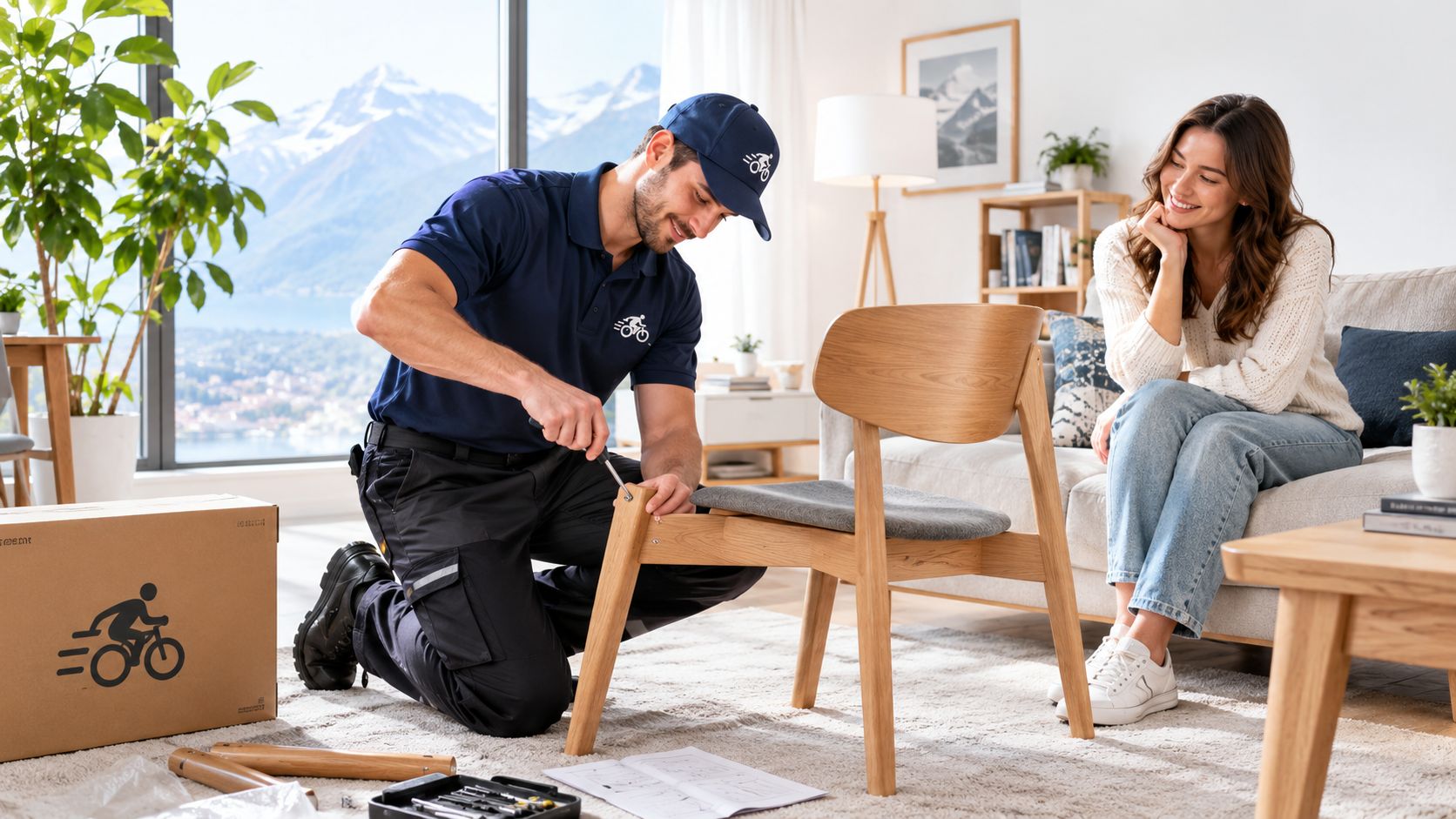
For the final step, you shouldn't wait until moving-out day to clean the furniture. Remove personal items, secure loose parts and photograph the condition after dismantling. A clearMöbellieferung in der Schweizideally includes scheduling, transport and, on request, assembly. This reduces the number of interfaces, but does not remove your obligation to provide the agreed access.
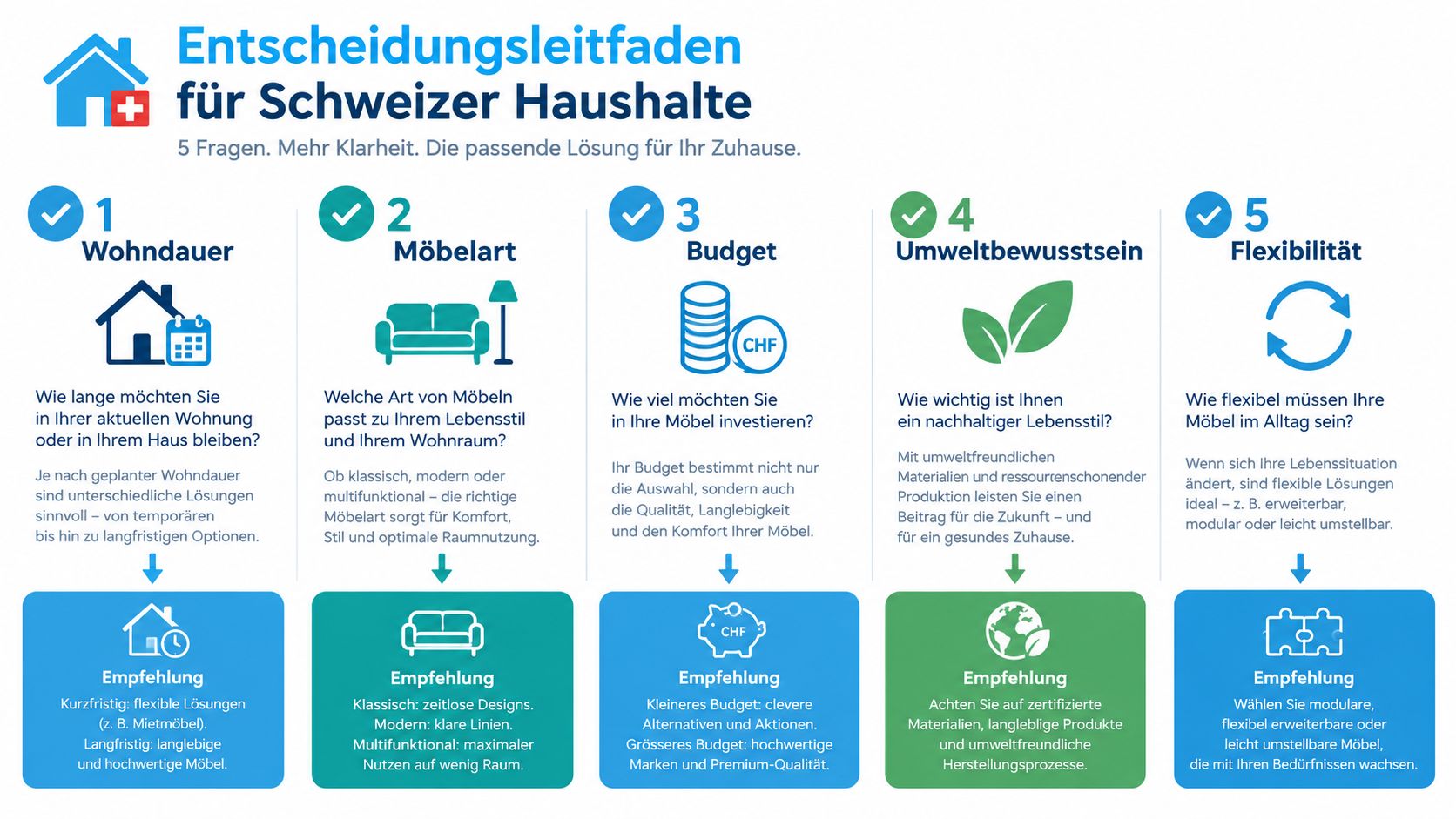
Decision guide for Swiss households and offices
The best decision can be made by answering five questions:
- Length of stay:Are you staying only temporarily or planning long-term in the same place?
- Type of furniture:Do you need an interchangeable standard piece of furniture or an individual custom-made item?
- Utilisation:Is the furniture used daily or does it stand in a rarely used room?
- Switching costs:What do delivery, assembly, return transport, cleaning and possible storage cost?
- Subsequent use:Can you sell or pass on the furniture, or take it with you to your next home?
When renting comes out ahead
For a stay ofunder 18 months, with modular furniture or when needs are unclear, I recommend renting. This applies especially to a basic set-up in a sublet, an expat stay, a fixed-term project, a flatshare with high turnover or a temporary office expansion. What matters is that the provider organises the collection and that furniture doesn't disappear into storage after a single contract.
Small flats amplify this effect. In 2024, people living in one- to two-room flats had a relocation rate of15.3 per cent. For flats with four or more rooms it was7.4 per cent. For people living in apartment buildings, the rate was10.5 per cent, in single-family homes5.1 per cent.Die BFS-Daten zur Wohnmobilität 2024show why flexible furnishing is particularly relevant in small rental apartments.
When buying is the better decision
If you are staying in the same place for more than three years, or dealing with heavy built-in units and custom-made pieces, buying is usually the more durable solution. The same applies to high-quality second-hand furniture that you will use for a long time and can later pass on. A solid wood table, a perfectly fitted shelf unit or a bed with personalised features should not be replaced for the sake of a short-term rental advantage.
Ask providers about modularity, repairs, spare parts, return rates and transport routes. Compare furniture rental shops, online platforms, retailers with a rental service and office suppliers not only on price, but on the overall service. For transport, what matters is whether appointments, assembly and return are planned together.
TIXPI organises moves within Switzerland, individual furniture transports, deliveries, assembly and disposal at a transparent price agreed in advance. Whether you want to rent, buy or return furniture,besuchen Sie TIXPIand plan your transport without unnecessary empty runs or surprises.