
You help friends move, rent a van or hire a company to do the entire household. Then a sofa slips in the narrow stairwell, a box of dishes falls to the floor or a deep scratch occurs in the parquet when loading. Only now does the crucial question arise:Who pays for the damage?
Transport insurance for private moves is not automatic all-round protection in Switzerland. It stands alongside the liability of the transport company, household contents insurance and private liability. Anyone who confuses these three areas risks a gap in coverage in the event of damage. The following rules will help you to assess the protection before the moving date objectively and without false promises.
The expensive moment of shock when moving privately
The moving day begins in a relaxed manner. Two friends carry the beige designer sofa out of the apartment, while a third person holds the front door open. It's getting tight in the stairwell. While turning, one of the helpers briefly loses his footing, the sofa hits the wall and the armrest tears.
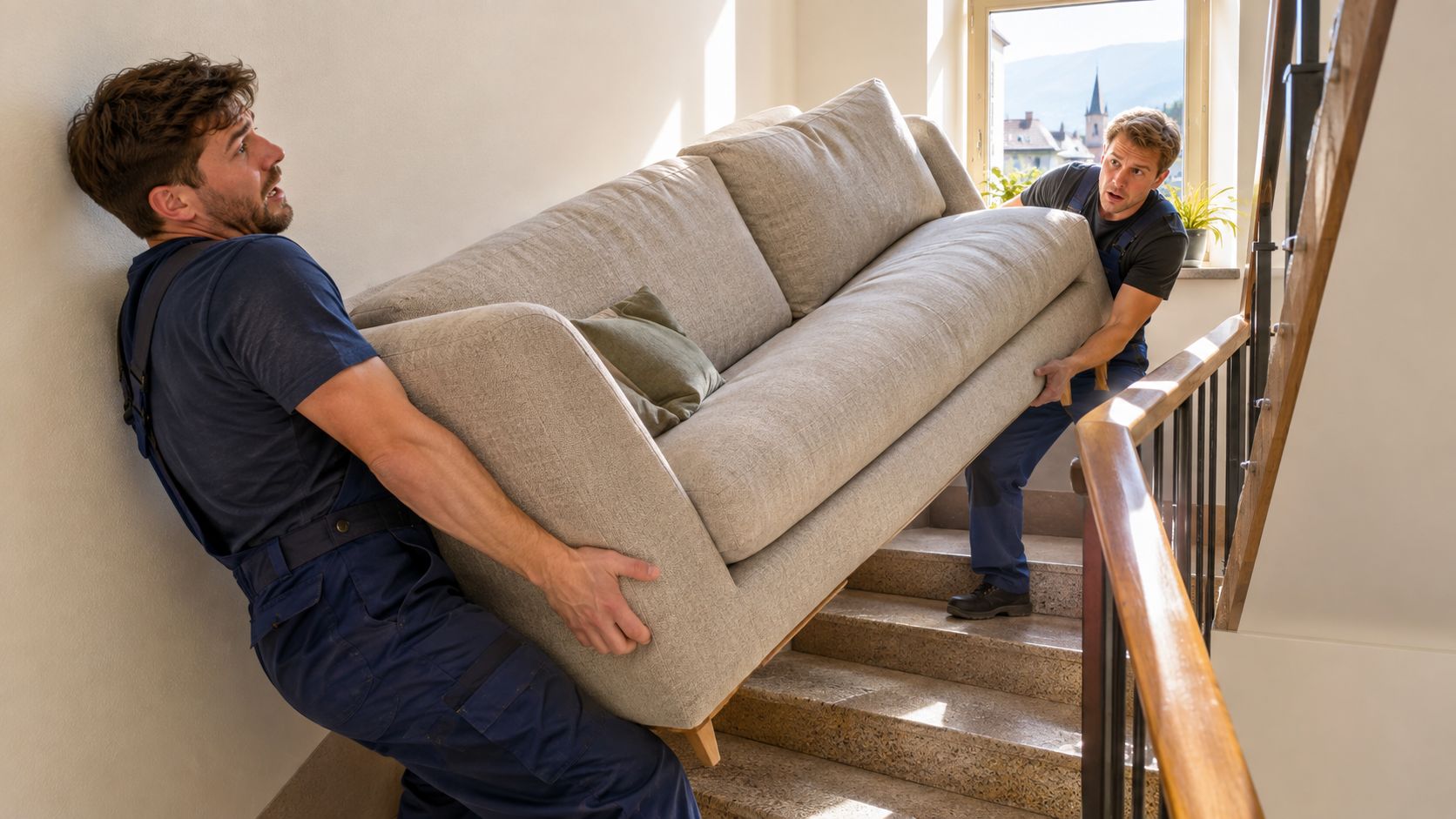
The problem doesn't just start with the repair bill. First you need to clarifyWho organized the transport, who damaged the item and which policy applies to exactly this cause. Different rules apply to private helpers than to a professional moving company. A self-rented van leads to different questions than a single furniture transport with assembly.
The Swiss moving structure makes this distinction particularly relevant. In 2022, around9.5% of the permanent resident populationchanged their apartment, that was about700,000 people. Last year it was around750,000 people. TheSchweizer Umzugsstatistik des Bundesamts für Statistikshows a regular, slightly declining market for the transport of furniture and household goods.
Short distances do not protect against damage.40% of movesoccurred 2022 within a radius of less than2 km, the average domestic moving distance was13.7 km. Particularly over short distances, damage often occurs when carrying, at narrow doors, when loading and unloading or during temporary storage.
My clear recommendation:Clarify insurance coverage before the first box is carried. When the damage occurs, there is hardly any time to read the general terms and conditions or discuss liability with friends.
When moving privately, you should therefore have three questions answered in writing:
- Who transports:private helpers, a rented van or a professional company?
- What is transported:cheap consumer furniture, high-quality electronics, art, antiques or a single piece that is difficult to replace?
- Which phase is insured:Packaging, dismantling, loading, travel, interim storage, unloading and assembly?
This check decides whether basic liability is sufficient or whether separate transport insurance makes sense. A spontaneous promise like “It’s already insured” is not enough.
Understanding legal liability and its limits
Many private customers assume that a moving company they hire will pay for any damage in full. That's not true. In Switzerland, the transporter's legal liability is generally based onArt. 447 OR. The carrier is liable for damage to the transported goods if the damage is due to fault. This is a basis for liability, but not fully comprehensive insurance for the entire new value.

What carrier liability actually provides
The specific contract and the company's general terms and conditions determine how damage is calculated. Providers often limit their responsibility to:Current value, an amount per kilogram or a limit per incident. For an expensive, lightweight item, a kilogram-based limit is particularly problematic.
An example makes the gap clear. A high-quality electronic device or a designer chair can have a high replacement value but weigh comparatively little. Even if the company has to answer for the transport damage, the contractual or statutory calculation may fall well short of the actual value.
Typical limitations concern:
- Slight negligence:The general terms and conditions may limit liability for less serious misconduct.
- Inadequate self-packing:For boxes you have packed yourself, compensation may be excluded if the packaging caused the damage.
- Incorrect instructions:Incorrect information about weight, fragility or dismantling can affect liability.
- Particularly fragile goods:Art, antiques, cash or certain electronic devices often require an express agreement.
- Force majeure:Events outside the controllable transport risk may be excluded or treated differently.
Damage to the property must also be considered separately. A broken table is damage to the goods being transported. A damaged stairwell, a scratched floor or a chipped wall, on the other hand, affects a third party's property and is not automatically covered by the same policy.
Why current value is often not enough
With current value, the depreciation due to age and use is taken into account. This may seem appropriate for an ordinary piece of furniture. However, for a well-preserved designer piece of furniture, a collection or a hard-to-replace one-off item, the current value does not necessarily correspond to the amount you need for an equivalent replacement.
A separate transport insurance policy can close this gap, depending on the policy and declaration. It can cover breakage, scratches, loss and damage during loading, transport and delivery. Whether work you do yourself, assembly or interim storage are also covered must be expressly stated in the insurance terms and conditions.
Before placing an order, these points therefore belong on your written checklist:
- Insured value:Does the current value or the replacement value apply?
- Liability limit:Is compensation paid per kilogram, per incident or on another basis?
- Deductible:What amount do you bear yourself per claim?
- Packaging:Are boxes you packed yourself included?
- Special items:Have art, antiques, electronics or musical instruments been declared?
- Transport phases:Does cover begin at collection and end only after assembly, or already upon delivery?
Anyone who does not answer these questions does not know what their insurance covers. TheSchweizer Übersicht zur Haftung bei Transportschädenalso points out the importance of current value, kilogram limits, exclusions and immediate documentation of damage.
Household contents and personal liability insurance compared
Household contents insurance is important during a move, but it does not automatically replace transport insurance. Swiss insurance terms and conditions generally provide cover at both the former and the new location as well as during the moving phase for a move within Switzerland. However, this does not mean that every impact, breakage or drop damage occurring while carrying items is insured.
TheAVB der Schweizerischen Versicherungsverbände zur Hausratversicherungunterscheiden zwischen dem versicherten Hausrat → Let me translate each segment.distinguish between the insured household contents, the insured risks, exclusions, the sum insured and the deductible. Fire, water or theft may be covered. An item that slips out of your hands while loading, on the other hand, may be covered only to a limited extent or not at all.
| Type of insurance | Typical cover during a move | Key exclusions & limits |
|---|---|---|
| Household contents insurance | Protection of household contents at the old and new location, depending on the insured risks | Transport damage caused by impact, breakage or falls is often excluded or limited; note the deductible and the sum insured |
| Personal liability insurance | Damage culpably caused to third parties by an insured person | Help given as a favour may trigger only limited liability; damage to your own household contents is not insured |
| Carrier's liability | Damage to the goods taken over for transport, in accordance with the law and the contract | Current value, weight limit per kilogram, per-event limits, packing faults and further exclusions possible |
| Separate transport insurance | Depending on the policy: breakage, scratches, loss or damage during defined transport phases | Check declaration, packing, work done yourself, assembly, storage, deductible and notification deadlines |
Private helpers are not a moving company
When friends help carry things free of charge, this constitutes a situation of assistance as a favour. The helper's personal liability insurance does not automatically pay for every damage to the property of the person being helped. What matters are the specific terms of the policy and the question of whether there was conduct giving rise to liability.
This is not a marginal, theoretical issue.62% of people who moved in the past ten years organised their change of home privately; among 18- to 35-year-olds the figure was 77%.These figures come from theZurich-Hinweisen zur Umzugsplanung. Anyone enlisting friends should therefore not wait until after an accident to check whether their personal liability insurance applies at all.
Clarify in advance who carries sensitive items. Valuable furniture and electronics do not belong between two boxes if nobody knows how they are secured. If you rent a van yourself, also check the rental terms, the vehicle insurance and responsibility for the load.
Inform your household contents insurer before the move about the date, the new address and a possible adjustment of the sum insured. In the case of a move abroad, household contents cover generally ends at the latest at the end of the insurance year, unless another arrangement is made. A Swiss policy must therefore not be tacitly assumed to provide cover abroad.
When transport insurance really pays off
An additional policy is not economical for every piece of furniture. It is worthwhile wherethe potential loss would be hard to bear, the value is poorly reflected by the basic liability, or several risky transport phases coincide.
Swiss moving statistics show that the risk varies considerably from household to household. In 2022, the relocation rate in apartment buildings was10.8%, compared with5.1%in single-family houses. In 2024, people living in one- to two-room apartments moved at a rate of15.3%, roughly twice as often as people in apartments with at least four rooms, whose rate was7.4%. These figures from theBFS- und BWO-Daten zur Wohnmobilitätsay nothing about the size of individual claims, but they do show how widely the volumes transported and moving situations can differ.
A practical decision in four steps
First, determine the value.Create an inventory list and mark items that you cannot replace at short notice. For valuable furniture, art or electronics, use the documented replacement value and collect purchase receipts, serial numbers and photos.
Second, check the type of transport.A single piece of furniture, an online order, a disposal job or an entire household all have different risk profiles. A transport involving collection, interim storage, redelivery and assembly has more interfaces than a direct trip.
Third, read the coverage phases.The policy must state clearly whether it applies during collection, packing, loading, transit, storage, unloading and assembly. Insurance that only covers the trip itself is of no help if damage occurs while you are doing the work yourself.
Fourth, compare the deductible and possible underinsurance.With a used piece of furniture that can be replaced cheaply, it may make sense to bear a limited loss yourself. With a high-value one-off item, this strategy is usually wrong, especially if the carrier's liability only takes into account the current market value or a weight limit.
Transport insurance is particularly advisable for:
- Designer furniture and antiques:Sentimental or market-based value cannot be reliably reflected by weight.
- High-quality electronics:A lightweight device can concentrate a high value.
- Art and delicate one-off items:Breakage or scratches can be difficult to repair.
- Interim storage:Responsibility can change at the transition from transport to storage.
- Combined routes:Several pickups, transfers and deliveries increase the number of critical handovers.
Economic rule of thumb:Don't insure every single box as a reflex. Insure the items and transport phases whose loss you could not easily absorb financially or practically.
With a provider such as TIXPI, you can check theKosten einer Transportversicherungfor the specific job. Here too, what matters is the actual scope of coverage, not the price alone.
Reporting damage and documentation in practice
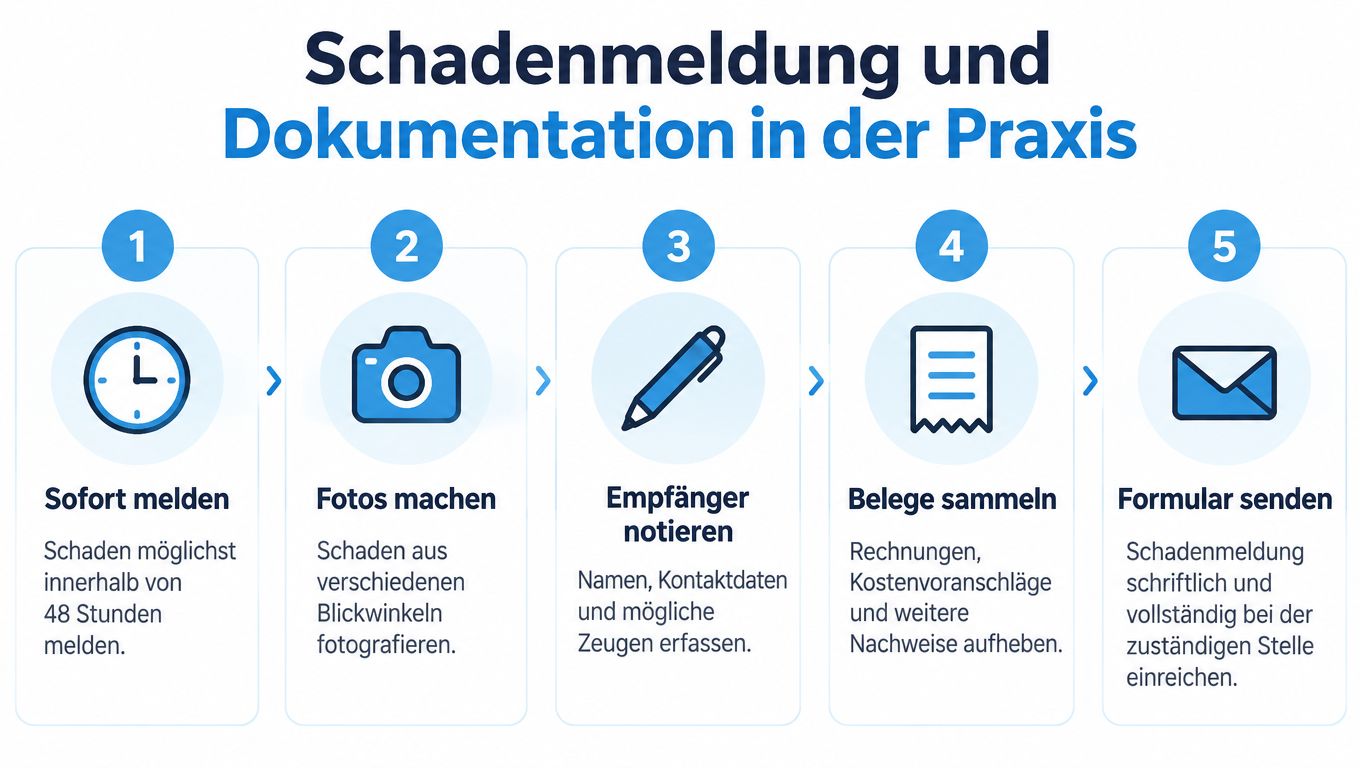
Damage without evidence quickly turns into a discussion about assumptions. A verbal complaint to the moving team is not enough. You need a traceable link between the condition before the transport, the process itself and the condition on delivery.
Before the transport
Photograph valuable items from several angles. Pay attention to edges, surfaces, connections and existing scratches. Supplement the images with an inventory list, purchase receipts, serial numbers and a brief description of the condition.
Also note any particularities of the packaging. Was a screen transported in its original packaging? Did you dismantle a piece of furniture yourself? Were the screws labelled? This information will later help to narrow down the cause of the damage.
On delivery
Check furniture, appliances and boxes as soon as possible. Visible damage must be recorded with a precise description in the work or delivery report. Don't just write "sofa damaged" – describe the location, type and extent of the damage.
Photograph the item from several angles and secure a copy of the signed report. Ask for the names of any people present if they saw the damage or the condition on delivery.
After unpacking
Hidden damage is often only discovered when you open the boxes. Therefore, check your household goods promptly and keep damaged packaging. Do not dispose of or repair the item before the transport company or the insurer has had the chance to examine the evidence.
For the notification, you should compile at least the following documents:
- Dated photos:Before photos, images of the packaging and detailed pictures of the damage.
- Inventory list:Item, condition, value and, where applicable, serial number.
- Delivery report:With the damage note and the details of the handover.
- Receipts:Purchase receipt, repair cost estimate or a comprehensible statement of value.
- Written notice of damage:By email or using the prescribed form.
Under the practice of the General Conditions of the Swiss Forwarders, the appropriate damage notification must be made at the latest withinseven days. Other contracts or policies may stipulate shorter or additional requirements. Apraktische Übersicht zur Schadenmeldung bei Umzugsschädentherefore points out the need for immediate documentation and written notification.
Do not wait to report the damage until all formalities have been settled. Send a preliminary written notification within the contractual deadline and submit any missing documents later, provided the contract allows this. For the orderly filing of the policy, inventory, photos and correspondence, aCheckliste für Versicherungsunterlagenis helpful.
In the event of damage, it is not the loudest complaint that counts, but the cleanest evidence.
Your strategic guide for your next move
Good moving preparation does not begin with loading, but with a decision about risk and responsibility. Work through the following points in this order.
Before booking
Record your household goods room by room. Mark valuable, fragile and hard-to-replace items. Check whether the stated insured value matches the replacement value and whether your household contents insurance is aware of the new address and the moving phase.
Then choose the transport model. For an entire household, a professional company can make sense. A single piece of furniture involves different requirements than a household clearance with interim storage. With private helpers, you should not regard liability for acts of courtesy as automatic full insurance cover.
Before the moving date
Have the transport company confirm the following in writing:
- Basis of liability:Statutory liability, limits under the general terms and conditions, and calculation based on current value or another value.
- Scope of cover:Loading, transport, unloading, assembly and storage.
- Own work:Packing, dismantling and self-hired vehicles.
- Special goods:Art, antiques, electronics and particularly sensitive furniture.
- Damage deadlines:Form, recipient and permitted notification channel.
Document the condition before transport. Label dismantled furniture parts, secure loose components and use suitable packaging for sensitive appliances. Also inform the property management or landlord if a lift, a stairwell or communal areas need special protection.
On moving day and afterwards
Appoint a person to document the process and the handover. Have any visible damage recorded in the report immediately. Check boxes and furniture at the new location and report hidden damage in writing without delay.
For individual pieces of furniture, deliveries or assembly work, you can compare theMöbeltransport mit passenden Transportoptionen. What matters is not simply the most convenient booking, but the combination of transport type, value, handovers and clear responsibility.
Frequently Asked Questions About Moving Insurance
Does the cover apply during temporary storage?
Not automatically at every stage. The transport policy may end once the goods are delivered to the storage facility, while different contractual terms apply for the storage period. Have it confirmed in writing whether moisture, theft, and damage during placement into storage and later removal are insured. The storage facility should be specified in the contract with its location, conditions and scope of liability.
Is a van I rent myself insured?
The vehicle insurance does not automatically cover the household goods in the cargo area. If you move yourself, you need to check vehicle cover, cargo, deductible and damage caused by improper securing separately. Private liability insurance also does not automatically cover damage to your own furniture.
What applies when private helpers assist?
Helping out as a favour is not a professional transport service. Whether a friend's private liability insurance applies depends on the specific conduct and the insurance terms. Discuss roles in advance and ideally do not hand over particularly valuable items without a clear agreement.
What happens when moving abroad?
When moving from Switzerland abroad, your existing household contents cover may end at the latest at the end of the insurance year. For cross-border transport, you need a separate review of the transport phase, destination country, customs, storage and sum insured. Do not rely on a Swiss household contents policy without written confirmation.
Do I have to report minor damage?
Yes, if you want to safeguard your claims. Damage can worsen after unpacking or become difficult to prove later on. Photograph it, note it in the report and report it within the contractual deadline, even if you do not yet know the final repair cost.
TIXPI organises private moves, individual furniture transports and deliveries with optional assembly, and shows the maximum price before booking. Check the right transport option and insurance cover for your job, and visitTIXPIbefore a small moving problem turns into a costly dispute.