
You're sitting in the van in the morning, the coffee is already half empty and the phone is silent. At the same time, you know that somewhere in your region a sofa has to be removed from an old apartment, a bed frame has to be sent from the warehouse to the customer and an office table has to be delivered to a new store before the end of the day. The problem is rarely that there is no work. The problem is that many transport companies chase the wrong work.
InFurniture transport ordersin Switzerland, the person who has the biggest truck or the longest radius does not automatically earn the most. Often the person who bundles short assignments neatly, schedules times closely and turns three small stops into a profitable half-day tour earns better. This is exactly where organization separates from just driving around.
Understanding the market for furniture transport orders
The typical mistake starts early in the day. A driver is waiting for the one big job that will save everything. A complete house clearance, preferably over a long distance and with a full vehicle. That sounds sensible, but in everyday Swiss life it is often out of touch with market reality.
In 2024, Switzerland9.3% of the population around took place, just like in the previous year. That corresponded to around697,000 peopleor about1,900 people per day. At the same time, the average moving distance was 13.4 km. This information comes from the Federal Statistical Office via theUmzugsdynamik in der Schweiz. For everyday life this simply means: a lot of exercise, little distance.
The structure is almost more important than the sheer quantity. Almost three quarters of the moves took place within the same canton, as the Swiss guide on the topicschwere Möbel transportierensummarizes. Anyone who is still planning as if the profit lies in long-distance transport is organizing around demand.
Where the orders really come from
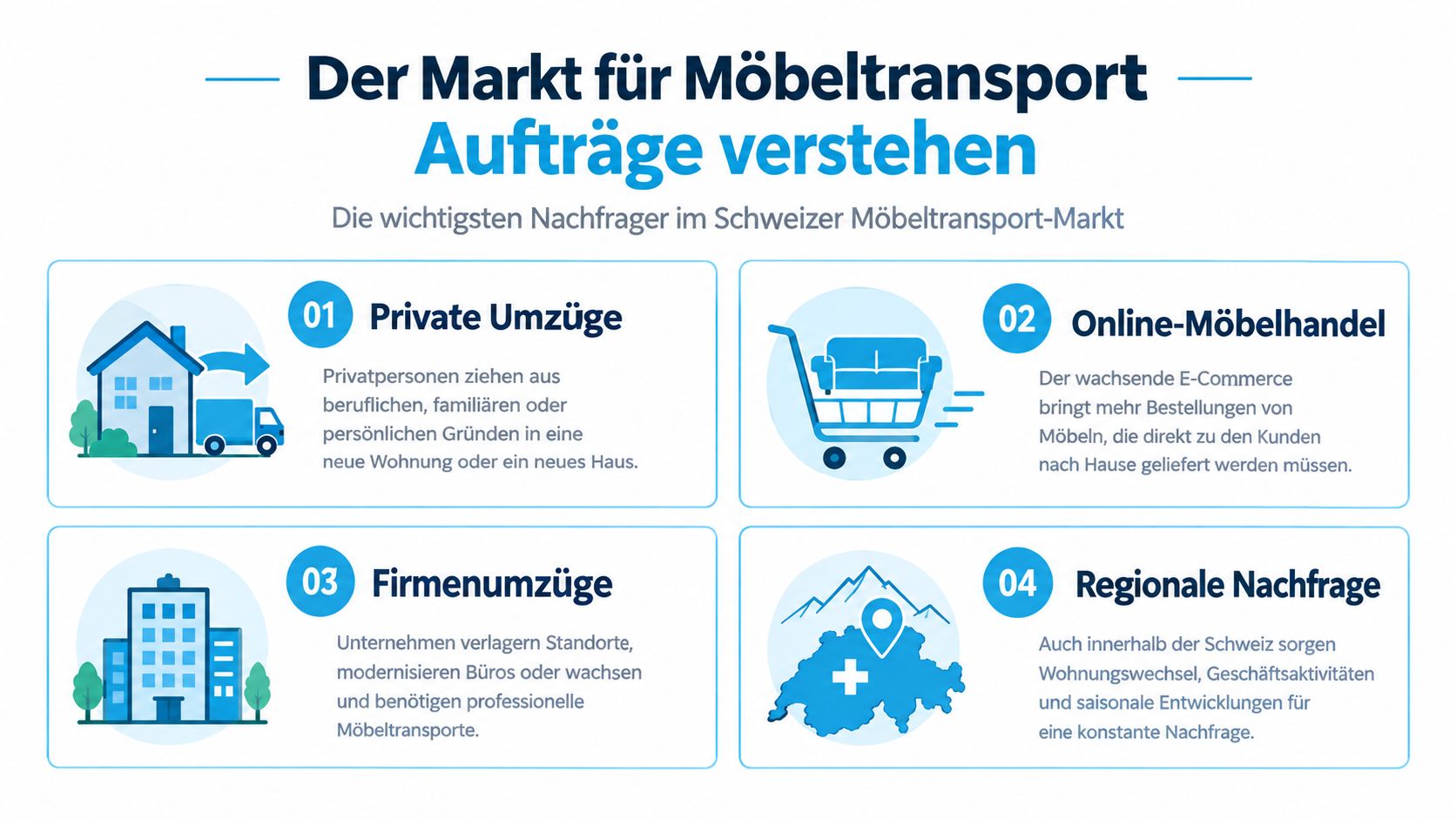
The market does not only consist of classic household moves. It is fed by several streams that operate in very different ways.
- Private small movesare often short-term, local and time-critical. This includes individual room changes, shared apartment moves or the transport of a few pieces of furniture.
- Individual furniture and subsequent purchaseswork differently. A sofa, a dining table or a cupboard often doesn't need a whole moving crew, but it still needs protection, carrying assistance and precise deadlines.
- Office and object transportsrequire more timing. There, less sentimentality counts, but more reliability in the time window.
- Deliveries from trade and importsgenerate constant additional demand on the last mile.
The fact that furniture flows themselves are an important factor can be seen from the trade data. In 2024, around575,200 tons of furniture importedand67,200 tons exported were produced in Switzerland. The import volume was therefore around8.5 timesas high as the export volume, as the statistics forSchweizer Möbelimporten und -exportenshow. Anyone who only sees furniture transport orders as a moving business is ignoring a large part of the market.
Practical rule:The most profitable day is often not the one with the largest order, but the one with the cleanest connections between small ones Orders.
If you understand this, you no longer think in terms of individual trips, but rather in terms of regional movements. This is exactly where models become interesting, whichMöbeltransporte in der Schweiz digital planbar macheninstead of just passing on loose inquiries.
Strategies for acquiring your next transports
Finding orders is not just a sales problem in the furniture sector. It's a scheduling problem. If short routes dominate, then a long list of half-suitable requests will do you little good. You need access to missions that fit the route, the vehicle, the crew and the day window.
Open platforms versus closed networks
Open classified ads, job boards and local advertisements provide reach. The catch is well known: lots of inquiries, a lot of query effort, unclear loading conditions, unclean address data, unrealistic price expectations. You quickly spend more time clarifying than driving.
Closed networks are more closely managed. There the number of visible orders is often lower, but the information is often more usable. This is crucial for furniture transport orders because an incomplete lead becomes expensive. If the information on floor, load-bearing distance, dismantling or time window is missing, your calculation will be tilted.
A short comparison from practice:
| Channel | Advantage | Disadvantage | When it fits |
|---|---|---|---|
| Open platform | A lot Visibility | high testing effort | if gaps need to be filled at short notice |
| Local network | trust-based handovers | limited range | if you are strong in a fixed region |
| Structured switching | more predictable Info | less spontaneous freedom | if you prioritize utilization instead of individual deals |
Why local reputation counts more than the lowest price
In the Swiss short-haul market, only the cheapest provider rarely wins. Clients quickly notice who shows up on time, communicates clearly and doesn't explain away damage. This is particularly important for small jobs. The customer not only compares the price, but also the effort. If he has to call back five times, your offer has already been burned.
The biggest weak point in the market is not a lack of demand, but a lack of transparency. Public and platform data show many advertisements and tenders, but hardly any reliable guidance on how demand, occupancy or price logic diverge regionally. This blind spot is exactly what the observation about fragmentierten Transportaufträgen in der Schweiz describes. In practice, this means: Those who only collect leads are often working in a fog.
What actually works in acquisition
Instead of accepting everything, good companies do a hard job of pre-sorting. I would first check every furniture transport order according to these criteria:
Does the order fit into an existing route
A mediocre individual order becomes good if it fills an empty section.Is the information complete enough
Unclear information about access, dismantling or need for help eats up margin.Can follow-up business be derived from this
Property management, furniture warehouses, fitters and small traders often bring in recurring operations.Is the time window operationally correct
A short route can block half the day if loading and unloading are poorly timed.
If you want to make money in the short-haul market, you don't have to win every request. He has to quickly sort out the wrong requests.
Calculation and legal protection in detail
An order is only good if it still earns money after the last signature field. Many people only count the vehicle, driver and fuel. That's not enough in the furniture sector. Here access, risk of damage, carrying work and complaint cleanliness determine your margin.

How to calculate without flying blind
I always separate furniture transport orders into four cost blocks. Not as an Excel gimmick, but because every block becomes visible in the event of a dispute.
Mileage and time
The route alone says little. Short distances can be expensive when looking for a parking space, stairwells and waiting times.Handling the object
A closet on the ground floor is a different job than the same closet on the fourth floor without a lift.Equipment and protective material
Ceilings, belts, rolling aids, edge and glass protection cost time in preparation and return.Risk premium
Sensitive surfaces, narrow old buildings and short handover times increase the potential for damage.
When insuring, it is worth taking a clear look at the insurance situation. A good start for customer discussions is the overview ofTransportversicherung und Kosten. The most important thing is that many customers wrongly assume that their household contents insurance covers the transport. This is usually not the case. The guide toHaftung bei Umzugsschädenexpressly points out that furniture must be separately insured during transport.
Liability and damage reporting must be carried out properly
In Switzerland, the Code of Obligations regulates the liability of the carrier. In the event of loss or damage, replacement must always be provided. In practice, a guideline value of 500 CHF per cubic meter is often given in ordinary cases, unless further insurance has been agreed. This emerges from the association's technical documentation in the document onSchweizer Umzugsbedingungen und Haftung.
Recording the damage upon handover is even more important. Visible damage must be recorded immediately. Hidden damage must be reported in writing within eight days. This distinction is central to furniture transport, as the specialist article onMeldung von Transportschäden in der Schweizexplains.
Important in everyday life:Without a clean handover protocol, you will not discuss the damage later. They discuss whether it even occurred during your operation.
What is often underestimated operationally
Most damage does not happen on the highway, but during manual handling. SUVA cites injuries caused by incorrect lifting as a common accident mechanism. A Swiss guide also estimates that over 40% of all moving damageoccurs when transporting heavy furniture, with an average amount of damage ofCHF 1,200. This classification is in the linked data collection of the Federal Statistical Office on the subjectUmzug und Transportrisiken.
That's why three things work reliably in practice:
- Heavy pieces disassemble, before they become problematic.
- Rolling aids, carrying straps and team liftsUse consistently.
- Loading sequence according to weight and tipping stabilityPlan, not randomly.
If you do this part sloppily, you are not only wasting time, you are also wasting your entire calculation Game.
Bundle tours and minimize empty trips
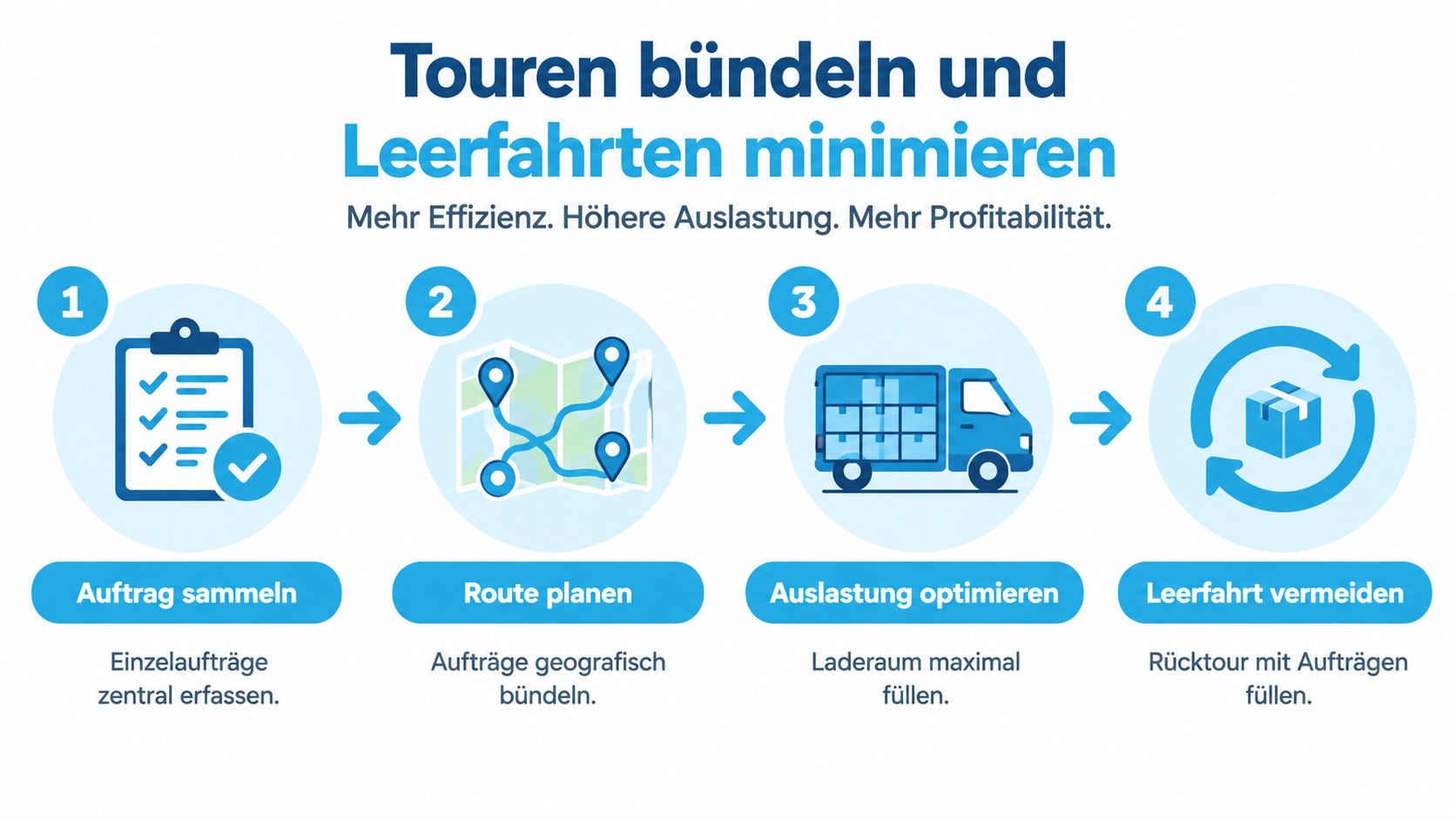
This is where you decide whether you are a transporter or just a mobile reaction service. Individual furniture transport orders bring in sales. Bundled tours bring income. Especially in the Swiss short-haul market, the leverage lies not primarily in more kilometers, but in better-filled kilometers.
The operational error in thinking is simple: many people plan the order first and then the capacity utilization. The reverse order is more profitable. You first plan your regional movement area and then place suitable individual orders on it.
The logic behind profitable bundling
A good bundle does not consist of as many orders as possible. It consists of compatible orders. Compatible means: similar region, similar time windows, consistent loading sequence and no contradictory requirements for personnel or vehicles.
I check bundles in three shifts:
| Test question | Good | Bad |
|---|---|---|
| Geography | Same axis or Neighboring zones | Zigzag through several city spaces |
| Loading image | Stackable, separable, securable | Bulky, blocks early stops |
| Time window | Staggering with buffer | several hard fixed dates at the same time |
What works particularly well in Switzerland
Short distances favor additional loading and connection logic. If many jobs run within the canton, you can build real micro-tours from isolated individual orders. A bed from storage, then a sideboard from a private address, and finally a return or disposal on the way back. Such chains look unspectacular on paper. They make the difference in the daily results.
A clear grid helps with scheduling:
The narrow time windows in the morning
Everything that needs access, administration or reserved handover comes first.The flexible ones at lunchtime Stops
Individual items with a short wearing time and little coordination fit well in the middle.Actively fill the return route in the afternoon
Don't just think about what is possible on the way home after an order.
If you want to sharpen your operational control, you will find inLogistik Einsatzplanung Leitfadena useful thought structure for planning, prioritization and use of resources. This is not a specialist furniture text, but the logic can be easily transferred to regional tours.
An empty return journey is not fate. It is usually a sales opportunity that is thought about too late.
Solutions that make additional loads visible and not just convey individual transports are interesting for such models. An example of this is the possibility of Möbeltransport als Beiladung zu organisieren when the route and capacity are available anyway.
What doesn't work
What regularly fails is blind collection. Three small jobs are not automatically better than one clean one. Bundles become particularly problematic when:
- the loading sequence is illogical, for example because the first delivery item is at the back
- too many special cases come together, for example assembly, glass, narrow stairs and fixed dates in the same cycle
- Buffers are missing, which creates a parking problem for the entire series tilts
Bundling does not mean stacking everything on one cart. Bundling means planning the day as a product.
From a lone fighter to a networked partner
Many good transport companies remain lone fighters for too long. Not out of conviction, but out of habit. You acquire things yourself, plan things yourself, drive things yourself and fill gaps yourself. This works up to a certain point. After that, self-organization takes up more time than it brings freedom.
The difference is particularly evident in furniture transport orders with a small-scale structure. When you work alone, you react primarily to what comes in. Anyone who works in a networked model can connect capacities better, distribute load peaks and identify idle times earlier.
Two models in direct comparison
| How it works | Strength | Weakness |
|---|---|---|
| Independent acquisition | Full control over selection and Price discussion | high expenditure of time, irregular pipeline |
| Networked collaboration | more predictable handovers and better connectivity | less complete autonomy in the process |
That doesn't mean that one is always right and the other is always wrong. A company that has strong regional roots and has permanent property managers or dealers can very well go it alone. But as soon as utilization fluctuates or several vehicles have to be coordinated, structure becomes more important than gut feeling.
What networks bring in practice
The real advantage lies not in just access to orders. He lies in standards. If data formats, time windows, contact persons and scope of services are more clearly defined, the friction loss per order decreases. It is precisely this loss of friction that is often underestimated in the short-haul market.
A networked model helps in three situations in particular:
- In the case of gaps between fixed assignments, because follow-up jobs can be assigned more quickly
- In the event of overflow, when you need to share or pass on capacity
- In the case of regional densification, when several small orders appear in the same zone
TIXPI can be classified as a structured approach in this context. The platform works with immediate prices, organizes transport and can coordinate individual items, partial moves or deliveries with assembly. Such a model is particularly interesting for transport companies if they want less cold calling and more predictable operational utilization.
Not every partnership increases profits. Good partnerships first reduce scheduling costs. Only then does the utilization increase.
Integration and standards in everyday working life
Entering a professional network rarely fails due to the technology. It usually fails due to unclear master data, slow feedback and inconsistent execution. If you want to get consistently good furniture transport orders, you have to work predictably in everyday life.
What you need to set up properly
Start with a complete profile. This includes vehicle type, areas of application, available carrying aids, assembly expertise and realistic time windows. If this information is vague, you will either receive the wrong order or not receive the right one at all.
In day-to-day business, simple standards count:
Answer quickly and specifically
Not “could work”, but a clear acceptance or rejection with conditions.Document cleanly
Photos before loading, protocol upon handover, short feedback Delays.Communicate special cases early on
Narrow access, the need for additional help or necessary dismantling should be discussed before departure.Stick to one process
Same checklist, same damage routine, same customer approach. This doesn't seem bureaucratic, but professional.
Anyone who integrates like this won't be booked because of a single cheap price, but because the client and the dispatch department know what they're getting.
If you not only want to find furniture transport orders, but also want to bundle them neatly and process them in a planned manner, it's worth taking a look atTIXPI. There, customers see immediate prices for furniture transport and removals, while transports are coordinated regionally and, if desired, organized with additional loading, home delivery and assembly. It is precisely this structure that is interesting for transport companies because it makes short Swiss deployments operationally usable instead of just generating new inquiries.