
Small moving vans in Switzerland start at around CHF 128.60, but the actual costs depend on whether you just rent a van or have a complex move professionally coordinated. A cheap daily rate is of little use when multiple trips, fuel, parking problems and damaged furniture add to the bill.
You may be stuck between half-packed boxes, a crowded basement and the question of whether a small van will suffice. Renting a van initially sounds like a simple solution. Book the vehicle, load the furniture, drive off. In practice, however, it is often only during loading that it becomes clear whether the planning was realistic. Then the washing machine is still in the basement, the sofa doesn't fit through the rear door and the reserved loading zone is already occupied.
Introduction - The moving decision point
The most common mistake doesn't happen when carrying it, but when choosing the vehicle. A van can appear large from the outside and still reach its limits when it comes to SPLIT. If you rent too small, you may end up paying for a second trip. If you rent too much, you risk unnecessary costs, difficult access and a vehicle that is not allowed to be driven with your existing driving license.Swiss traffic statistics show why light commercial vehicles play a special role for moves. In 2024, light commercial vehicles accounted for onlyLoading volume, payload or interior length
light commercial vehicles in road freight transport, but they accounted for70% of the vehicle kilometers driven. Delivery vans are particularly important in inner-city and regional traffic, where house changes and furniture deliveries take place. Since 2000, the total road freight transport performance has increased by21% increase, as shown by theThe small rental car and the big surprise.Bundesamt für Statistik zum Strassengüterverkehr5% of the transport performance
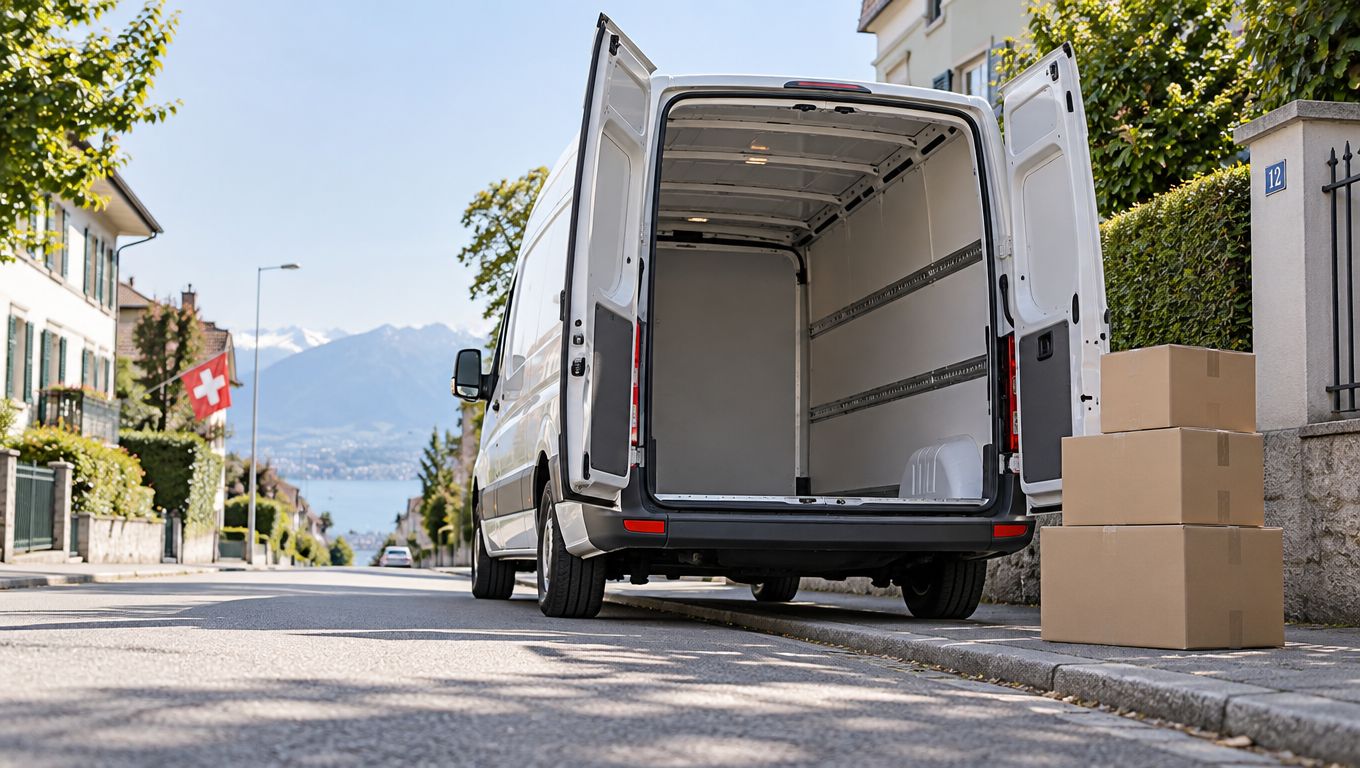
A typical one Moving yourself often starts well. Some boxes, a bed, a table and a few shelves seem to fit easily into a small van. During the actual loading, bulky individual items are added. The closet cannot be dismantled, the mattress blocks access to the boxes, and heavy objects push the payload up long before the room is completely filled.
Professional transport takes this combination of
into account. This is the crucial difference between a pure vehicle comparison and reliable moving planning.Don't decide based on the vehicle name, but rather based on the heaviest item, the longest piece of furniture and the most difficult access.Volume, weight, access and order
The price is only the first CheckpointPractical rule:
A rental price does not automatically cover every position. Kilometers, fuel, protection packages, additional materials, waiting times, parking permits and additional trips can reduce the original benefit. Comparis quotes rental prices of
for medium-sized vans. For the entire transport of aCHF 2,050 to 3,200the typical total costs are mentioned there, depending on the scope of services and the general conditions. You can find these values in the Comparis guide to moving costs.The right question is therefore not: “Which van is the cheapest?” It is:CHF 100 to 300Which solution will complete my move with as few trips as possible, a manageable risk and a realistic amount of time?3-room apartment over 50 km
Understanding the technical basics and vehicle classesThree values count when comparing:
Technische Grundlagen und Fahrzeugklassen verstehen
Beim Vergleich zählen drei Werte:Load volume, payload and dimensions. Das Ladevolumen describes… — no, output English. Let me produce translation.The load volume describes how much space is available for boxes and furniture. The payload shows how much weight may be loaded in addition to the driver and vehicle equipment. The interior length determines whether long pieces of furniture fit in without risky tilting.
| Vehicle type | Load volume | Payload | Ideal for |
|---|---|---|---|
| VW T6 Transporter | 5.8 m³ | 904 kg | Small shared flat, individual pieces of furniture, compact move |
| VW Crafter Short | 10.5 m³ | 1,131 kg | Several rooms, larger households |
| Iveco Daily Short | 10.8 m³ | 1,250 kg | Family household, lots of furniture and boxes |
The technical specifications come from theTransporter-Angebot von Europcar Schweiz. There, the VW T6 offers5.8 m³of load volume and904 kgof payload. The VW Crafter Short reaches10.5 m³and1,131 kg, the Iveco Daily Short10.8 m³and1,250 kg.
Assess volume and weight separately
Moving up from the T6 to the 10 m³ class almost doubles the available space. The payload, however, does not increase in the same proportion. That matters when a washing machine, solid wood furniture, boxes of books or several heavy cabinets are being transported. A vehicle can still have free space and yet already be at its weight limit.
The interior length makes a further difference with long furniture. On the VW T6 it is2.29 m, on the larger vehicles the values range between3.13 and 3.25 m. For a dismantled bed or a long sideboard, this difference can determine whether the piece of furniture lies securely or has to be improvised.
A larger load compartment does not solve a weight problem. It only solves the space problem.
Check the vehicle class and access
Swiss moving situations place additional demands. Underground garages, narrow residential streets, inner courtyards and low passageways make length and height just as relevant as cubic metres. A large van may be more efficient on paper, but cannot be positioned sensibly at the destination.
Before booking, therefore check:
- Load area:Does the longest piece of furniture fit in without dangerously protruding?
- Payload:Have heavy appliances and furniture been accounted for together with the driver and passengers?
- Height and length:Do the underground garage, access road and loading zone permit the vehicle's dimensions?
- Driving licence:Is your licence category sufficient for the total weight of the desired vehicle?
For registration purposes, thetotal weight stated in the vehicle registration documentis decisive. The ACS describes it as the maximum weight with which the vehicle may be operated. If a transport vehicle including its load exceeds3.5 tonnes, the performance-related heavy vehicle charge may also become relevant. The rules on weight and the HVC are explained by theACS zum Gesamtgewicht im Fahrzeugausweisand theBundesamt für Zoll und Grenzsicherheit zur LSVA.
An overview of suitable vehicles can also be found atTransporter mieten für den Umzug. What remains decisive is matching the vehicle data with your specific living situation.
Cost factors when renting a moving van
The base price is visible; the actual cost gap arises later. Homegate quotes prices for small moving vans fromCHF 128.60 including 150 km, for medium-sized vehicles fromCHF 149.60and for large vehicles fromCHF 209.40. The step from a small to a medium vehicle is therefore onlyCHF 21. You will find these price levels in the Homegate comparison of moving vans.
The difference seems small when the vehicle is returned to the same location and the included mileage is sufficient. It no longer seems small when the small van requires a second trip or has to be booked longer into the evening. A larger vehicle can then be the more economical solution despite the higher daily rate.
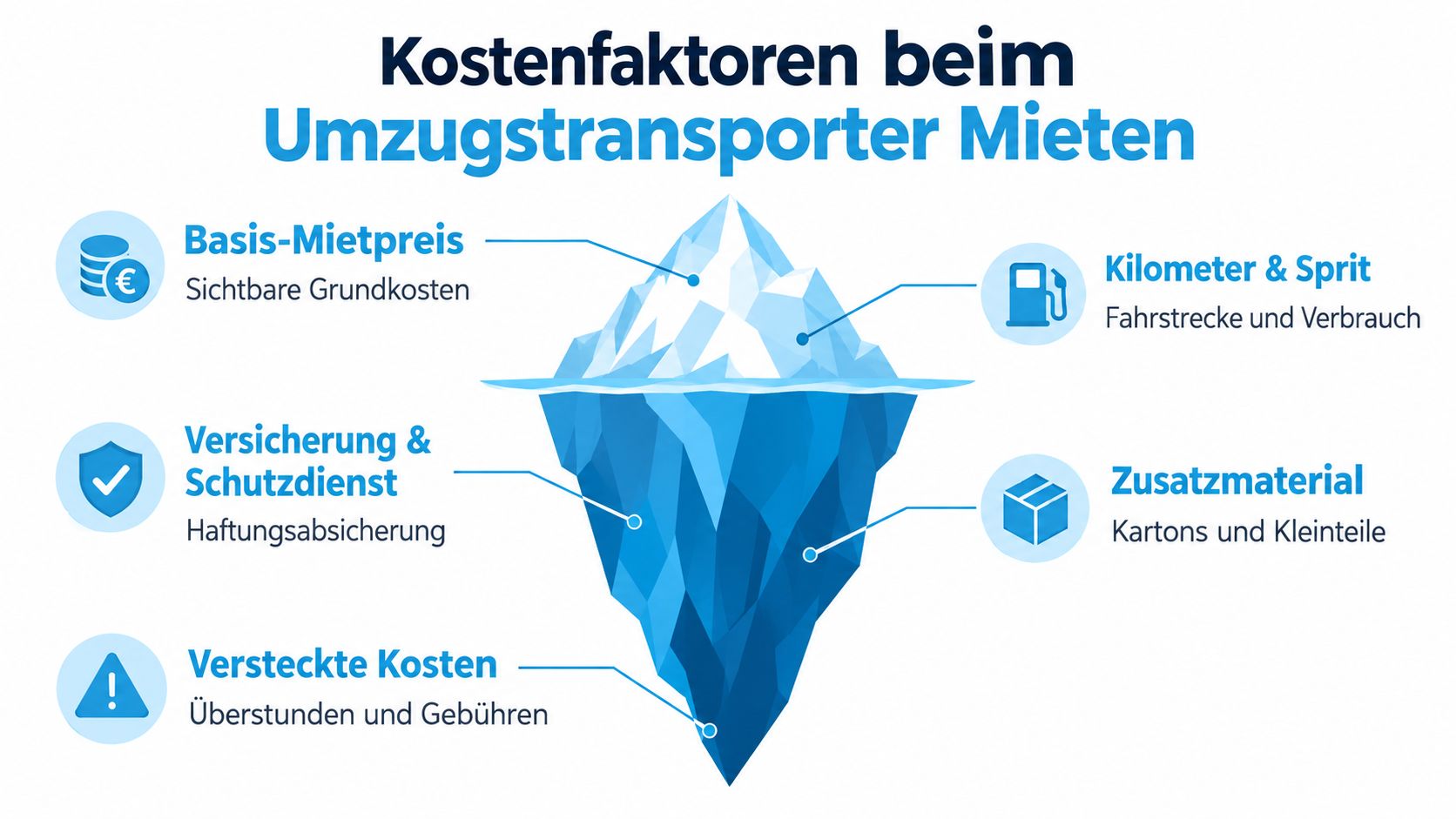
Building the full calculation
For vans, Quickrent quotes roughly, depending on the class,7 l diesel per 100 km,850 to 1,100 kg payloadand6 to 18 m³ capacity. The details can be found on theÜbersicht zu Transportern von Quickrent. Actual consumption depends on the model, the load, the route and your driving style.
For a workable calculation, at least these items belong on one sheet:
- Rental price:Daily or weekend rate including the kilometres covered.
- Kilometres:Check additional kilometres and possible one-way fees.
- Fuel:Take return requirements and expected consumption into account.
- Cover and liability:Read the deductible, insurance cover and exclusions.
- Working time:Factor in helpers, waiting time, late return and additional trips.
- Access:Budget for parking permits, long distances to the building entrance or special equipment.
Where a self-managed move loses its advantages
Driving yourself works well when the volume is clearly limited, reliable helpers are available and both addresses are easy to access. It works poorly when furniture is only sorted on moving day, several floors have to be managed without a lift, or the van is only available for a short time.
A Swiss rental company quotes, depending on the vehicle class,6 to 18 m³capacity. This range shows why the term "van" on its own says very little. Anyone comparing only the daily price is comparing vehicles with very different capacities.
TheKostenübersicht zum Transporter mietenhelps with the preparation. The most important comparison, however, is the total of vehicle, helpers, time and risk. A seemingly cheap rental vehicle becomes expensive as soon as a second trip, damaged furniture or an unorganised loading zone draws out the process.
Advantages of a professional moving company
A professional moving company sells vehicle space, labour and reliable processes as a complete package. Its real value lies in the coordination: it puts together a suitable team and combines transport, carrying, assembly and scheduling. This shifts the comparison from the individual rental day to the total cost of carrying out the move. The difference between driving yourself and a full-service move often arises from additional trips, paid helper hours, waiting times and damage that is not visible in the rental price.
The work before moving day
Before the job, the items to be moved, access routes, floors, lift sizes, delicate furniture and the order of the work are clarified. A usable quote shows which services are included and which additional work is charged separately. TheKostenübersicht einer Umzugsfirmashows which total costs are realistic.
Pay attention to these components:
- Clear description of services:Transport, carrying, dismantling, assembly and packing must be identifiable individually.
- Written cost basis:A fixed price or hourly billing must be clearly established.
- Liability rules:Damage, items you have packed yourself and particularly valuable goods should be discussed in advance.
- Access check:Narrow stairwells, a lack of parking options and long carrying distances must be factored into the planning.
- Special equipment:A furniture lift, additional protective blankets or assembly tools can change both the process and the price.
Weighing time against money
With a self-organised move, you pay with the rental price and with your own time for planning, driving, carrying and returning the vehicle. A service provider charges for coordination and labour, but takes the ongoing organisation off your hands. This trade-off is particularly worthwhile if you are away for work, have only small time windows or heavy furniture.
The hidden costs often become apparent on moving day. An unavailable loading zone lengthens the carrying distance, a delayed loading process jeopardises the vehicle's return, and a misjudged load may make a second trip necessary. With a full-service move, such points are factored into the schedule in advance. If you organise everything yourself, you also carry the risk if one detail doesn't work out.
When full service makes sense
A service provider is especially suitable whenseveral trades come together. Furniture dismantling, assembly, packing, disposal, interim storage and difficult access can all be coordinated within a single process. With combined transports, a bundled route can avoid additional organisation and separate trips.
Local rules apply to disposal. Depending on the location, municipalities charge for bulky waste by item, weight or volume. In Zurich, a flat-rate home collection of coarse bulky waste by the city costs80 francs, as Comparis describes in its guide to disposing of furniture before a move. For the recycling centre, a specialist overview states22.70 francs per 100 kg of bulky waste, with each additional unit started costing19.45 francs. A collection by ERZ is listed there at86.50 francs per 15 minutes started, as you can read atUmzug Zürich zur Sperrgutentsorgung.
The service provider combines transport and disposal in a single process. This means that furniture you've sorted out is less in the way on moving day, and handovers between different parties are no longer necessary.
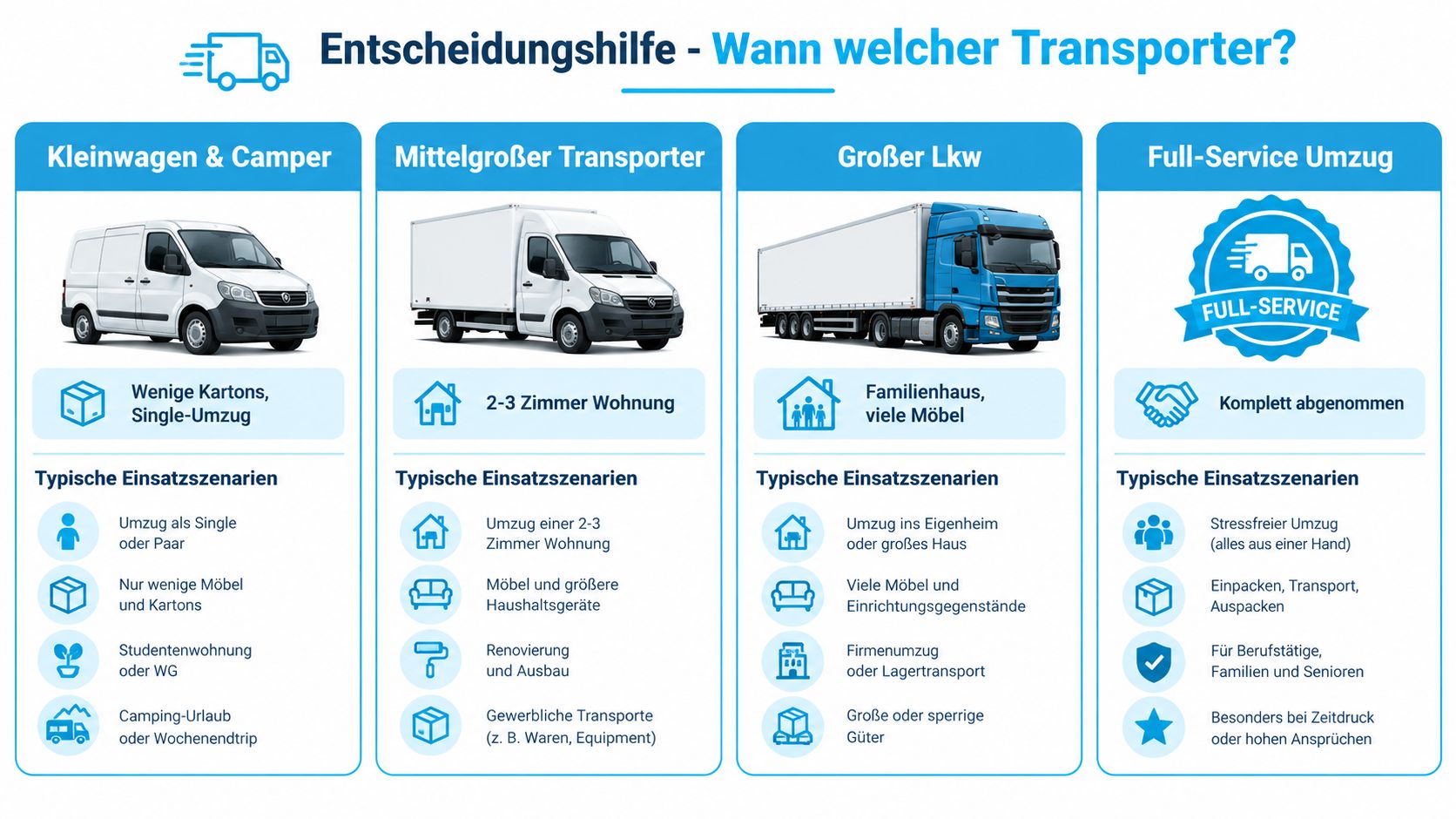
Decision guide – which van when?
The right choice depends less on the label "small" or "large" than on your actual situation. A single person with a few boxes needs a different solution than a family with a cellar, attic and heavy appliances. The number of helpers also changes the equation. A large vehicle is of little use if there's nobody around who can load it safely.
Moving small quantities yourself
A small van is suitable if the volume of goods remains manageable, the furniture can be dismantled and the distances are short. This applies, for example, to a few boxes, a bed, a desk and a handful of household appliances. The key is to sort things out beforehand and not only realise at the loading point that the cellar and attic need to come along too.
For this option, you should draw up a simple inventory list. Note down large pieces of furniture, heavy appliances and anything that cannot be dismantled. Measure the longest items and compare them with the length of the loading area. This takes little time and prevents an incorrect booking.
Calculating realistically for several rooms
For several rooms, the mid-range vehicle class is often the better compromise. Homegate shows that the surcharge from a small to a medium-sized rental vehicle can be justCHF 21, while the additional loading volume and greater reserves simplify the process. However, the figure is only meaningful if mileage, insurance and return conditions are comparable.
A larger vehicle is often worthwhile if it avoids an additional trip. But the access has to work. Check the height of the underground garage, the courtyard, the turning circle and the distance from the parking space to the entrance before you book.
When a professional is the better decision
A whole family household, lots of heavy furniture, complicated assembly work or difficult building access all argue in favour of professional support. The same applies if you don't have reliable helpers or if the move has to be completed within a tight time window.
For 7.5-tonne trucks, Switzerland requires driving licence categoryC1, as explained in a Swiss overview of theTransporter mieten und den Fahrzeugklassen. For vehicles above3.5 tonnes total weight, the HVF (LSVA) rules may additionally apply. The vehicle class you choose therefore affects not only the load space, but also the driving licence required, the charges payable and the possible uses.
If you already have to improvise around helpers, access, weight and disposal before loading has even begun, the cheapest solution is probably no longer the rental van.
The decision in four questions
Answer these questions before booking:
- How much is really left?Anything that will be disposed of, sold or put into storage does not belong in the transport volume.
- What is heavy and long?Appliances, solid wood furniture and long panels determine the technical limits.
- How difficult are the two addresses?Floor level, lift, parking space and carrying distance affect the amount of work involved.
- Who will carry and assemble?If helpers or tools are lacking, a service provider has to be factored into the calculation.
This way you don't end up comparing on gut feeling, but making a decision based on risk, effort and total price.
Conclusion - how to save time and money on your move
A removal van comparison must not stop at the daily rate. Small rental vans start atCHF 128.60 including 150 km, mid-size ones atCHF 149.60and large ones atCHF 209.40, as the Homegate benchmark shows. These entry-level prices are helpful, but they say nothing about whether the vehicle will be big enough, how many trips will be needed or how much work you'll have to do yourself.
The widespread assumption that "renting yourself is always cheaper" only holds true under certain conditions. A small household with little furniture, good access and reliable helpers can genuinely save money by driving themselves. But as soon as extra volume, heavy furniture, assembly, disposal or tight deadlines come into play, the share of hidden costs grows.
The reliable comparison
Work through three scenarios before booking:
- Rental van:Rental, included kilometres, additional kilometres, fuel, insurance cover, materials and a possible extra trip.
- Rental van with helpers:All vehicle costs plus carrying, assembly, waiting time and organisational tasks.
- Professional booking:A written all-in price including clearly defined services, liability and additional items.
With a professional quote, you shouldn't just check the final amount. Ask about the vehicle type, the planned team size, the carrying service, assembly, disposal and the arrangements for unforeseen work.
My practical recommendation
Only book the small van if the inventory list is clearly going to stay small and the access routes have been checked. Choose the mid-size class if the extra volume can save you several trips. Opt for a service provider if heavy furniture, complex access, assembly or time pressure dictate the process.
Also, don't treat disposal and loading zones as an afterthought. These are precisely the points that cause unnecessary delays on moving day. Anyone who reduces their belongings early, checks furniture dimensions and compares the full bill saves not only money, but also physical strain and nerves.
TIXPI organises removals, furniture transports, deliveries, disposals and optional assembly throughout Switzerland, with digital booking and a visible price upfront. For your specific move, check which solution suits your volume, access situation and schedule, and visitTIXPIto make a direct enquiry.