
A move is imminent? Then terminating the current rental agreement is one of the first, but also most important, steps. Many people underestimate this formal act, but this is exactly where traps lurk that can end up being expensive - for example due to an unwanted extension of the contract.
The key is to know the legal deadlines, maintain the correct form and ensure that your letter actually reaches the landlord on time.
Cancel your rental agreement safely in Switzerland
A move almost always begins with terminating the old rental agreement. This guide will take you through the process in Switzerland in a practical way. This way you are legally on the safe side and avoid expensive mistakes.
We clarify the crucial basics so that you can avoid typical pitfalls.
- Statutory notice periods:You need to know which deadlines apply according to the Code of Obligations (OR) and what is written in your contract.
- Correct form:Your termination letter must meet all legal requirements to be valid.
- Delivery:It is not enough to send the notice of termination - it must also be verifiably received by the landlord on time.
Very important: What is always crucial is that the landlord receives the notice of termination on time, not the date of the postmark. A delay of just one day could mean paying another month of rent.
The basics of terminating a rental agreement
A statutory notice period ofapplies to apartments in Switzerland at least three months, usually at the end of a month. This rule is anchored in Article 266c of the Code of Obligations (OR) and gives both sides – tenants and landlords – the necessary planning security.
But be sure to take a look at your own rental agreement. Sometimes longer deadlines or special termination dates such as the end of March, June or September are set there. These contractual agreements then take precedence. You can also find detailed information about this in our article onNotice period for an apartment in Switzerland.
Compliance with these deadlines is also relevant for us as a moving company. If we know when your tenancy ends, we can optimally plan the moving date and coordinate our routes.
From the correct wording of the letter to the final handover of the apartment - with the right information everything goes smoothly and you can look forward to your new home.
How to terminate your rental agreement properly and formally
Ordinary termination is the standard way to get out of a rental agreement in Switzerland. But the devil is in the details. Even small formal errors can invalidate the entire termination, and you suddenly find yourself stuck in the old contract for a longer period of time.
To avoid this, you need to keep three crucial points in mind: the deadline, the form and the verifiable receipt of the letter.
The following process will show you what is important to ensure that your termination is rock-solid.
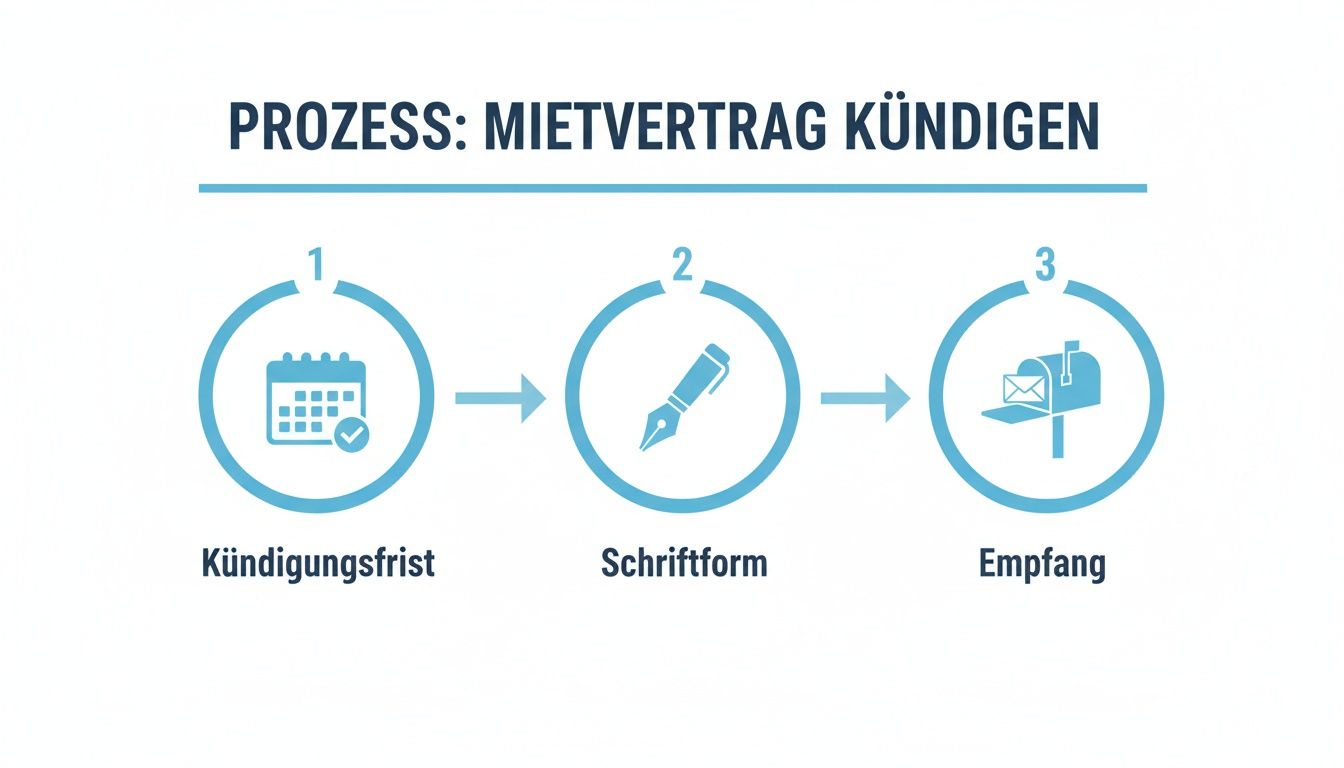
You can see it clearly in the graphic: It's a chain of actions in which every link has to be right. From the correct calculation of the deadline to the written form to the confirmed receipt by the administration - everything has to be right.
The notice period – more than just three months
The heart of every termination is the right deadline. A legal minimum period ofapplies to apartments three months, but what matters is what is written in your rental agreement. Very specific termination dates are often set there, which are based on local customs.
Common termination dates in Switzerland are, for example:
- At the end of each month:The most flexible and modern option, often with the exception of December.
- Quarterly:Classically on March 31st, June 30th and September 30th.
- Semi-annually:In some cantons, termination is only possible on March 31st and September 30th.
A typical example from practice:You live in Bern and would like to cancel your apartment on September 30th. Your contract provides for a three-month period and quarterly appointments. For everything to work out, your letter of termination must beno later than the last working day in Junearrive at the administration. If it arrives even one day late, the cancellation will only apply to the next possible date - and that would be December 31st.
A common and costly mistake: Many people believe that the date of the postmark counts. Incorrect! The only legally relevant moment is when the landlord actually has the notice of termination in his hands or can pick it up at the post office.
To give you a quick overview, we have summarized the most important deadlines and formalities in a table.
Overview of notice periods and formalities
This table summarizes the most important statutory notice periods for various rental properties in Switzerland.
| Rental property | Statutory minimum notice period (OR) | Typical termination date | Formal requirement |
|---|---|---|---|
| Living spaces | 3 months | Local dates (often the end of March, June, September) or the end of each month (except December) | In writing |
| Business premises | 6 months | Local appointments or according to contract | In writing |
| Furnished rooms | 2 weeks | At the end of a one-month rental period | In writing |
| Parking spaces (rented separately) | 2 weeks | To the end of a month | In writing |
Remember: The contractual agreements take precedence as long as they do not fall short of the legal minimum deadlines. Taking a look at your rental agreement is always the first step.
The letter of termination – clear, unambiguous and signed by everyone
Termination must always be made in writing. A short email, a text message or a phone call are legally ineffective and are not sufficient.
The content must be unique and the letter must be fromall persons, which are in the rental agreement,personally signedbecome.
Special case of family apartment: An often overlooked hurdle
There is an important trap lurking here for married couples and registered partnerships: Even if only one person has signed the rental agreement, for a family apartmentboth partnerssign the termination. Alternatively, one person may terminate, but must provide written consent from the other. If the second signature or declaration of consent is missing, the entire termination is invalid.
If you are unsure about the wording, a good template is worth its weight in gold. You can find a tested and legally secure basis in ourTermination letter apartment template.
Delivery – safe is safe
Have you formulated and signed everything perfectly? Super! Now the letter just needs to be guaranteed to reach the landlord.
The only truly safe way is to send viaRegistered mail. This is the only way you will end up with a legally valid receipt that proves the delivery attempt.
And what if the landlord ignores the registered letter and doesn't pick it up? No worries. The termination is deemed to have been delivered on the day on which the letter was first available for collection at the post office - usually this is the day after the delivery attempt.
Alternatively, you can hand the letter in person to the administration or landlord. In this case, be sure to insist that receipt is confirmed to you on a copy with a date and signature. Without this receipt, you have nothing in hand in the event of a dispute.
Our tip from experience:Always plan a buffer and never send the cancellation at the last minute. An unforeseen postal problem or holiday can quickly delay delivery - and that can cost you a whole month of extra rent. It is better to send the cancellation a week too early than a day too late.
Cancel without a deadline and find a new tenant
Sometimes life throws all your plans into disarray: an unexpected job offer in another city, family changes or simply the desire to move more quickly. When the next official termination date is still months away, the situation often feels like a dead end. But don't worry, Swiss tenancy law has a flexible and fair solution here - termination without notice.

This option allows you to get out of your contract early. The central condition for this: You must suggest a suitable new tenant to your landlord. If you succeed, you are out of your contractual obligations and do not have to continue paying the rent until the bitter end of the regular period.
Understanding the obligation to find a new tenant
The possibility of terminating the contract outside of a deadline is clearly regulated in the Code of Obligations (Article 264 OR). You are released from your rental obligations as soon as a suitable candidate is ready to sign the rental agreementexactly the same conditionsto take over.
This is really to be taken literally. The new tenant not only has to accept the same rent and the same additional costs, but also all other contractual conditions - be it a ban on pets or specific rules in the house rules. Nothing will be changed in the existing contract.
The essence of it is this: you suggest someone who will seamlessly follow in your footsteps. The landlord must not suddenly offer the contract to the new tenant on worse terms only to reject it and thus keep you in debt.
Criteria for a reasonable new tenant
But who is considered a “suitable” or “reasonable” new tenant? Your landlord can't just randomly reject every candidate. The reasons must be objective and understandable.
A new tenant is usually considered reasonable if he meets three main criteria:
- Solvency:The candidate must be financially able to pay rent on time. A rule of thumb is often that the gross rent should not make up more than a third of the net income.
- Solvency:He or she may not have any open debt collections. A fresh extract from the debt collection register is therefore an absolute must.
- Matching structure:The new tenant must fit the apartment and the house community. A family of five would be unreasonable in a one-room apartment, as would a noisy shared apartment in a house in which only older people who need peace and quiet live.
After you submit your suggestions, the landlord has a reasonable period of time to review them. Depending on the situation, this is usually between10 and 30 days. During this time he must review the documents and make a decision. If he lets this deadline pass without doing anything, you are also off the hook.
How to find and present the perfect candidate
Finding a new tenant requires some initiative. It's not enough to quickly throw a name at the landlord. You must provide him with a complete and convincing application.
Start with a good ad. Take attractive photos in daylight and describe the advantages of the apartment honestly and in detail. Use well-known real estate portals, but don't underestimate the power of social networks or the bulletin board at your workplace.
The new tenant candidate
needs these documents Collect a complete application dossier from every serious interested party. This speeds up the process immensely for the landlord.
- Completed registration form:Many administrations have their own forms. Just ask for it.
- Copy of ID or residence permit:To identify all adults who wish to move in.
- Current extract from the debt collection register:Not older than three months to prove financial reliability.
- Proof of income:The last three pay slips or the employment contract are ideal here.
Have you found one or, ideally, several suitable candidates? Submit their complete dossiers in writing and by registered mail to your administration. From a purely legal point of view it is sufficient toa single reasonable new tenantto suggest. From a strategic perspective, however, it is always smarter to present two or three options. This increases the chance of a quick acceptance enormously.
Other special situations for early termination
In addition to successfully finding a new tenant, there are other, albeit rarer, reasons that can justify early termination of the contract. However, these are linked to fairly strict requirements.
| Special situation | Conditions for extraordinary termination |
|---|---|
| Death of the tenant | The heirs can terminate the contract with the statutory notice period to the next statutory date (Art. 266i OR). |
| Serious defects | If the apartment becomes uninhabitable (e.g. due to massive mold or a heating failure in the dead of winter) and the landlord does nothing, termination without notice may be possible. |
| Important reasons | If there are unforeseeable, serious reasons that make sticking to the contract unreasonable (e.g. a serious illness that requires a move to a nursing home), the court can allow early termination (Art. 266g OR). |
| Divorce/Separation | A divorce alone is not a reason for special termination. The contract continues. The ex-partners have to agree on who is moving out, or they have to work together to find a new tenant. |
These special cases are often complicated and often require legal clarification. In the vast majority of cases, finding a suitable successor is the quickest and safest way to get out of the rental agreement early.
If the landlord gives notice: How to protect your rights
The letter of termination in the mailbox is often a big shock for tenants. Suddenly the security of your own four walls is in question. But don't worry, you are by no means defenseless in this situation. Swiss tenancy law is strong and protects tenants from arbitrary or unfair terminations.
Termination by the landlord must always be on aofficially approved formtake place and be clearly justified. If this form is missing, the termination is invalid from the start. There are legitimate reasons for termination, but also those that are considered abusive and which you can successfully challenge.
Permissible reasons for termination by the landlord
Not every termination is automatically unfair. There are definitely valid reasons that entitle a landlord to end a tenancy. The only important thing is that these reasons are understandable and real.
The most common legitimate reasons include:
- Urgent personal needs:The landlord or close relatives (such as parents or children) demonstrably need the apartment themselves. A mere declaration of intent is often not enough; the need must be specific and urgent.
- Economic reasons:If the landlord is making unreasonably poor returns on the property and renovation or sale is necessary to improve the situation.
- Comprehensive renovation:If a major renovation is planned that makes it impossible to stay in the apartment during the work, termination may be justified. However, the construction project must already be specifically planned and approved.
A particularly sensitive issue is dismissals due to restructuring. Sometimes they just serve as an excuse for luxury modernizations and massive rent increases. Especially in tense housing markets, people pay close attention here.
The housing shortage is a reality in many Swiss cities. Between 2018 and 2022, over2,000 apartment buildingsvacated, which was around30,000 residentsconcerned. These measures are primarily concentrated in large cities. In regions with high housing pressure, particularly strict protective regulations apply, which have been tightened again since the housing protection initiative in May 2022. Affected tenants may even have the right to return after the renovation. More about the backgroundFind out at zkb.ch.
When termination is unfair
Termination is considered unfair if it violates good faith. This happens, for example, if the landlord gives reasons that are not true or if the termination is a kind of “revenge”.
Typical examples of unfair dismissal:
- The notice of termination comes because you as a tenantlegitimate claimshave made a claim - for example, have demanded a rent reduction or have insisted on the removal of a defect.
- The landlord wants to give you aby giving notice Force contract change, for example an unjustified rent increase.
- The termination is given to get rid of a tenant who is currently in aArbitration or legal proceedingswith the landlord.
If you suspect that any of these cases apply to you, you should definitely take action. Wrongful termination can be appealed, but you must strictly adhere to the legal deadlines for doing so.
Contesting the termination: The path to the arbitration authority
Are you convinced that the termination is unfair? Then you need thiswithin 30 daysafter receipt, dispute it with the responsible arbitration authority. This deadline is absolutely crucial - if it is missed, the termination will be legally binding, even if it was unfair.
The process is clearly structured:
- Submit a request for arbitration:You submit a written request to the authority. In it you explain that you are contesting the termination and briefly explain why you consider it unfair.
- Arbitration hearing:The authority invites both parties – you and your landlord – to an oral hearing. The goal is to find an amicable agreement.
- Possible outputs:If no agreement is reached, the authority will either determine that the termination is invalid, make a proposed judgment or give you permission to take the case to court.
The rent extension as the last option
Even if the termination itself is legal, that doesn't mean that you're out on the street straight away. If the termination of the tenancy represents a particular hardship for you or your family, you can apply for aRent extensionapply for.
Such a hardness exists if:
- Despite an intensive search, you cannot find a suitable replacement apartment.
- There are special personal circumstances (e.g. old age, illness, pregnancy, school-age children in the middle of the school year).
- You are strongly tied to the location professionally.
The arbitration authority weighs your interests against those of the landlord. An extension can last up tomaximum four yearsbe granted. It gives you valuable time to find a new place to live in peace. Important: The application for extension must also be made within the30 day periodafter receipt of the notice of termination.
This is how the apartment handover is completed
The notice has been given, the moving date is approaching - now comes the final, but often crucial, act: handing over the apartment. This is much more than just a formality. At this moment it will be decided whether you will get your rental deposit back quickly and in full or whether laborious discussions about defects and costs will begin.
Good preparation is really everything here. If you plan ahead, you will be much more relaxed about the appointment and can conclude the tenancy agreement neatly.

The handover of the apartment is the final point of yourTermination of the rental agreement in Switzerlandand should definitely not be taken lightly. With the right strategy for cleaning, repairs and the handover protocol, you can protect yourself against unpleasant surprises.
Cleaning and small repairs
The condition in which you must hand over the apartment is stated in the rental agreement. In most cases, a thorough final cleaning is required. The term “swept” comes up every now and then, but is rather the exception and only means that coarse dirt has to be removed.
For most tenancies, however, a much more comprehensive cleaning obligation applies. These typically include:
- Kitchen:The oven, steam hood, refrigerator and dishwasher must be sparkling clean inside and out. Limescale on the fittings has no chance.
- Bathroom:Joints, tiles, toilets and sinks must be meticulously cleaned and descaled.
- Window:All windows – inside and outside – must be cleaned, including the frames and window sills.
- Floors:Depending on the covering (parquet, laminate, carpet), specific, thorough cleaning is required.
A classic point of contention is small repairs. As a tenant, you are responsible for what is known as “small maintenance”. Specifically, this means: Minor damage that occurred during your rental period and that you can repair yourself without much effort must be repaired before you move out.
This includes, for example, properly closing dowel holes, replacing a broken toilet seat or replacing seals on the faucet.
The handover protocol as a key document
The be-all and end-all when handing over an apartment is the handover protocol, often also called the acceptance protocol. It is your most important piece of evidence and protects you as well as the landlord from unjustified additional demands.
Plan enough time for the joint inspection with the landlord. Go through room by room and look at everything critically - ideally in daylight, as you can see more.
What must be included in the protocol?
- Condition of the rooms:Each room should be listed individually with its condition (walls, ceilings, floors).
- List of defects:Every defect, no matter how small, must be described precisely. Also note who is responsible for the fix and when it must be completed by.
- Meter readings:Note the current levels for electricity, water and heating.
- Key collection:The exact number and type of all keys handed over (front door, mailbox, cellar, etc.) must be noted.
- Date and signatures:Finally, both parties, i.e. tenant and landlord, must sign the protocol.
Very important:Only sign the protocol if you agree with the content100%agree. If you are unsure about something or have a different opinion, write it down by hand in the minutes before you sign. With your signature you acknowledge the recorded condition and the agreed defects.
Normal wear and tear versus excessive use
A central point in discussions is often the question: What is normal wear and what goes beyond that? Traces that arise from normal everyday life over the years are considered normal wear and tear and have already been paid for with the rent.
| Normal wear and tear (included in rent) | Excessive use (tenant is liable) |
|---|---|
| Shadows from pictures or furniture on the walls. | Deep scratches in the parquet because furniture was moved without protection. |
| Slightly yellowed wallpaper due to exposure to sunlight. | Large, colored stains on the wall that cannot easily be painted over. |
| Slight traces of wear on the carpet. | Burn holes in the carpet or on the floor covering. |
| Normal signs of wear on kitchen appliances. | Cracks in the sink or a broken stovetop. |
As a tenant, you are liable for damages resulting from excessive use, but only tovalue. The landlord can't charge you for a brand new refrigerator if the old one was already ten years old. The lifespan table of the tenants' association provides clear indications here.
The intricacies of this document are crucial. Detailed information aboutthe pitfalls of the delivery protocol and how to protect yourself, you can read about it in our further article:https://tixpi.ch/de/wohnungsubergabe-2-0-die-tucken-des-gabeprotocols-und-wie-sie-sch-schutzen/
Questions and answers about terminating a rental agreement
The cancellation process is full of small but crucial details. Here I have put together the most frequently asked questions for you that arise again and again when terminating a rental agreement in Switzerland. Short and to the point so that you can quickly get clarity about your situation.
What happens if I miss the notice period?
Anyone who misses the notice period - even if only by a single day - will have their cancellation invalid for the desired date. Unfortunately it's that simple. The rental agreement then continues automatically untilnext possible regular termination date.
This can quickly become expensive and means that you have to pay rent for another month or even three months longer if the deadline is quarterly. This is exactly why it is so important to send the cancellation by registered mail and with enough time buffer. It's better to plan a few extra days.
Do I have to give reasons for my termination?
No, as a tenant you are not obliged to give a reason for a regular termination. A clear and unambiguous letter expressing your desire to end the tenancy is sufficient.
The situation is different in the case of an extraordinary termination without notice, for example due to serious defects. In such a case, you not only have to explain the reasons in detail, but you also have to give the landlord a deadline to fix the problem - unsuccessfully, of course.
An important tip from practice:Conversely, the landlord must give reasons for his termination upon your request. If he doesn't do this, the termination remains valid, but it could be a strong indication of unfair termination. This will help you enormously if you want to dispute the termination.
Can I send a cancellation via email?
Absolutely not. Terminating the rental agreement by email is possible in Switzerlandlegally not valid. The law requires the written form to be mandatory, and that means: paper and a handwritten signature of all tenants who are in the contract.
The digital form does not meet this requirement. To be on the safe side, there are only two ways: print out the cancellation letter on paper, sign it and send it by registered mail or hand it over in person and have receipt confirmed in writing. Everything else is legally ineffective.
Is there a connection between rent and termination?
Yes, there is, even if it is not obvious at first glance. If, for example, you demand a rent reduction because of a fall in the reference interest rate, you are protected from a so-called “revenge termination” during the procedure and for a certain period afterwards. If the landlord terminates your contract in direct response to your request, this is considered abusive and you can successfully defend yourself against it.
It is also exciting to see how interest rate developments can influence moving plans. When the reference mortgage interest rate fell in Switzerland, many tenants took the opportunity to demand a rent reduction. Since such a reduction always only takes effect from the next possible termination date, this can influence the decision whether to move or benefit from the lower costs. More about theThe effects of the reference interest rate can be found on crowdhouse.com.
In summary: Swiss tenancy law provides clear structures, but the devil is in the details. However, with good planning and knowledge of your rights and obligations, the termination will be a smooth transition to your new home.
Moving is more than just a formal act – it is the start of a new phase of life. To ensure that this start is as relaxed as possible,is taking over TIXPIthe entire organization of your move. From planning to transport to furniture assembly – we ensure that everything runs smoothly. Get your instant price now and plan your next step without stress onhttps://tixpi.ch.