
You already have the rental date in your calendar, the helpers have organized it and notice when you first compare the price: the van appears to cost little, but no one says clearly what will actually be on the bill in the end. Especially in Switzerland, free kilometers, additional kilometers, weekend tariffs, deposits, deductibles and late returns can quickly put the cheap daily price into perspective.
Renting a van for moving works reliably if you calculate not just the vehicle, but the entire process. The decisive factors are the right size, a realistic schedule, safe loading and the question of whether self-driving really offers an advantage over a professional crew.
The true costs of renting a moving van
The daily price is only the first value in the invoice. For a van in the 3.5 tonne class, the typical daily rent in Switzerland is aroundCHF 50 to CHF 130. Swiss comparison prices often include 100 to 150 free kilometers. Depending on the provider, each additional kilometer can cost aroundCHF 0.15 to CHF 1.30. The information and the most important cost factors are summarized in theÜberblick zu Transporter-Mietkosten in der Schweiz.
The kilometers make the difference
Don't just plan the route between the old and the new one Address. The actual mileage includes the journey to the pick-up station, possible detours, several loading trips, the return and, if necessary, an empty journey. A small move with two journeys can therefore cause significantly more kilometers than the pure distance between the apartments would suggest.
Check these points before booking:
- Free kilometers:How many kilometers are actually included in the tariff?
- Additional kilometers:Is each additional kilometer charged individually or is there an additional one Flat rate?
- Return:Does the vehicle have to be returned at the same location, by a certain time or outside opening hours?
- Timeout:How much does a late return cost if loading takes longer?
- Deposit:How much is the blocked amount Amount and when will it be released again?
- Insurance:What deductible remains in the event of damage?
Practical rule:Before booking, calculate the likely total route, not the shortest route in the navigation program.
A correct offer compare
A cheaper rental price can make sense for short distances and punctual return. However, if there are many kilometers, a long day of moving or a return on the weekend, the total count counts. Surcharges for Saturday, an additional rental period or special vehicle equipment can also change the result.
Therefore, compare at least three values together:Rental price, kilometer costs and risk costs. A tariff with a slightly higher daily price, more free kilometers and a suitable deductible can be cheaper for your move than a basic tariff with a lower starting price.
You can find an understandable list of the typical items in the guide toKosten beim Transporter mieten. Before paying, confirm which services are included in the final price. Verbal promises are of little help if different conditions are later stated on the bill.
Vehicle size and timing for your moving day
The wrong vehicle either causes additional journeys or unnecessary difficulties when maneuvering. First, decide what is actually being transported: large cupboards, sofas, beds and household appliances not only need volume, but also a suitable loading space height, a wide opening and a sensible interior layout.
Start with an inventory list. Measure the bulkiest furniture and mark which pieces cannot be disassembled. Cardboard boxes are usually easier to stack, while upholstered furniture, mattresses and fragile items require gaps and protective material. The SPLIT provides assistance with cardboard planning. For an apartment with several pieces of heavy furniture, a medium-sized van is usually more practical. A 3.5-ton truck becomes interesting if you have to move a lot of furniture, numerous boxes or bulky items in as few trips as possible.Ratgeber zur benötigten Kartonmenge beim UmzugBut more loading volume is not automatically better. A large vehicle requires more space to turn, makes reversing more difficult and can be problematic on narrow driveways or in urban areas. Therefore, check the parking options at both addresses before booking. If a vehicle with a lifting platform is required, the access for the vehicle and the lowered platform must also work.

The right rental time
For Switzerland, a current market overview says around
. Most providers are located in
,
andBasel with 60. In these densely populated markets, the selection of vans and vehicles with lifting platforms can be more limited.Saturdays, Fridays, Sundays and the end of the month are particularly popular for many moves. If your appointment is flexible, consider a weekday or a less typical drop-off time. A half-day rental only works if boxes are completely packed, there are enough helpers available and the parking spaces are secured. Otherwise, the supposed savings will turn into a paid extension.therefore recommends early reservation.The following video supplements the planning with practical tips for selecting and using a rental van.2,018 moving and storage service providersDo not book the vehicle until the loading volume, pickup time, loading zone and return realistically match. The best tariff is of no use if you start the moving day under time pressure.Zurich with 126Der Marktüberblick zu Schweizer UmzugsdienstleisternBerne with 61
Correct loading and securing of the freight
A van is not a storage room into which you can place items at will. While driving, brakes, curves and bumps affect every piece of furniture. Without weight distribution and securing, cabinets can tip over, boxes can break and heavy objects can slide forward.
Loading from heavy to light
Place heavy objects as low as possible and as close to the partition wall to the driver's cab. Washing machines, filled boxes and massive furniture do not belong in unstable piles. Lighter boxes go on top, sensitive things in protected spaces.
A practical sequence looks like this:

Load appliances, dismantled cabinets and sturdy boxes first.
Form a heavy base:
Place furniture on the sides and keep the center of gravity low.
- Place small, soft objects in free areas without squashing them.Surfaces fill in:
- Stow glass, plants and loose decorations so that they do not come under pressure.Use hollow spaces:
- Attach tension straps to suitable lashing points and secure the load against movement check.Place sensitive items last:
- Empfindliches zuletzt platzieren:Back up everything:
- Alles sichern:Spanngurte an geeigneten Zurrpunkten befestigen und die Ladung gegen Bewegung prüfen.
Moving blankets protect surfaces, but do not replace straps. A cupboard that is just wedged between other furniture can still move when you brake hard. Also make sure that doors and emergency exits are not blocked and that the driver's view remains clear. Further information for thesicheren Transport von Möbelnwill help with the preparation of bulky items.
Observe Swiss loading rules
The load must not exceed the permissible total load and the roof load. It may not protrude laterally beyond the vehicle and may not protrude longer than 3 meters forwardand5 meters backwardsprotrude. If the load protrudes beyond the rear of the vehicle by more than 1 meter, the end must be signaled. These specifications are explained in theRatgeber zum Möbeltransport in der Schweiz.
This also applies to private moves. A long table top cannot simply protrude out of the rear door if it is unsecured or exceeds the required limits. Before setting off, check that the rear doors are closed, that the belts are under tension and that no object can fall out when opened.
The safest load is the one that does not move even when you brake hard.
Drive at an adjusted speed and expect a different braking distance. Especially with a fully loaded vehicle, you should take corners slowly and have a second person guide you when reversing.
DIY rental car compared to a professional crew
Self-driving initially seems like the cheapest solution. You pay for the rental van, organize friends and carry out the carrying, loading, driving, unloading and return yourself. This can make sense for a small, well-prepared move over a short distance, but requires sufficient time, physical stamina and reliable helpers.
The alternative is a professional crew with transport organization, carrying assistance and, if necessary, assembly. Platforms like TIXPI connect transport with helpers and can coordinate the process from planning to delivery. The relevant comparison is therefore not just rental car versus service price, butVehicle costs versus total effort.
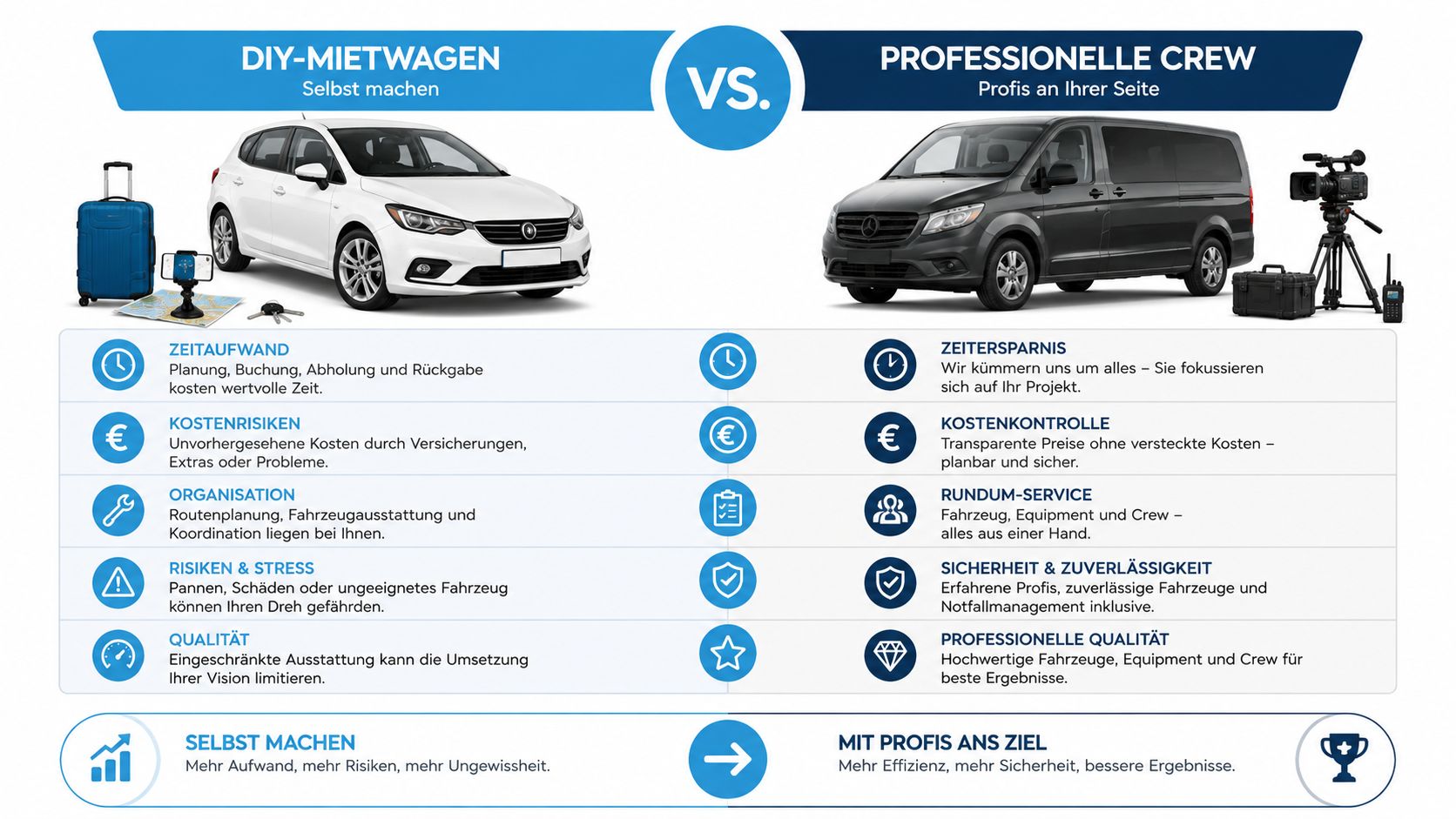
When DIY makes sense
DIY is more suitable if the goods to be moved are manageable, the furniture is largely dismantled and you can park directly at the old and new address. A flexible choice of date also speaks for self-organization, because you don't necessarily have to choose the most popular moving day.
In addition to the rental price, also take into account your own time, food for helpers, possible additional trips and the risk of damage. A single damage or late return can greatly reduce the expected savings.
When a crew gives a better bill
When there is a lot of heavy furniture, narrow stairwells, no elevator or tight time windows, a professional solution becomes more valuable. The crew has experience in carrying and stowing and takes on tasks that would otherwise fall to you and your helpers.
Comparison calculators for Swiss moves show total ranges of aroundCHF 1,820 to CHF 2,500 for 10–50 kmDepending on the distance. TheseVergleichswerte für Umzüge in der Schweizare significantly higher than a pure vehicle rental, but include a more comprehensive service. The decisive factor is whether you actually need this service and which components are included in the offer.
Insurance and stress-free return
The move doesn't end with the last box in the new apartment. Only when the van has been returned correctly and the condition has been documented will you complete the rental cleanly. Many discussions arise not because of major damage, but because of unclear previous damage, lack of fuel or a late return.
Document before departure
Take time for a thorough check when picking up. Photograph visible scratches, dents, damaged mirrors, tires, and the interior. Make sure that the pictures clearly show the condition and the time of handover remains traceable.
Read the handover protocol completely. If previous damage is missing, have it completed before departure. Also check whether accessories such as belts, blankets or a hand truck are actually present and functional. What is not documented upon handover is more difficult to assign later.
Classifying deductibles and additional protection
Insurance does not automatically reduce every financial risk. The decisive factors are the remaining deductible, excluded damage and the question of whether the protection only applies to the vehicle or also to certain accessories. Let us explain how damage to the roof, truck bed, tires, rims and underbody is treated.
Don't blindly choose the cheapest or most comprehensive option. If several people are driving, it must be clarified whether additional drivers are licensed and insured. Write down the names and conditions in writing instead of relying on casual information at the counter.
Prepare the return
Plan a time buffer for the return. Remove packaging, sweep the hold and adhere to the agreed tank rule. If you return it outside of opening hours, you should clarify in advance how keys, photos and proof of condition will be handed over.
Take photos of the vehicle again as soon as it is parked. Document mileage, fuel gauge and overall condition. If damage occurs while driving, report it immediately and objectively. A quick report is usually better than trying to ignore damage when returning it.
Frequently asked questions about renting a van for moving
Can I drive a 3.5-ton truck with a normal car license?
This depends on the vehicle category, the permissible total weight and the conditions of the rental company. Before booking, check your driving license, vehicle documents and rental conditions. Do not rely solely on the colloquial term “3.5 tonner”.
What happens if a time is exceeded?
Report a delay as soon as it is foreseeable. The provider can tell you whether an extension is possible and what additional costs will arise. If you simply return the van later, you risk different billing and problems with the next reservation.
How do I book a hand truck, belts or a furniture lift?
Ask about accessories before completing the booking. A hand truck makes heavy individual items easier, while straps and blankets can prevent damage. A furniture lift also needs enough space on the facade and a suitable access route.
When is it worthwhile to hire a crew instead of a rental car?
If you have little help, are moving heavy furniture or only have a short time window, you should calculate the value of your own working time. For a manageable move with good preparation, DIY can be enough. When conditions are complex, a transparent, complete offer is often a more reliable decision.
TIXPI organizes moves, furniture transport and optional helpers with an immediately visible price and coordinates the process up to delivery, including assembly if desired. Check your needs and visitTIXPI before reserving a van.