40 kg and 2.5 m are the crucial limits in Zurich: disassemble large furniture so that every part remains underneath and you often avoid the more expensive bulky goods route. This only works if the individual parts are actually accepted and the local requirements are checked before transport.
The scenario is familiar: the moving date is approaching, an old cupboard has to go, the sofa blocks access and the mattress and carpet also have to disappear. Many people load the piece of furniture into the vehicle unchanged and only notice at the collection point that the weight, length or material does not fit. This is then followed by a paid collection, a second transport or an improvised disposal.
From bulky goods to recycling, why preparation is everything
Anyone who wants to dismantle and dispose of furniture should not start with carrying it, but rather with checking the local rules. In Switzerland, bulky waste such as furniture, mattresses and carpets are part of the municipal bulky waste or disposal process. TheKanton Zürich beschreibt Sperrgut als Abfall, der nicht in normale 35-Liter-Behälter passt, und nennt Möbel ausdrücklich als Beispiel. Municipalities organize collection and transport, and the system is financed through volume-dependent fees.

The most common mistake happens before dismantling
A dismantled wardrobe can be treated differently than a complete wardrobe with doors, back wall and fittings. It is easier to carry, takes up less space and, depending on the community, can be delivered as wood or a separate material fraction. If, on the other hand, you only look for a solution at the collection point, you have already lost the cheapest option.
Therefore, check four points in advance:
- Municipality:Which collection point is responsible, and do you need toll stamps or registration?
- Limits:What mass and weight apply per Single piece?
- Material:Is wood accepted separately, or does the furniture have to be handed in as mixed bulky goods?
- Access:Does the disassembled furniture fit through the stairwell, elevator, door and vehicle opening?
Practical rule:First clarify acceptance conditions, then get tools. Dismantling depends on the disposal route, not the other way around.
Municipal collection points often make sense if you can carry, sort and transport them yourself. Private services are a better choice if a suitable vehicle is not available, heavy parts come from upper floors or the appointment cannot be rescheduled. The price comparison must therefore not only take into account the disposal fee. Vehicle rental, helpers, parking permits, time expenditure and the risk of rejection are also included in the bill.
If you would like to learn more about the basics of different disposal methods, you will findDESKSPACE Leitfaden zur Möbelentsorgunga useful addition. When transporting, protect edges, floors and walls with suitableumweltfreundlichem Verpackungsmaterial instead of loading loose boards and glass surfaces unsecured.
Dismantling furniture correctly and separating it professionally
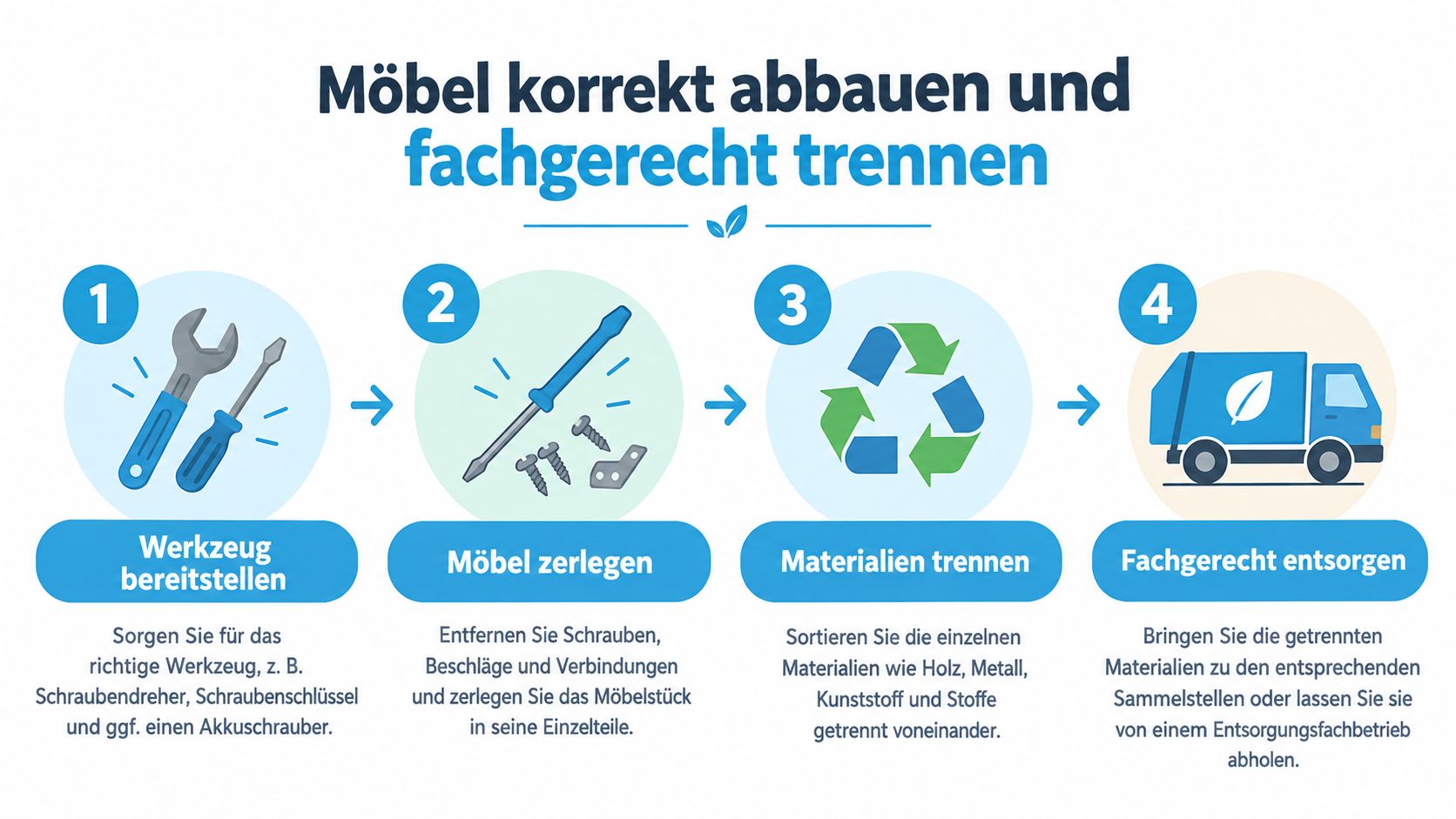
Clean disassembly begins with order. Take photos of the furniture from the front, inside and back before loosening any screws. Gather small bags, painter's tape, a waterproof pen, screwdriver, Allen wrench, cordless screwdriver, pliers and utility knife. If you have glass, mirrors or tall cabinets, you will need a second person.
Disassemble in the correct order
Remove contents completely:Empty drawers, compartments and attachments. This prevents hidden damage and makes the furniture manageable.
Remove moving parts:Doors, drawers, shelves, castors and handles go first. Label each part with a simple identifier, such as “Cabinet on the left, door on top.”
Releasing connections:Work from the outside in. Loosen visible screws and connectors without using brute force on glued areas or swollen chipboard. Back panels can often only be removed after the nails or staples have been removed.
Bundle components:Screws and fittings belong in a labeled bag. Tape it to the associated component or place it in a clearly marked box. This means that usable furniture remains usable for later reconstruction.
Securing edges:Protect glass, mirrors and coated fronts with blankets or cardboard. Do not carry long boards loosely upright if they can swing out in the stairwell.
The following video can clearly explain the sequence for typical furniture connections:
Treat wood, metal and upholstery separately
Woodincludes solid wood, chipboard, MDF and coated furniture parts. Remove metal handles, hinges and, if possible, plastic strips before disposing of wood separately. Glued or heavily coated parts do not automatically belong in the same group as untreated wood. The acceptance practice of your collection point is crucial.
Metalis made up of frames, hinges, rails, feet and connecting elements. Small pieces of metal should not be left loose between wooden boards if the municipality offers separate collection. For large metal frames, check whether the collection point accepts them as individual items.
Upholstery and textilesSofas, armchairs and mattresses often remain mixed bulky items. Remove removable covers and separate wooden frames, metal bases and loose upholstery only if your community accepts these fractions. Simply cutting open a sofa without knowing how to dispose of it creates additional work and dirty individual parts.
The economic logic is clear: regional disposal information states for mixed bulky goods or household waste34 to 38 CHF per 100 kgand for wood12 to 16 CHF per 100 kg. At the same time, some municipalities acceptup to 100 kg of bulky waste free of chargeor work with disposal brands, as theregionalen Preis- und Mengenangaben zur Sperrmüllentsorgungshow. The dismantling can therefore influence the fee class, volume and transport route, but it does not replace the local inspection.
A structuredAnleitung zum Schrankaufbaualso helps with the reverse process: who connections recognizes and numbers components, dismantles in a more controlled manner and damages less material.
Understanding and applying Swiss disposal regulations
A dismantled cabinet fits into the vehicle, but a single side part exceeds the acceptance limit. It is precisely these details that determine whether it is cheaper to dispose of the waste yourself or whether a second trip is necessary. In Switzerland, different requirements apply depending on the municipality for bulky goods, fees, brands, opening times and material acceptance.
In Zurich, bulky goods are considered combustible waste that is too big or too heavy for the Züri bag. The city calls the recycling center and the mobile recycling center for this purpose. At the mobile recycling center, a single item weigh a maximum of 40 kg and be a maximum of 2.5 m long. For a sofa there is a maximum length of2 m, as theSperrgutinformationen der Stadt Zürichnote.
The limit applies per individual piece
When dismantling and disposing of furniture, it is therefore not just the total amount that counts. A cabinet can consist of several boards, each of which is within the specifications. The assembled body, on the other hand, may be too heavy or too long. The responsible authority also determines whether wood, metal, upholstery or mixed bulky goods are accepted.
Only measure and weigh each part after disassembly. Doors, back panels, bases and side panels are often easy to carry, while the complete piece of furniture prevents them from being accepted. If a component remains outside the limit, further dismantling is only worthwhile if it actually creates a suitable size and does not cause unnecessary sorting work.
Local inspection in the correct order
- Check municipality:Open the official website of the responsible municipality or recycling center.
- Clarify material:Ask about wood, metal, upholstery, mattresses and mixed bulky goods.
- Check mass:Check maximum weight and maximum length of each module.
- Confirm fees:Clarify brands, weight tariffs, allowances and collection costs before loading.
Depending on the order, a private collection service takes care of carrying, transport and Disposal. The price is not based solely on the weight of the material. Floors without an elevator, long distances, narrow stairwells and short-term appointments increase the effort. This eliminates the risk of standing in front of a closed or incompetent collection point with an unsuitable vehicle.
If there are several types of material, heavy components or unclear municipal boundaries, afachgerechte Entsorgungcan be the more practical solution. The decisive factor is the comparison between controlled personal effort and calculated complete service.
Weigh costs and disposal options correctly
The cheapest disposal is not automatically the one with the lowest official fee. Own transport can be economical if the furniture is disassembled, the vehicle is available and the collection point is on the route. It quickly becomes unattractive if you organize a vehicle, coordinate several people or have to drive again because the limit values are exceeded.
A simple decision model helps:
| Situation | Sensible way | Why |
|---|---|---|
| Dismantled wooden parts, suitable dimensions, suitable Vehicle | Municipal collection point | You control sorting and transport yourself |
| Items cross local borders | Larger collection point or private service | Delivery at the mobile yard can fail |
| Heavy furniture from upper floors | Professional Collection | Carrying and transport risk are outsourced |
| Reusable furniture in good condition | Check transfer or sale | Disposal is avoided |
| Mixed materials without clear acceptance | Clarify in advance or choose full service | Incorrect sorting caused Detours |
When dismantling has the greatest effect
Dismantling is almost always worthwhile if it solves three problems at the same time: The furniture becomes portable, each module remains within the acceptance limits and materials can be separated sensibly. It is less worthwhile if, when disassembled, a piece of glued furniture only breaks into dirty, unusable pieces.
For Zurich, the crucial values are again the limit of40 kg per individual item,2.5 m lengthand the sofa exception of2 m, as thepraktischen Hinweise zur Sperrgutentsorgungexplain. If a piece of furniture is delivered unchanged and exceeds one of these limits, acceptance may fail. Then there are additional routes, a new appointment or a more expensive collection.
Calculate your own effort realistically
Don’t just factor the disposal fee into your decision. Also allow time for disassembly, packaging, carrying, travel and cleaning. For a single, simple shelf, DIY is usually sensible. For a large sofa, a built-in wall with glass or a piece of furniture from a cramped old apartment, a professional can be a lower-risk solution despite the higher bill.
A low tariff is of no use if the furniture is rejected at the point of collection.
Also plan an alternative. If the local authority only accepts certain fractions, wood, metal and upholstery may need to be transported separately. A private service can take over this coordination, but can only calculate transparently if you provide photos, dimensions, floor, lift and access in full.
Professional help vs. DIY at a glance
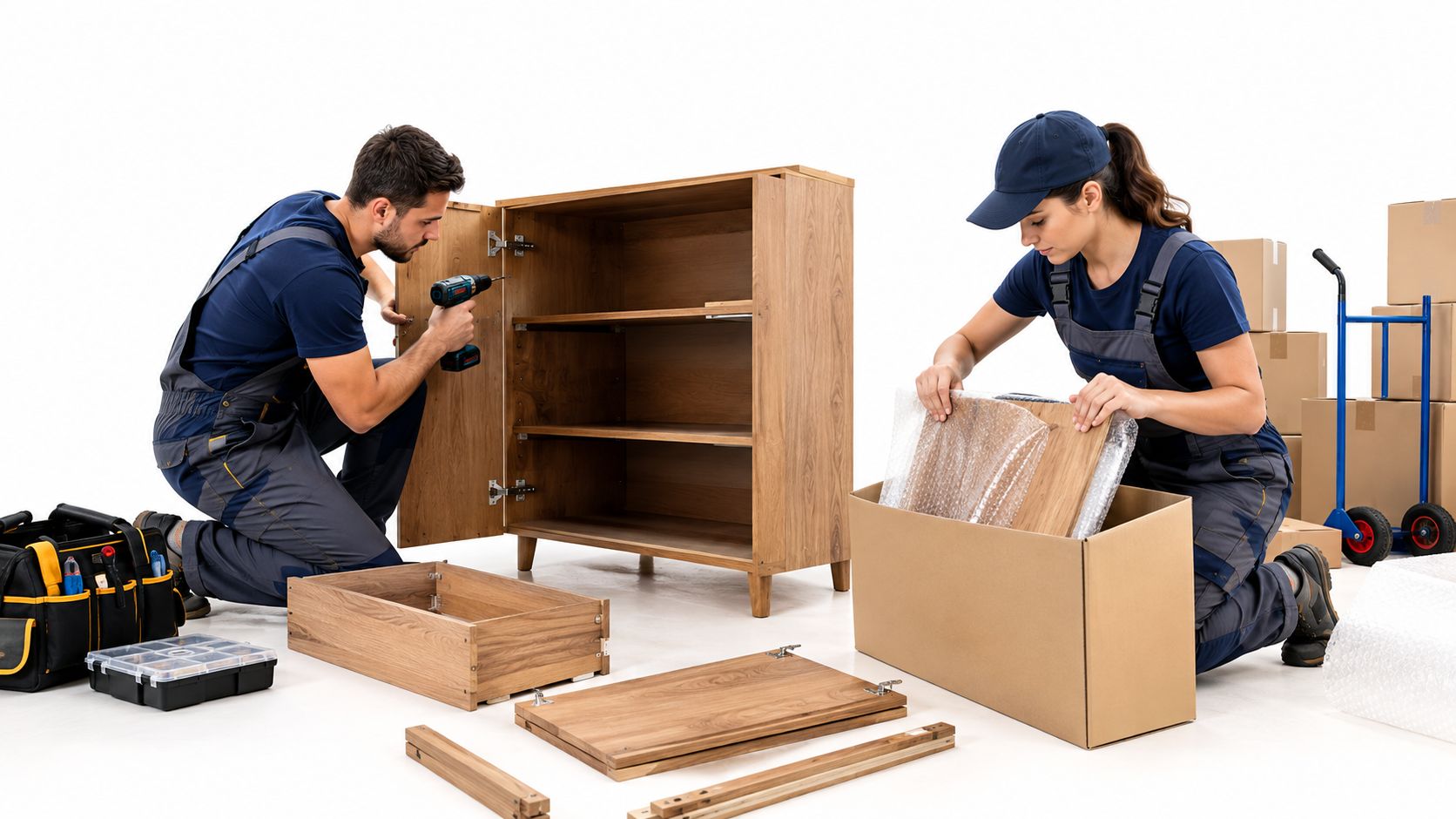
Dismantling and transporting yourself suits stable, screwed furniture with a manageable weight. You set the pace, can sort parts and avoid additional work. However, you bear the risk of damaged floors, broken fronts, lost fittings and an unaccepted delivery.
Professional help is not automatically the most economical solution. But it becomes interesting as soon as several works come together. This includes dismantling, carrying from upper floors, temporary storage, vehicle organization, sorting and driving to the correct disposal point.
Doing it yourself is fine if these points are met
- The furniture is screwed together:Screws, connectors and back panels can be removed without force.
- The work remains safe:No heavy glass surfaces, unstable constructions or electrical and gas-conducting structures Connections.
- The vehicle fits:The dismantled parts are protected and do not protrude unacceptably.
- The disposal point is confirmed:Material, opening and fees are clarified before departure.
- Helpers are available:Heavy parts are not only transported through stairwells worn.
For kitchens, permanently installed elements and furniture with connections, the sensible contribution often ends with emptying and documenting. Water, electricity and gas belong in expert hands when there is uncertainty. One wrong move can turn a simple disposal into a claim.
Professionals win above all when it comes to coordination
A professional service bundles several steps that often have to be organized separately in private life. At TIXPI you can plan furniture disposal with collection, transport and disposal according to Swiss specifications, receive a fixed price and book an appointment. This is particularly practical if furniture has to be carried from each floor or you do not have your own transport option.
Nevertheless, compare offers based on the scope of services. Ask whether dismantling, carrying, flooring, disposal fees and any additional travel are included. Describe the sofa, shelf, bed frame or cupboard with photos and dimensions so that the price is not based on an overly optimistic assumption.
The decision can be reduced to one sentence:Doing it yourself saves money if acceptance, safety and transport are already under control. Professionals save effort if exactly these three points remain uncertain.
If you would like to have furniture dismantled and disposed of, TIXPI describes your items, organizes collection and transport and shows you the binding fixed price before booking. VisitTIXPI, enter your furniture, floor and desired date and choose the solution that suits your disposal project.