
If you want to terminate your apartment in Switzerland, the right procedure is crucial. You must submit the termination in writing byRegistered mailand adhere to the deadline specified in the rental agreement. As a rule, this is three months. Make sure that your letter reaches the landlord on time - this will save you expensive misunderstandings and an unwanted contract extension.
Getting the termination legally secure
The decision has been made, you are moving. But before you pack the first boxes, the administrative foundation must be properly laid. A formally correct termination is not just a formality, but rather your legal protection against unnecessary costs and conflicts. Even a small mistake in the process can result in your tenancy being extended unintentionally by months.
This first step is really crucial for a clean and stress-free move out. It's about knowing the rules of the game and applying them precisely.
Notice periods and dates: The rental agreement has the first say
First of all, take a close look at your rental agreement. Here you will find the two crucial details for your cancellation: theNotice periodand theNotice dates. The notice period indicates how long in advance you have to give notice - for apartments in Switzerland this is almost alwaysthree months.
The notice dates determine the date on which you can actually give notice. These are often so-called “local appointments”. Depending on the canton or municipality, this could be the end of March, the end of June and the end of September, for example. In some regions, every end of the month (except December) is a possible termination date.
And what if your rental agreement is silent about this? Don't worry, the law will apply. According to the Code of Obligations (OR), a notice period of three months applies to the next usual local date. It is therefore essential to briefly find out about the conditions where you live.
From practice:The decisive factor is always the day on which the landlord actually has your termination letter in his hands - not the date of the postmark! Therefore, always plan a buffer of a few days. So you are on the safe side.
Why registered mail is your protection
A verbal termination or a quick email is not legally sufficient in Switzerland. The termination must be made in writing and delivered in such a way that you have tangible proof. This is exactly where registered mail comes into play.
Sending by registered mail serves as incontestable proof that and when your landlord received the notice of termination. If there are any discrepancies, you can always provide proof from the post office that you have met the deadline. This effectively protects you against the claim that the notice of termination was never received.
A common pitfall: the signature of both partners
If you live in a family apartment, there is an important feature that is often overlooked. Even if only one person signed the rental agreement at the time, in the event of terminationBoth spouses or registered partnersboth spouses or registered partners must always sign.
This regulation serves to protect the family and is intended to prevent one person from giving up the shared apartment without the knowledge of the others. In this case, a termination signed by only one person is simply invalid. Be sure to clarify this point to avoid a nasty surprise.
In order to better understand the exact legal deadlines, we recommend that you delve deeper into the topic. You can find comprehensive information about this in our detailed article about theKündigungsfrist für Wohnungen in der Schweiz.
The following overview summarizes the most important points for your planning.
Notice periods and dates in Switzerland at a glance
Here you will find a compact overview of the legal minimum periods and the typical local termination dates. This allows you to secure your planning and know exactly what you need to pay attention to.
| Features | Legal regulation | Practical tip for tenants |
|---|---|---|
| Notice period | At least3 MonthsFor apartments, unless otherwise contractually agreed. | Check your rental agreement carefully. Plan delivery by registered mail with a buffer of3-5 working days. |
| Termination date | ToLocal dates, if nothing is specified in the contract. | Inquire with your municipality or the arbitration authority about the local usage. |
| Form of termination | Written, preferably by registered mail. | Keep the postal receipt of the registered letter carefully. It is your legal proof. |
| Signature | For family apartments,always both partnersmust be signed. | Always obtain both signatures to ensure the validity of the termination. |
With this information you are well prepared to take the first step of your move confidently and legally master.
Move out flexibly through termination without notice
A job change in another city, an unexpected addition to the family or simply the desire for change - life rarely sticks to the rigid termination dates in the rental agreement. So what do you do if you have to cancel your apartment in Switzerland but the next official date is still months away?
Don't worry, you don't have to pay double rent for months. Fortunately, there are legal ways to get out of the contract early.
By far the most common method, which is also provided for by the law, is to appoint a suitable new tenant. Alternatively, you can try to reach a direct termination agreement with your administration. Both methods require some initiative, but can save you a lot of money in the end.
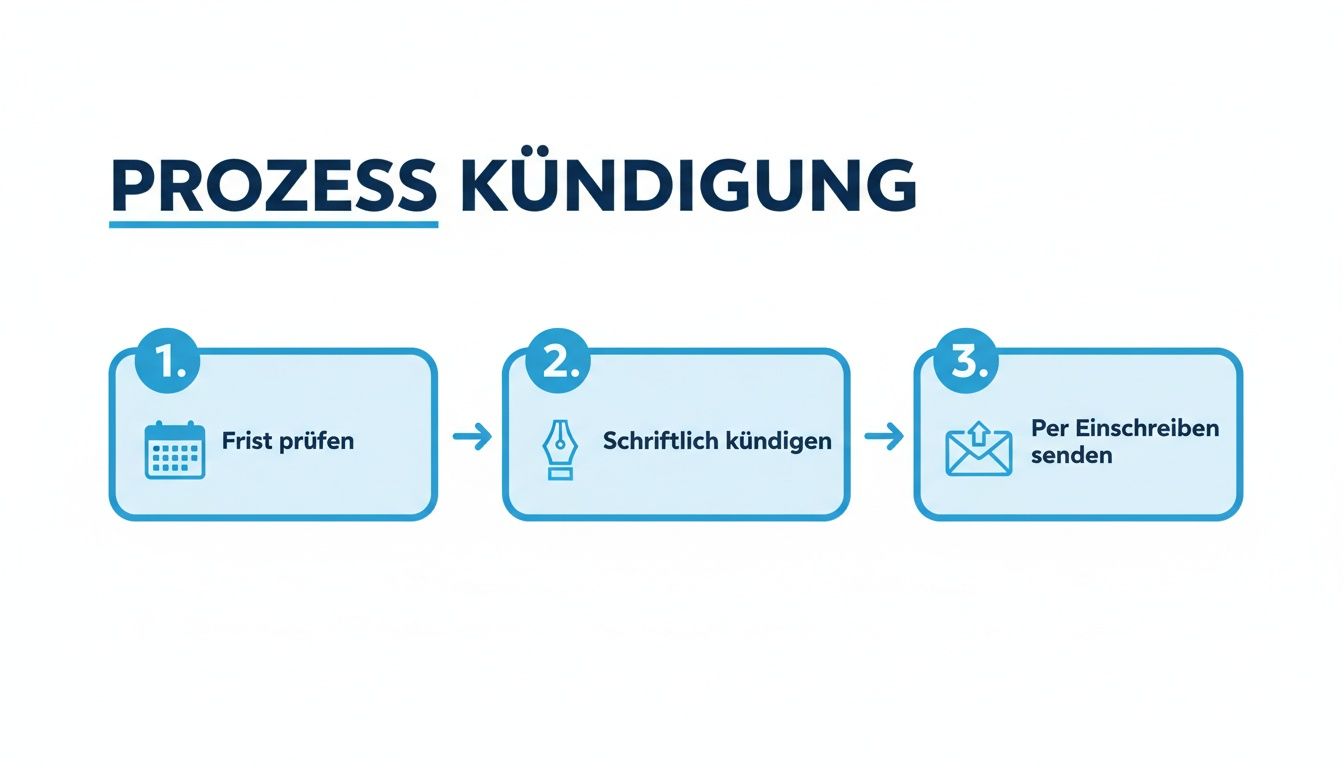
The graphic makes it clear: whether regular or extraordinary termination, the basics always remain the same. Check the deadline, give notice in writing and send the whole thing by registered mail - that is the indispensable basis.
Finding a new tenant as a standard solution
If you want to terminate the contract without a deadline, Swiss tenancy law (Art. 264 CO) provides a clear solution: You will be released from your obligations if you suggest areasonable and solventNext tenant to the landlord. It is important that the person is willing to take over the rental agreement under exactly the same conditions.
But what does that mean specifically?
- Able to pay:The candidate must be able to cover the rent without any problems. As a rule of thumb, rent should not make up more than a third of your net income. The decisive evidence for this is a clean, up-to-date debt collection statement.
- Reasonable:This term is a bit more flexible. The new tenant must not bring any obvious disadvantages to the landlord. For example, a family of eight would not be able to live in a one-room apartment. However, the criteria must be objective - the landlord's personal preferences do not count.
Practical tip:Never rely on just one candidate. It can always happen that someone backs out at the last moment or is rejected by the landlord for good reasons. It's best to present a list oftwo to three qualified interested partiesto be on the safe side.
The tight housing market can paradoxically work to your advantage here. The number of vacant apartments in Switzerland reached its lowest level in 12 years in 2025, underlining the ongoing shortage. According to a UBS study based on data from the Federal Statistical Office (BFS), the rate fell toexactly 1.00 percent, which corresponds to 48,455 empty apartments - 3,500 fewer than in the previous year. This high demand often makes it easier to find suitable candidates quickly. Find out more about theErgebnisse der Studie zum Schweizer Wohnungsmarkt auf finews.ch.
The process of finding a new tenant
Once you have found one or more candidates, you must officially propose them to the landlord. This is done via a complete application dossier, which usually contains the following:
- Completed registration form (often provided by the landlord)
- Current debt collection statement (not older than three months)
- Copies of the last pay slips
- Copy of the ID or residence permit
Send these documents together and by registered mail to your administration. From the time the landlord receives the documents, he has a review period of approximately 10 to 20 days. If he doesn't respond during this time or rejects an obviously suitable candidate without a good reason, you're off the hook. You are then released from your obligations from the date on which the new tenant would have taken over the apartment.
For detailed instructions and even more tips on how to proceed in the event of an early termination of the contract, take a look at our guide toausserterminlichen Kündigung einer Wohnung.
The alternative: negotiate a termination agreement
The search for a new tenant is not always the best or only way. Sometimes it is much easier to talk to the landlord directly and reach aThis can be a very pragmatic solution, especially for professionally managed properties. You can suggest terminating the contract early for a lump sum compensation. This covers the landlord's administrative costs for the new rental and could, for example, correspond to half or a full month's rent.amicable termination agreement
The big advantage here is the clarity. As soon as the agreement is signed, you are released from all obligations and do not have to worry about viewings or application files. The only important thing is: Be sure to put such an agreement in writing in a document signed by both sides.
Special cases: What to do when things get complicated?
Life rarely sticks to scripts. Termination under Scheme F is quick and easy, but what happens when the circumstances are a little trickier? What if you live in a shared apartment, a death turns things upside down or you want to end a sublease agreement? It is precisely for such situations that there are clear rules that you should know in order to be legally on the safe side.
With the right knowledge, you can navigate safely through these unforeseen events. In this way, you not only protect yourself, but also everyone else involved from expensive misunderstandings and legal pitfalls.
Cancellation of a shared apartment: it only works together
In a shared apartment, everything depends on the type of rental agreement. In most cases, all residents have a single main rental agreement
In einer Wohngemeinschaft hängt alles von der Art des Mietvertrags ab. In den meisten Fällen haben alle Bewohnerinnen und Bewohner einen einzigen Hauptmietvertrag alsSolidarity tenantssigned. At first it just sounds like a legal term, but it has a very tangible meaning: everyone is jointly liable for the rent and the contract.
This joint liability leads to an important consequence for the termination: It is only valid ifAll main tenants named in the contract terminate together. The letter of termination must also be signed by everyone. A single person cannot simply get out of the contract on their own.
So what are the options if only one person wants to move out?
- Joint termination:The simplest, albeit most radical, way. The entire shared apartment terminates the contract on time. The remaining residents can then try to negotiate a new contract with the landlord - ideally with a new roommate on hand.
- The contract change:This is often the most pragmatic solution. Talk to the landlord. If he agrees, the person moving out can be released from the contract and replaced by a new tenant. It is important that this change is recorded in writing in a contract amendment.
Death of a tenant: What heirs need to know
The death of a tenant is an emotionally difficult time, which unfortunately also entails administrative obligations. However, Swiss tenancy law has a fair regulation for this: the rental agreement does not automatically pass to the heirs if they do not want to keep the apartment.
The heirs have aextraordinary right of termination. You can terminate the rental agreement with the statutory notice period of three months to the next local termination date. This even applies if longer periods or other dates were agreed in the original rental agreement. All heirs must sign the termination together.
Very important:This special right of termination must be exercised on thevery first possible dateafter the death. If the heirs miss this opportunity, the rental agreement with all rights and obligations passes to them. From then on, the normal notice periods specified in the contract apply again.
Termination of a sublease agreement
There are also clear rules for subletting, but they differ slightly from those for the main tenancy. Regardless of whether you are subletting a room yourself or are a subtenant: the deadlines stated in the sublease agreement primarily apply. If nothing is regulated there, the law steps in.
You are particularly flexible with furnished rooms. A very short statutory notice period of only SPLIT applies here, which can be given at the end of a rental month. The situation is different for unfurnished rooms or entire apartments that are sublet: the same deadlines apply here as for a normal tenancy, i.e. usuallythree monthson the usual local dates.The current situation on the housing market shows how important clear termination rules are. Rising rents and a lack of new buildings are increasingly leading to terminations and often making moves unavoidable. The BWO's housing market monitor has calculated that around two weeks
has been needed annually over the last five years to keep vacancies stable. Examples such as the threatened move-out of tenants in Geroldswil ZH and Bern-Bümpliz due to renovations confirm this pressure. More about theA correct termination, especially in these special cases, creates the necessary legal security in an increasingly challenging environment..angespannte Lage auf dem Schweizer Wohnungsmarkt können Sie bei Blick.ch nachlesen6,000 apartments were missing
Successfully mastering the handover of the apartment
Die Wohnungsübergabe erfolgreich meistern
The notice has been given and the move is getting closer. Now comes the moment that often decides whether the deposit will be paid back quickly: the handover of the apartment. Good preparation is really everything here and protects you from expensive additional demands and unnecessary stress.
This final act in the tenancy agreement is your chance to complete everything neatly and correctly. With the right strategy, you not only secure your money back, but also ensure a positive outcome with your administration.

Swept clean or sparkling clean? What is really required
The term “swept clean” regularly causes discussions. It does not mean that you have to restore the apartment to a new condition, but simply that it must be empty and roughly cleaned. So sweep or vacuum and remove any obvious dirt.
In practice, however, most administrations expect more. Be sure to take a close look at your rental agreement. A thorough final cleaning is often required there - and that is a completely different caliber.
Final cleaning: Where most mistakes happen
A thorough cleaning goes far beyond vacuuming. It's often the small details that divide opinions during the handover. Think about the areas that are often forgotten in everyday life:
- Windows and blinds:Cleaning inside and outside, including frames and ledges. Slat blinds are real time wasters.
- Kitchen:Oven, steam vent (clean or replace filters!), refrigerator and all cupboards must be cleaned inside and out.
- Bathroom:Calc on joints and fittings must be removed, and the ventilation grilles must not be forgotten either
- Balcony/Terrace:Wipe the floor once and remove any cobwebs.
- Basement/Attic:These rooms must be completely empty and swept.
Many tenants decide to outsource this task to professionals, and that is often a good one idea. If you book a professionalUmzugsreinigung mit Abnahmegarantieyou are on the safe side. The cleaning company is then present at the handover and will correct any complaints immediately and free of charge.
Expert tip:Does the rental agreement state that you have to have a professional final cleaning carried out? This clause is often only valid if the landlord also gave you the apartment professionally cleaned when you moved in. It's worth taking a look at the move-in protocol!
Small maintenance vs. real damage: who pays what?
A classic point of contention when handing over: What is normal wear and tear and what is damage that I have to pay for? The boundary is not always razor-sharp, but there are clear guidelines.
As a tenant, you are responsible for the so-calledsmall maintenance. These are small repairs that you can do yourself without specialist knowledge and with little effort. As a rule of thumb, the costs should not exceedCHF 150per repair.
What you as a tenant have to fix yourself:
- Replace shower hoses or toilet seats
- Defective light bulbs or fuses Replace
- Oil squeaky hinges
- Remove self-attached adhesive hooks or nails including dowels (and close the holes professionally!)
- Remove light limescale deposits
What passes for normal wear and tear:Normal wear and tear occurs through everyday use and is already paid for with the rent. These include, for example:
- Slight shadows from pictures or furniture on the walls
- Superficial scratches in the parquet that occur in everyday life
- Slightly yellowed wallpaper due to sunlight
Any damage that goes beyond this - such as a large red wine stain on the carpet, deep scratches in the parquet or a cracked window pane - must be reported to the landlord. Normally this is a case for your private liability insurance.
The handover protocol: your most important document
The apartment handover protocol is the be-all and end-all when you move out. It records the condition of the apartment and protects both parties from later, unjustified claims. Plan enough time for the joint inspection with the landlord and take a close look.
The following checklist will help you proceed systematically and not overlook anything important.
| Responsibilities | What you need to pay attention to | Typical mistake |
|---|---|---|
| Cleaning | Kitchen (oven!), bathroom (limescale!), windows & blinds. Everything has to be really clean. | Only clean superficially; forgotten corners such as ventilation grilles or filters. |
| Small repairs | Close dowel holes professionally, replace defective small parts (e.g. shower hose). | Fill holes only with toothpaste; Ignore defective parts. |
| Report damage | Report major damage (e.g. crack in the sink) to the liability insurance early on. | Hide damage and hope that it is not noticed. |
| Move-in report | Take your move-in report with you when handing over to avoid existing defects | Leave the move-in protocol at home and can no longer remember. |
| Check the protocol | Read every point in the handover protocol carefully before signing. | Sign under time pressure without having read everything. |
| Key return | All received keys (apartment, Basement, mailbox, etc.) must be returned. | Forgot or lost a key and have to bear the costs of changing the lock. |
Do not sign the protocol until you agree to each point. If you do not recognize a defect, note it in handwriting right next to it with the addition “will not be recognized”. Your signature only confirms that you were present at the inspection - not automatically your consent to the content.
With these precautions you can ensure that you get your deposit back in full and without unnecessary discussions.
Plan your move cleverly after the cancellation
The paperwork is done, the cancellation is on the way - now the real freestyle begins: organizing your move. Smart planning not only saves you nerves, but also goes a long way on your wallet. With the right strategy, moving house won't be an effort, but rather a smooth transition to your new home.

The key to a relaxed move is to start early. As soon as the cancellation letter is on its way by registered mail, you should take care of the transport of your belongings.
Finding the right transport partner
Choosing the moving company is one of the most important decisions in the whole process. It's not just the price that counts here, but above all reliability and a smooth process. The best time to book issix to eight weeksbefore the moving date - especially if it falls at a hectic end of the month.
Platforms like TIXPI make this step refreshingly easy. Instead of having to laboriously obtain offers from different companies, you will immediately receive a transparent price. The service organizes everything else in the background, from finding the right team to delivery to your new address. This gives you planning security and takes a huge burden off your shoulders.
Use smart transport solutions and save costs
Moving doesn’t have to cost the earth. There are clever ways to noticeably reduce expenses without compromising quality.
One of the cleverest methods is theCollective transport. If you're just moving a few pieces of furniture or a few boxes, providers like TIXPI will bundle your delivery with other orders on the same route. In this way, you share the vehicle and personnel costs, which leads to significant savings.
This method has another big advantage: it is more sustainable. Because the vehicles are optimally utilized, there are fewer empty trips and the CO₂ emissions per transport fall. So you benefit twice - financially and for the environment.
Flexibility for every situation
No matter whether the entire household of a family or just the new sofa needs to be transported, modern logistics solutions adapt flexibly. You can not only book the transport itself, but often also additional services such as dismantling and assembling your furniture.
Incidentally, after termination, the chances of getting a new apartment have increased slightly. The online housing index (OWI) reports that the supply of rental apartments on Swiss platforms will grow by 6 percentin 2025. Between October 2024 and September 2025, around408,600 rental apartmentswill be advertised across Switzerland - an increase of 24,000 advertisements compared to the previous year. This relaxes the market somewhat after the termination phase. Thevollständigen Ergebnisse dieser Marktanalyse finden Sie auf swiss-press.com.
With good planning, you can take advantage of these market movements and make your move worry-free and efficient once you have found your new home. This makes changing your apartment a positive start to a new phase of your life.
The most frequently asked questions about terminating your apartment in Switzerland
In practice, the termination process often raises very specific questions. When you're in the middle of it, details suddenly appear that you hadn't even thought about before. Here you will find clear and quick answers to the most common uncertainties so that everything goes smoothly when you move out.
Can the landlord simply reject my termination?
Clear answer: No. If you submit your notice properly and on time, the landlord cannot reject it. A termination is a so-called unilateral declaration of intent - your decision counts.
The only important thing is that you follow the rules of the game: The deadline and the termination date specified in the contract must be correct, and the written form is mandatory. It's best to send the letter byRegistered mail, then you have a watertight receipt.
A rejection would only be conceivable if there was a formal error. A classic situation is that the signature of the spouse or registered partner is missing in a family apartment. In the event of an extra-scheduled termination, the landlord may reject a new tenant you have suggested - but only for valid, objective reasons.
What happens to my rental deposit?
If the handover of the apartment has been successfully completed, the landlord must release the rental deposit including interest. He gives the banking institution his consent to do this. This should normally happen quickly after moving out.
The landlord may, however, withhold the deposit (or part of it) if:
- There are still rent payments outstanding.
- Damage in the apartment that goes beyond normal wear and tear needs to be repaired.
- There are still outstanding utility bills for which an additional payment is likely is.
An important tip from practice:The landlord reportswithin one yearIf you don't have a claim after moving out, you can apply to the bank to release the deposit yourself - even without his signature. The handover protocol is worth its weight in gold because it proves the condition in which you left the apartment.
Do I have to tolerate viewings for new tenants?
Yes, as a tenant you are obliged to allow viewings for potential new tenants. This is part of the so-called duty of toleration. But don't worry, that doesn't mean that your apartment will become a public transit point.
The landlord must announce viewing appointments well in advance and take your working hours and privacy into account. You do not have to accept mass viewings or appointments late in the evening or on a Sunday. It has proven to be a good idea to agree on one or two fixed time slots per week with the administration. This brings calm to the process.
If you are currently planning a move, it is also worth taking a look at the current housing market. UsefulTipps zum Umgang mit der Mietpreisspiralecan help you better plan the financial side of the change.
Can I withdraw my notice?
This is a tricky point. A notice of termination once received by the landlord is legally effective. You cannot simply revoke it unilaterally. If you have changed your mind, you are dependent on the landlord's concession.
Speak immediately and ask whether he is prepared to consider the termination as invalid. If he agrees, be sure to have this confirmed in writing! But if he has already promised the apartment to a new tenant, your chances are usually zero. The following applies here: First come, first served - so acting quickly is everything.
A smooth move starts with a clean notice and ends with a reliable partner for the transport.TIXPIrelieves you of the logistical stress - with transparent prices and complete organization of your moving day. Book your stress-free move easily online athttps://tixpi.ch.