
Terminating an apartment in Switzerland is not rocket science, but there are a few rules you should know. The most important point first: The termination must always bein writingand sent viaRegistered mail. This is your insurance, the legal proof that the landlord has actually received your letter. This way you avoid unnecessary discussions from the outset.
The foundation for a clean apartment termination
Terminating the rental agreement is a formal step that requires a little care. A small error in the form or the deadline can quickly result in the termination being invalid - and the move out is then inadvertently delayed. That's why it's crucial to know the basics of Swiss tenancy law and apply them correctly. It's not just about writing a letter quickly, but rather getting a legally clean process going.
This first step lays the foundation for everything that follows: from the search for a new tenant to the final handover of the apartment. A clean approach gives you security and ensures a smooth transition to your new home.
Formal requirements - you have to pay attention to this
Swiss tenancy law clearly regulates what a termination should look like. Oral agreements or a simple email are definitely not enough here.
- Written form is mandatory:The termination must always be made in writing.
- Handwritten signature:The document must be signed by everyone who is in the rental agreement. Without exception.
- Shipping by registered mail:This is not explicitly required by law, but is absolutely essential in practice. This is the only way you have proof in your hand that the landlord received the notice of termination on time. What is important is not the postmark, but the moment from which the landlord can pick up the letter at the post office.
These rules protect both sides and create clear conditions from the start.
The following infographic shows you the simple three-step process with which you can correctly terminate your apartment.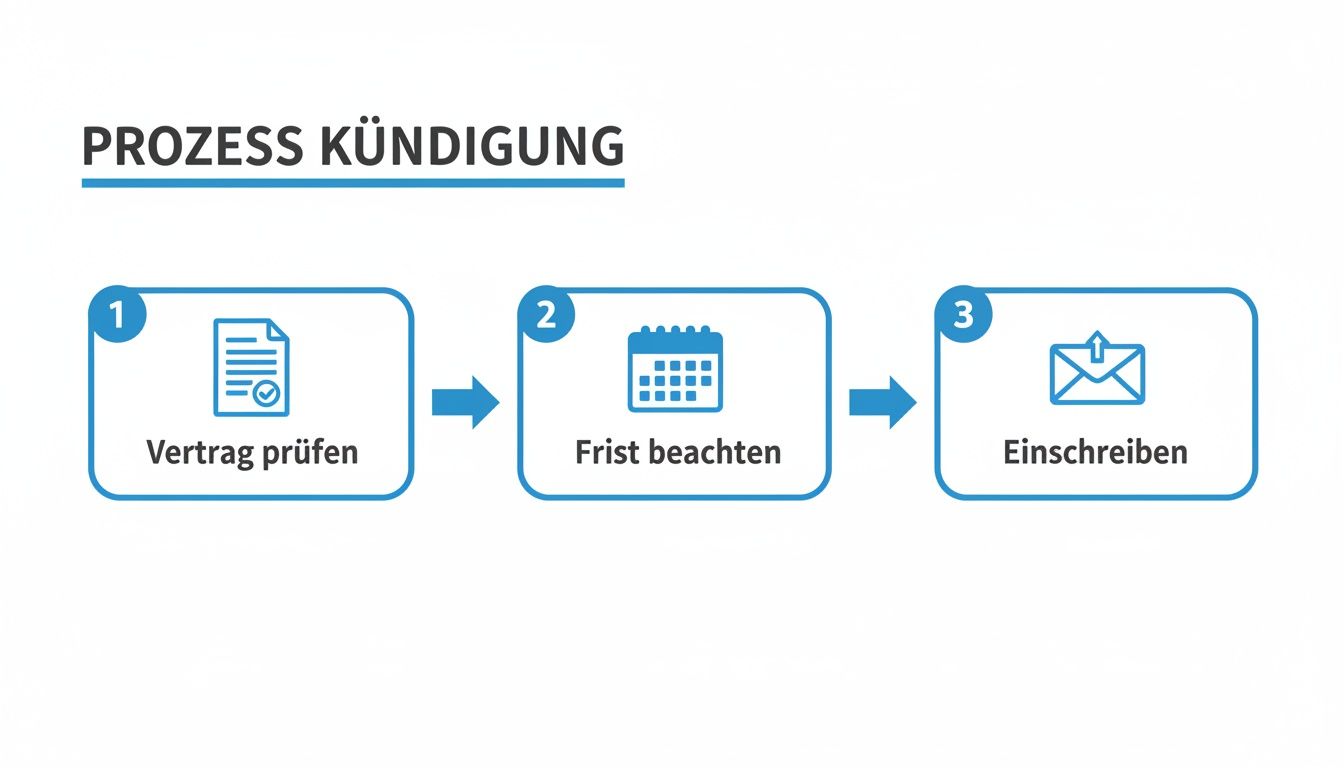 As you can see: everything starts with a close look at your apartment Contract, involves strict adherence to deadlines and ends with verifiable shipping.
The special case of family apartment
Do you live in the apartment with your spouse or in a registered partnership? Then be careful, special rules apply here. Even if only one person has signed the rental agreement, for a valid terminationboth partners must always sign.
This regulation protects the family. It is intended to prevent one person from giving up their shared roof over their heads behind the backs of others. A termination that is signed by only one partner is not valid under the law.
Notice periods and dates: The timing is everything
After the form, the deadline is the most important point. The first look should always be your rental agreement. What was agreed there takes precedence over the general legal regulations.
The notice period for apartments is usuallythree months. But also pay attention to the specified termination dates. Often you can only cancel at the end of a month, although December is sometimes excluded. In many cantons there are also the "customary local dates", for example the end of March, June or September.
If there is nothing precise in your contract, the law applies according to Art. 266c CO (Code of Obligations). This sees a deadline ofthree monthsfor a local appointment. In order not to make a mistake here, it is best to ask your local arbitration authority which dates are considered "local" in your community.
The following table gives you a quick overview so that you can plan your termination correctly.
Notice periods and dates in Switzerland at a glance
| Features | Legal Regulation | Practical tip |
|---|---|---|
| Notice period | At least3 monthsfor apartments (Art. 266c OR). | Always check your rental agreement first! A longer period may be agreed there. |
| Termination date | On a local date, unless otherwise stated in the contract. | Inquire about the local settlement dates from your municipality's arbitration authority (e.g. March 31st, June 30th, September 30th). |
| Receipt of the Notice of termination | The notice of termination must be received by the landlord.Send the registered letter at least one week before the end of the month to be on the safe side.before the start of the notice period | Weekends/Holidays |
| If the last day of the notice period falls on a weekend or a holiday, this applies next business day. | Plan a buffer. What counts is the day on which the landlord can pick up the letter for the first time, not the postmark! | Keeping these points in mind will save you a lot of trouble and ensure that your termination goes smoothly. |
If anything is unclear or disputes arise, a
can be worth its weight in gold. It helps with legal questions and, in an emergency, also covers legal fees.Rechtsschutzversicherung für MietangelegenheitenGetting out of the rental agreement early
Life rarely follows fixed plans. A sudden job offer in another city or personal changes – and the long-term rental agreement no longer fits your current living situation. Fortunately, Swiss tenancy law is quite flexible here. You don't have to stay in the apartment until the bitter end, because the
makes an earlier exit possible.Basically there are two ways to release you from the contract early: extraordinary termination for an important reason and - the much more common case - appointing a reasonable new tenant. However, both options require that you know the rules of the game exactly and adhere to them.Extraordinary termination
Extraordinary termination: The path for hardship cases
This path is only intended for really serious situations. An extraordinary termination is an option if the continuation of the rental agreement has become absolutely unreasonable for one party.
A classic example would be a serious defect in the apartment. Imagine that the heating fails permanently in the dead of winter, you have massive mold infestation or unbearable noise pollution - and the landlord simply does nothing despite a written request and a deadline.
But the hurdles for this are deliberately high. A small inconvenience is not nearly enough. It must be a condition that massively impairs living and is clearly the responsibility of the landlord.
The most common way: appointing a new tenant
By far the most common and practical method of getting out of the contract earlier is to appoint a new tenant. According to
you are released from your obligations as soon as you propose to the landlord a new tenant who isexactly the same conditionsand willing to take over the contract atIt is a widespread myth that you have to present three interested parties. Legally speaking, that’s enoughArt. 264 ORexakt gleichen Bedingungenreasonable
Important to know:Es ist ein weitverbreiteter Mythos, dass man drei Interessenten präsentieren muss. Rechtlich gesehen reichta single onesuitable and reasonable candidate. If the landlord rejects this candidate without a good reason, you are still released from the contract.
The current housing market obviously plays a big role here. In tight markets, interested parties can often be found quickly, but landlords' requirements can increase at the same time. Interestingly, the willingness to move in Switzerland is at an all-time low - only9.3 percentof the population recently changed apartments. More about theHintergründen dieser Entwicklung verrät das Bundesamt für Statistik.
What makes a new tenant “reasonable”?
In order for the landlord to accept a proposed candidate, the candidate must meet some clear criteria. This is not arbitrary, but follows fixed rules.
- Solvency:The new tenant must be able to afford the rent. The rule of thumb is that gross rent should not be more than a third of net income. A fresh extract from the debt collection register without entries is the be-all and end-all here.
- Contract transfer under the same conditions:The new tenant must be prepared to take over the rental agreement one-to-one - with the same rent, the same additional costs and the same rental period. He cannot negotiate new conditions.
- Objective reasonableness:The new tenant must objectively fit the apartment. For example, it would be unreasonable to propose a one-room apartment to a family of five. However, the landlord's personal reservations (e.g. against a nationality or pets, if these are not explicitly prohibited) do not play a role and are legally untenable.
The correct process when looking for a new tenant
To save yourself time and stress, it is best to proceed strategically. Good preparation is half the battle.
- Inform in writing:Inform your landlord by registered letter that you will be moving out early and finding a new tenant. Mention your desired move-out date.
- Place advertisements:Use the well-known real estate portals to advertise your apartment. Meaningful photos and an honest description are crucial.
- Collect applications:Ask interested parties to send you a short application dossier. The standard here is a registration form, a current extract from the debt collection register and copies of the most recent pay slips.
- Suggest candidates:As soon as you have a solvent and suitable candidate, forward their complete dossier in writing and by registered mail to your landlord. Ask for feedback within a reasonable period of time, for example10-14 days.
If the landlord does not respond or rejects an obviously suitable candidate for no reason, you are released from your obligations from the date on which the new tenant would have moved in. For more detailed instructions and other professional tips, we recommend our guide toausserterminlichen Kündigung einer Wohnung. This way you can ensure that you do every step correctly and get out of your old rental agreement quickly and cleanly.
How to master the apartment handover
The final act when it comes to “terminating an apartment in Switzerland” is the apartment handover. An appointment with consequences, because this is where it is decided what happens to your rental deposit. With the right preparation, this potential stress test will result in a confident conclusion to your tenancy agreement. The point is to avoid misunderstandings and ensure you don't have to pay for anything you didn't cause.
The key to success? To restore the apartment to the condition agreed in the contract. But that doesn't mean that everything has to look like new. The law makes a clear distinction between normal wear and tear and damage that goes beyond this. A good plan for the last few days before the handover is worth its weight in gold.
Preparation is everything
Smart preparation doesn't just start the day before the handover. Plan the final cleaning carefully, because in Switzerland landlords often expect immaculate cleanliness that goes far beyond normal house cleaning.
- Windows and blinds:All windows must sparkle inside and out, including the frames. The slatted blinds are a classic that is often forgotten - pay attention to them.
- Kitchen:Oven, steam vent and refrigerator must be absolutely free of grease. Take care of even the smallest corners and joints.
- Bathroom:Limescale on fittings and shower walls? A no-go. The drains must also be clear and clean.
- Floors and walls:Minor signs of wear are okay, but larger stains or blemishes should be repaired.
Given these high requirements, it can really be worth hiring professionals. Many cleaning companies offer apartment cleaning with an acceptance guarantee. The highlight: The company is present at the handover and will correct any complaints immediately and free of charge. This not only saves time, but above all a lot of nerves.
Normal wear and tear or excessive damage?
A sticking point in every apartment handover is the question: What is normal wear and tear and what am I liable as a tenant? Don't worry, the law is on your side and protects you from excessive claims.
Remember:You don't have to pay for normal wear and tear that comes from everyday use. These include, for example, shadows from pictures on the wall or slight scratches in the parquet that simply happen over the years.
The situation is different with excessive wear or real damage. These are defects that would not have occurred if the apartment had been handled carefully.
| Normal wear and tear (landlord's responsibility) | Excessive damage (tenant's responsibility) |
|---|---|
| Shadows from pictures on the wall | Deep scratches in the parquet due to the backs of furniture |
| Dowel holes (professionally closed) | Nicotine-yellow walls due to smoking in the apartment |
| Slight tracks on the carpet | Large wine or grease stains on the carpet |
| General material fatigue | Cracks in the sink or a broken tile |
Important: Even if you are liable for damage, you never have to replace the new value. The SPLIT is always calculated, which takes into account the service life of the damaged item. For example, a20 yearsold wallpaper has practically no value anymore - even if you have caused a crack.The handover protocol: your most important documentCurrent value
The apartment handover protocol is your most important piece of evidence. It is the written inventory of the condition of the apartment at the moment of handover. Handle this document with the greatest care.
Take your time and check each individual point before signing. Don't let yourself be pushed. Go through room by room and compare the current condition with the protocol that you filled out when you moved in.
These points must be recorded in the protocol:
Every scratch, every stain, no matter how small - everything should be precisely described in the protocol.
- Alle festgestellten Mängel:All identified defects:
- Who is responsible?It must be clearly defined which defects the landlord is responsible for and for which you as the tenant are responsible.
- Meter readings:Note down the current levels for electricity, water and heating.
- Number of Key:Record exactly how many keys (apartment, cellar, mailbox, etc.) you have returned.
- Date and signatures:Both parties, tenant and landlord, must sign the protocol.
If you do not agree with a point, do not simply sign. Instead, make a handwritten note of your dissenting opinion directly on the record before you sign. Take additional photos of disputed points with your smartphone - the date is saved in the image data and can be worth its weight in gold in later discussions about the deposit.
How to move after the termination without stress
The termination has been given, the date for handing over the apartment has been set - and now? Now the big logistical task begins: the move. In Switzerland, where the housing market is often tense, the whole thing quickly feels like double pressure. Not only do you have to find a new place to live, you also have to organize your move out perfectly.

The current situation doesn't make it any easier. The number of vacant apartments in Switzerland is at its lowest level since12 years. The quota recently fell to exactly 1.00 percent, which means that only 48,455 apartments were free across Switzerland. This is particularly noticeable when it comes to rental apartments: supply is far from meeting demand. So if you have to do yourCancel your apartmentyou need strong nerves - and a good plan.
Planning is everything
A smooth move begins long before the actual moving day. Good preparation is the key to staying on top of things and avoiding the typical stress traps. Similar to preparing for a big trip,eine detaillierte Checkliste für Ihre Umzugsplanung helps you to really think about everything.
Service providers like TIXPI do a lot of the work for you here. Instead of having to laboriously obtain and compare offers from different moving companies, you will immediately receive a transparent, fixed price. No hidden fees, no nasty surprises. This provides financial clarity and security right from the start.
TIXPI takes care of the entire process - from dismantling the furniture to safe transport to the disposal of old things that you no longer need. You only have one contact person who coordinates everything for you.
This central organization not only saves a huge amount of time, but also saves your nerves. You don't have to deal with different providers for transport, assembly and disposal. One call, one solution.
Solutions for every case
No two moves are the same. Sometimes an entire household has to change location, other times it's just the new sofa from the online shop.
Here are typical situations for which TIXPI has the right solution:
- The complete move:Are you moving your entire household? Then a professional crew arrives to do everything for you from A to Z.
- The furniture transport:Have you bought a bed online or want to pass on the old cupboard to a friend? TIXPI takes care of the transport of individual pieces.
- The crew rental:Perhaps you have already organized the transporter yourself, but need a few strong hands for lugging and assembly? You can also easily book a professional crew for this.
This flexible approach ensures that you get exactly the help you really need in your situation.
Save money and protect the environment
A smart logistics system has even more advantages. TIXPI tries to bundle transports wherever possible. This means that routes are planned in such a way that empty trips are avoided and utilization is maximized.
This has two positive effects. Firstly, theCO2 emissions significantly reduced, which makes the move more sustainable. Secondly, the resulting cost advantages can be passed on directly to you. You see the maximum price when booking - if a route can be bundled, your final bill will often be even lower. This not only makes moving after the termination easier, but also more budget-friendly and environmentally friendly.
The termination letter: How to word it correctly
When terminating your apartment in Switzerland, a small formal error can lengthen the entire process unnecessarily. It's not just about quickly informing the landlord that you're moving out. Rather, you need to draw up a legally watertight document that leaves no room for misunderstandings. Every single piece of information has its reason and ensures legal validity.

You can imagine the termination letter as the foundation of the extract. If this wobbles, the whole project comes to a standstill. That's why it's so crucial not to just blindly copy a template, but to really understand why each component is important.
The core content that definitely shouldn't be missing
A complete termination letter is your protective shield against later arguments. Check carefully whether your letter contains the following points completely and correctly:
- Full addresses:Your address as the sender and the exact address of the landlord or administration as the recipient. These must be identical to the information in the rental agreement.
- Date of the letter:The date on which you write the letter is a must.
- Clear subject:Formulate a clear subject line, for example: “Termination of the rental agreement for the apartment [your address, incl. floor]".
- Precise property name:Identify the rental property unambiguously. Provide the exact address, floor and apartment number. If additional rooms such as a basement compartment or a parking space were rented, these are also included in the termination.
A typical mistake that happens again and again is the inaccurate name of the apartment. If the subject only states the street, but not the floor or the apartment number, this could theoretically lead to confusion in a large apartment building and make the termination contestable.
State the termination date crystal clear
The most important sentence in the entire letter is the wording of the termination date. Absolute clarity is required here to eliminate any doubt.
Write it down clearly: “We hereby terminate the rental agreement for the above-mentioned apartment on time at the next possible date, the30. September 2024.” Mentioning the specific date is worth its weight in gold. A vague formulation like “in three months” is far too imprecise and opens the door to interpretation.
At the same time, you should ask the landlord for written confirmation. This gives you the security that your cancellation has not only been received, but also accepted. A simple sentence like “We ask you to confirm receipt of this termination and the end of the contract in writing” is sufficient.
The professional conclusion
A good termination letter looks one step further – to the handover of the apartment. Be cooperative and ask the landlord to suggest a few deadlines for the handover.
And at the very end comes the most important thing: thePersonal signature. All main tenants named in the rental agreement must personally sign the document. In the case of family apartments, as already mentioned, this applies to both spouses or registered partners - even if only one signed the contract at the time.
To make your life easier, we have summarized all the important points in a practical template. You can find a detailed guide and a directly usable SPLIT from us. With this tool you can be sure that you will overcome all formal hurdles and that your termination of your apartment in Switzerland will go smoothly.Vorlage für Ihr Kündigungsschreiben zur WohnungThe most frequently asked questions about termination of your apartment in Switzerland
The thought of terminating your apartment often brings with it a whole series of questions. Even if you think you've thought of everything, there are still uncertainties. This is exactly where we want to start and clarify the most common concerns of tenants in Switzerland so that you can master the final steps confidently.
Whether it's about the deposit, the validity of the termination or small but crucial details - knowledge is the best protection against unpleasant surprises. Let's tackle the points that always cause headaches in practice.
What happens if I miss my notice period?
Unfortunately there is no leeway here: If your cancellation letter reaches the landlord even a single day late, the notice for the desired date is no longer valid. It is then automatically postponed to the
.This can be expensive. For example, if you miss the deadline for September 30th, your termination will not take effect until October 31st - if this is contractually provided for. In the worst case scenario, you end up paying double rent for a month.next possible regular termination date
A classic stumbling block: Many people believe that the postmark is crucial. Incorrect! What counts is the day on which the landlord can actually collect the registered letter from the post office. Therefore, always plan a buffer of several working days – better safe than sorry.
Can the landlord simply reject my termination?
Clear answer: No. A termination that has been submitted in the correct form and on time is a unilateral declaration of intent. The landlord cannot reject them. As long as you have complied with the formal rules of the game - i.e. in writing, with the signatures of all main tenants and on time - your termination is absolutely legally valid.
A written confirmation from the landlord is practical for your own documents, but is not necessary for the termination to be effective. Does the landlord not respond at all? No problem. If you keep the receipt of the registered letter, then you are on the safe side.
How quickly do I have to get my rental deposit back?
After the apartment has been handed over and the handover protocol has been signed by both sides, the deposit should actually be released quickly. There is no fixed law for this, but in practice a deadline of
has been established, provided there are no outstanding claims.But be careful: the landlord has the right to withhold the deposit up to30 days
if the utility bill is still outstanding. Only when this year is over can you, if necessary, request approval through court.Do I have to paint all the walls white when I move out?12 months
Muss ich bei Auszug alle Wände weiss streichen?
This question regularly causes discussions. The rule of thumb is: If you have taken over the apartment with white walls, you must return it in a neutral, light color. The landlord doesn't have to tolerate brightly colored walls.
However, you don't have to be responsible for normal wear and tear. A few professionally filled dowel holes are usually no reason for complaint. A complete repainting is only necessary if the walls are excessively worn - for example due to heavy smoking in the apartment or because the children have used them as a canvas.
What can I do if I can't find a new apartment after giving notice?
Looking for an apartment in Switzerland can be a real ordeal. The vacancy rate for rental apartments fell by8.6 percentin one reporting year, which further exacerbates the situation. At that time only 40,423 rental apartmentswere empty. If time is of the essence, you have a few options:
- Subletting:Actively look for a room to sublet. This is often the quickest temporary solution.
- Furnished apartments:These are more expensive, but are usually available at short notice and are flexible.
- Look for a conversation:Ask your current landlord whether an extension of one month would be possible. If the relationship is good and there is no new tenant in sight, a solution can sometimes be found here.
The tense market situation shows how important early planning is. Take a look atweitere Einblicke zur Entwicklung des Schweizer Wohnungsmarktes to better assess the current challenges.
The notice has been given, the new apartment found? Perfect! Now the move is on. So that this last step goes smoothly, TIXPIis there for you. We organize your entire move, the transport of individual furniture or the disposal of old items - all at transparent, immediate prices. Focus on your new home, we'll take care of the logistics. Plan your stress-free move now onhttps://tixpi.ch.