
You're standing in front of the old apartment with your bunch of keys, a moving wagon is blocking the street below, and someone is already asking about the no-parking zone. It is precisely at this moment that you realize that moving in Switzerland is not just about boxes, but about deadlines, approvals, handovers and neat order. If you're wondering what it really means, you don't need a generic packing list, but rather clear Swiss logic.In practice, it's rarely the distance that determines the effort involved, but rather the organization on site. In Switzerland, many people move within the same canton, the distances are often short, but the processes remain strictly regulated, especially in cities and in rental apartments. That's exactly why this guide takes you step by step through the priorities, from termination to handing over the keys, in the way you really need it in Switzerland.What to consider when moving
Why a move in Switzerland needs to be planned differently
The moving van is parked in a Zurich neighborhood, the driver is doing a lap for the third time, and the neighbor points to the curb and asks whether the no-parking zone is even approved. This is exactly where it becomes clear that moving to Switzerland cannot be solved with a standard checklist. It's not just about carrying and packing, but about access, community, rent and clean receipts.
Swiss reality is dense, local and often cantonal.
all changes of residence take place within the same canton, theAverage moving distance is 13.4 km. This means: parking, lift times, carrying routes and permits are often more important than the route itself, as Swiss statistics show. You can find out more about this in the official moving data from the Federal Statistical Office and in theThree differences that should not be underestimated.Übersicht zu offiziellen Zügelterminen in der SchweizAlmost three quarters
Firstly, deadlines and official channels do not just run "somehow", but through the municipality and Canton. Secondly, parking and access in Swiss cities regularly require permits or are at least heavily regulated. Thirdly, rental contracts, handovers and insurance are often formulated in such a way that small mistakes can become expensive later.
Anyone who plans the moving day without Swiss authorities' logic almost always ends up with more stress than necessary.
In addition, there is the structural reality. Many houses are older, narrow and multi-story, with narrow stairs, small elevators or no elevator at all. Anyone who only thinks about boxes here is planning too short, because the formal issues have to be right first, then the logistics follow. It is precisely this order that makes the difference between chaos and a controlled process.Practical rule:
Deadlines, authorities and tenancy law under control
When moving in Switzerland, the order counts almost more than the to-do list itself. First, the old apartment must be clearly terminated, then you need to look at the new community, only then is it worth planning the detailed logistics. Anyone who mixes up this order risks double rent, late notifications or unnecessary pressure shortly before the appointment.
Cancellation, registration and notifications
For apartments in Switzerland there is usually a
; The notice of termination must be received by the landlord no later than the last day before the start of the period. This is followed by notification to the new municipality, as the change of address must usually be reported towithin 14 days. In practice, this means that the move does not just begin with the transport, but rather with a clear deadline plan.innerhalb von 14 Tagenlegal minimum period of 3 months
Anyone who juggles authorities and family quickly realizes how important an orderly sequence is. A good source of comparison for families who have to complete organizational steps in parallel is theAllchecklist Anleitung Baby anmelden, because the logic of deadlines and responsibilities is thought about very similarly there. TheÜbersicht zum Abmelden bei der Gemeinde.
What goes together legally and practically
In Switzerland, the rental deposit is typically deposited in a blocked account or via rental deposit insurance, and the return of the apartment must be processed in a protocol. Anyone who only works verbally here often has discussions later. The address of the health insurance company, AHV payment office and road traffic office should also be adjusted at an early stage so that nothing gets stuck in the old apartment.
| Step | Deadline | Responsible body |
|---|---|---|
| Cancel rental agreement | 3 Months, in writing and on time | Landlord |
| Register apartment in new municipality | Within 14 days | Resident control / municipality |
| Address changes internally | Immediately after fixing the moving date | Health insurance company, AHV, road traffic office, Employer |
| Return of the old apartment | On the agreed handover date | Administration / landlord |
If you send the notice too late, you lose time. If you forget to register in the new community, you risk getting into trouble. Anyone who underestimates the handover protocol will have little evidence later.
Typical mistakes are banal but expensive: a forgotten subtenant clause, a contract extension that was tacitly expected or a refund of the deposit that was clarified too late. That's exactly why the authorities' side belongs before the packing phase. Only when deadlines and responsibilities are in place is the rest of the work worth it.
Packing cleverly and preparing the apartment

Packing works well when it is not organized according to chaos, but according to rooms. The best order is simple: rarely used rooms first, kitchen structured with labels and photos, bathroom and medication at the very end as the last box. If you work like this, you don't have to search desperately for the toothbrush bag or the charging cable on the first evening.
Material that has proven itself in Swiss apartments
Stabledouble corrugated boxesare mandatory, especially if stairs are narrow or boxes have to be lifted several times. Books belong in smaller, sturdy boxes, glass in special boxes, clothing in clothes boxes with a rail so that they remain wrinkle-free. Furniture blankets and stretch wrap protect edges and surfaces better than improvised blankets or loose cloths.
A common mistake is too much weight in one box.Boxes over 20 kgare inconvenient, difficult to carry and increase the risk of damage. A lack of labeling is just as problematic, because without a target space and contents, even a good crew loses time unnecessarily.
Making the apartment and furniture suitable for moving
Cabinet doors should be secured, drawers emptied and screws in labeled bags should be attached directly to the piece of furniture. Electrical devices without documented disassembly cause confusion later, especially if they are affected by transport or assembly. I also recommend taking photos of the drawer interiors of the kitchen because these pictures save a lot of time when putting them away.
Swiss house logic is worthwhile for apartment maintenance. Reserving a lift, checking the house rules for the day of the move and scheduling the municipality's bulky waste collection early enough are not trivial matters. Parquet and panels are protected with felt pads and a clean base, not with vague hopes of “caring carefully”.
Note:Good preparation not only saves time, it also reduces damage and discussions during the handover.
Transport, crew and platforms in comparison
The right transport solution depends on the amount of furniture, accessibility and deadline pressure. A small apartment with few pieces of furniture can often be cleared out yourself if you prepare well. Heavy cupboards, narrow stairwells or a fixed handover date, on the other hand, speak for professional support, even if it costs more.
Three models, three responsibilities
WithDIY movingWith a rented van, you organize the vehicle, protective material, helpers and time slots yourself. Travel costs, parking tickets and food for the helpers are added. This model can be suitable for short distances and a manageable household. Clarify in advance who is liable in the event of a damaged piece of furniture or an injury.
A classicMoving companyprovides crew, equipment and transport in one order. This reduces your organizational effort, but usually costs more and is booked up more quickly in high season. When it comes to heavy furniture, multiple floors or no elevator, well-practiced carrying work is particularly important. Check on the order which damages and additional services are actually insured.
Platform models likeTIXPIarrange moving partners and bundle booking, appointment coordination and additional services. This helps to keep multiple offers and scopes of services comparable. You can find a directVergleich der Umzugsmodelleonline. Adigitale Lösung für Bauleiteralso shows how much time clear coordination can save among several participants.
| Model | Own effort | Liability |
|---|---|---|
| DIY | high | complete dir |
| Removal company | medium to deep | depending on the order and insurance |
| Platform model | medium | regulated depending on the partner and order |
Which model fits?
DIY is suitable if you have little furniture, short distances and enough helpers are available. A moving company makes sense if carrying assistance, a narrow time window or clearly regulated liability are important. Platforms lie in between. They bundle the organization while you can specifically compare partners and the scope of services.
The price alone is not the deciding factor. Check who provides the vehicle and crew, what work is included, who is liable in the event of damage and whether there are additional costs for heavy furniture or difficult access. Especially in Swiss cities, a seemingly cheap solution can become more expensive due to additional journeys, waiting times and a lack of helpers.
No-parking zones, parking and moving day
Moving day determines stress, costs and speed more than any other phase. If the car isn't positioned correctly, the lift is blocked or the crew doesn't have a clear path, the entire process falls apart. In Swiss cities like Zurich, Bern or Basel, access is often not just “a bit narrow”, but operationally critical.
Parking is not an afterthought
An approved no-parking zone is often the difference between an orderly start and chaotic improvisation in densely built-up areas. Depending on the municipality, this may take several weeks in advance, so the application should not be submitted until shortly beforehand. Signs, permits and neighbors belong together because no one wants to find themselves standing in front of an illegally parked car in the morning.
Parking the vehicle should be planned generously, not on the edge. A few extra meters to the entrance can slow down the whole process, especially when a lot of boxes and heavy furniture are being moved one after the other. If there is a lift in the old or new property, it should be reserved, otherwise the process will quickly run counter to other users.
This is how the day remains controllable
It is best to start the day with a clear order, first boxes, then dismantled furniture, then bulky items. Weather also plays a role, as rain makes cardboard slippery and easily causes floor marks. If you plan a lunch window for the crew, you prevent unnecessary breaks at the wrong time.
- Secure access:Approve the no-parking zone and mark it correctly on site.
- Reserve the lift:Fix early in old and new properties.
- Time the process:First small items, then furniture, then Rest.
- Note down times:Time stamps per stage make later billing and clarification easier.
The time crunch on moving day is often underestimated. If helpers have to wait or the car is not close enough, not only the costs increase, but also the likelihood of errors and damage. This is exactly why the parking must be in front of the first box, not after it.
Ensure handover, meter readings and insurance
The handover is the moment when a normal move becomes a legally relevant protocol. Anything that is not clearly documented here is difficult to prove later. That's why you shouldn't just "hand over" the apartment, but rather create the documents consciously.
What really counts when handing over
The handover protocol must be read line by line, not just signed. Visible defects should be recorded together with the administration, and only where they are no longer considered normal wear and tear. Every room, every fitting and every floor covering should be photographed with a date so that later discussions are not based on memories but on receipts.
The meter readings are also included. Electricity, water and gas should be read together with the administration or the next tenant and countersigned in the protocol. Otherwise, later differences will quickly end up in the utility bill, and then things will become unnecessarily slow.
Document insurance and damage immediately
The household contents insurance should be checked for transport and moving protection before moving. Many policies cover household contents at the old and new place of residence at the same time during the move, depending on the provider for a limited transition period. This is particularly important if something is damaged on the day of the move or shortly afterwards.
Damage must be documented immediately. Take photos, report in writing, set the deadline for reporting, that's the order. In the event of visible damage to furniture, receipts for emergency purchases should also be kept because they are part of the settlement.
Practical principle:Without a photo, report and immediate report, damage is often just an allegation later.
Those who take this routine seriously prevent the usual discussions after moving in. Clean documentation immediately pays off, especially when it comes to floors, furniture and handover problems. This is not bureaucracy for bureaucracy's sake, but rather the safety net of the entire move.
Schedule and common mistakes at a glance
A good move doesn't go well spontaneously, but is planned well in advance. The following timeline summarizes the important steps at a glance so that you don't have to search through pieces of paper, emails and deadlines before the move. If you stick to this, you will have significantly less pressure on the deadline.
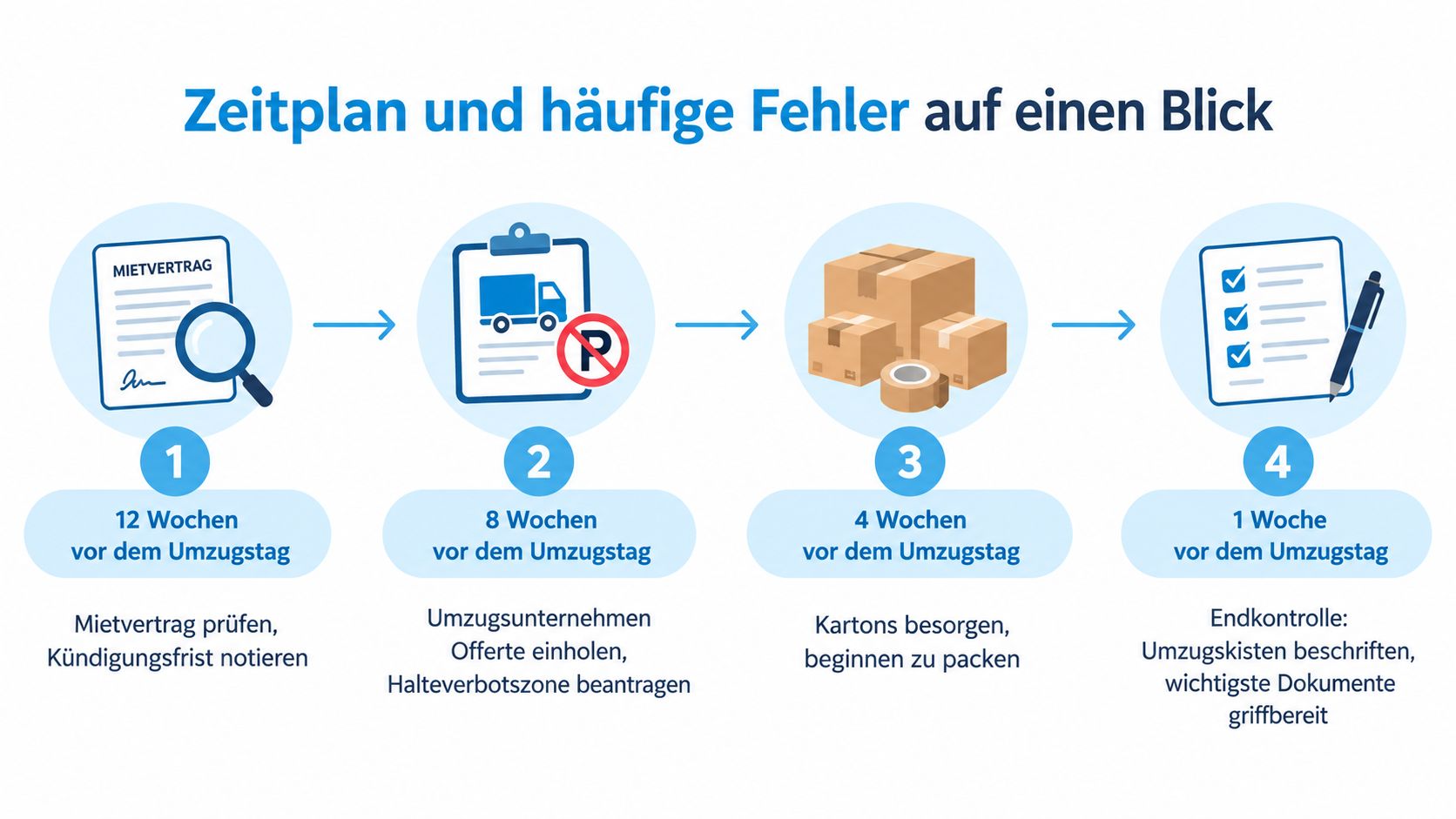
The four most important time windows
- 12 weeks in advance:Check the rental agreement and note down the notice period.
- 8 weeks before:Obtain offers and apply for a no-parking zone.
- 4 weeks before:Get boxes and start packing.
- 1 week before:Keep final inspection, labeling and important documents to hand.
This includes the small but crucial tasks such as forwarding, Lift reservation and meter readings. If you only want to do these points in the last week, you will create stress that could easily be avoided. A clean schedule not only relieves you, but also helpers and administration.
The most common mistakes
- Cancellation too lateof the old apartment, even though the deadline has long since expired.
- No reserved lift times, especially in cooperatives and large properties.
- Forgotten meter readings, which later lead to disputes over additional costs
- No parking zone not applied for, even though the car has no other space.
- Underinsured transport, if damage is only noticed afterwards.
- No photos before Handover, even though these are exactly the documents that count.
- Unplanned costs for bulky goods or special transport if contaminated sites are discovered too late.
Anyone who takeswhat to consider when movingseriously does not need a perfect checklist, but rather a prioritized plan. First deadlines and authorities, then access and logistics, then packing and handover - this is exactly the order in which a Swiss move runs most smoothly. If you want clear, digital coordination, take a look at TIXPI, where moves and transports in Switzerland are organized and combined with practical processes around planning, transport and handover.