Renting furniture in Switzerland is particularly worthwhile for transitional situations or high-quality furnishings when you factor in the total costs including delivery, assembly and return. The market includes199 companiesand grew between 2020 and 2025 at a CAGR of0.8%, so remains a small but stable niche.
The crucial question is: Are you really comparing the monthly rate, or are you also including those costs that are barely visible in the rental offer? Delivery, floor, assembly, deposit, return and disposal often determine whether renting is actually cheaper and more practical than buying.
Introduction to furniture rental in Switzerland
Renting furniture in Switzerland is particularly worthwhile in transitional phases. You set up an apartment for a temporary stay, bridge a move, wait for your own furnishings or flexibly equip an office. Anyone who buys in such situations ties up capital and often creates a logistics problem for later. The furniture must be sold again, stored, transported or disposed of.
The Swiss market remains small, but is clearly recognizable. An industry analysis counts199 companiesin the area of rental and leasing of personal and household-related goods. Furniture is expressly included in this segment. Between 2020 and 2025, the sub-industry developed with aCAGR of 0.8%, indicating a stable niche rather than a mass market. You can find more details about the Swiss classification in theBranchenübersicht zur Möbelmiete in der Schweiz.

Why renting pays off in transitional phases
The financial advantage is not just in the monthly rate. It only becomes apparent when you add up usage, delivery, assembly, return and later expenses. With a temporary stay, you don't buy anything in stock, you don't organize resales and you don't need a long-term storage solution. With high-quality furniture or appliances, you save yourself the high initial investment and still retain appropriate equipment.
Renting is also often the cleaner solution from a logistical perspective. A provider can coordinate delivery, setup and pickup. This helps in Swiss cities with narrow stairwells, limited parking spaces or apartments that are only accessible on a fixed date. These points in particular are often presented too briefly in the rental offer and drive up the actual costs.
Practical rule:Don't just ask for the monthly amount. Ask for the total price for delivery, use, assembly, return and possible additional services.
For whom furniture rental is particularly suitable
- Temporary households:You live in Switzerland for a limited period of time, are moving for work or are bridging a renovation.
- Relocation situations:You immediately need a habitable apartment while keeping your own furniture are still on the way.
- Company:You set up workstations, project offices or transitional rooms without permanently purchasing inventory.
- Quality-conscious tenants:You use high-quality pieces without having to bear the purchase price, resale and disposal yourself.
Renting is less convincing if you have very furniture Keep it for a long time, require little flexibility and safely cover transport and assembly yourself. Then compare the rental agreement directly with a purchase offer and the follow-up costs.
Which rental model suits you
Which rental model suits your stay, your budget and your planned move? The decisive factors are the period of use, the notice period and the costs for professional logistics. Don't choose based on the lowest starting price. Check how delivery, assembly, collection, disposal and possible extensions are charged.
Short-term rental for transitions and individual occasions
The short-term rental is suitable for temporary apartments, events, visits and short-term workspaces. You get ready-made equipment without having to buy furniture or store it yourself later. Depending on the provider and type of furniture, daily or monthly conditions are possible. Before booking, have the period, the minimum rental period and the return period confirmed in writing.
Fixed logistics costs are particularly significant for short-term use. Therefore, ask for a complete offer including delivery, floor or access costs, assembly, collection and possible disposal. A professional logistics solution prevents narrow stairwells, a lack of parking spaces or a tight handover window from making the process more expensive. Also ask for a clear regulation for damaged packaging and furniture parts left behind.
Subscription and long-term rental for mobile living situations
A subscription is suitable if you want to remain flexible for longer and need complete furnishings. In the Swiss market, subscription and short-term models with around3,000 rentable itemswere described by Beliani in 2019. The planned duration was from 12 or 24 months, complete facilities were advertised from 99 francs per month. Other providers quoted monthly ranges of 200 to 500 francs for furnishing a four-room apartment. These historical market signals are documented in theBranchenanalyse zu Miet- und Leasingangeboten in der Schweiz.
The advantage lies in predictable payments and lower capital commitment. Nevertheless, check whether you can exchange furniture, add to it or return it early. Also clarify who will organize dismantling, transport and reconstruction when moving. A long commitment becomes expensive if you continue to pay for several months after moving home or have to finance additional trips.
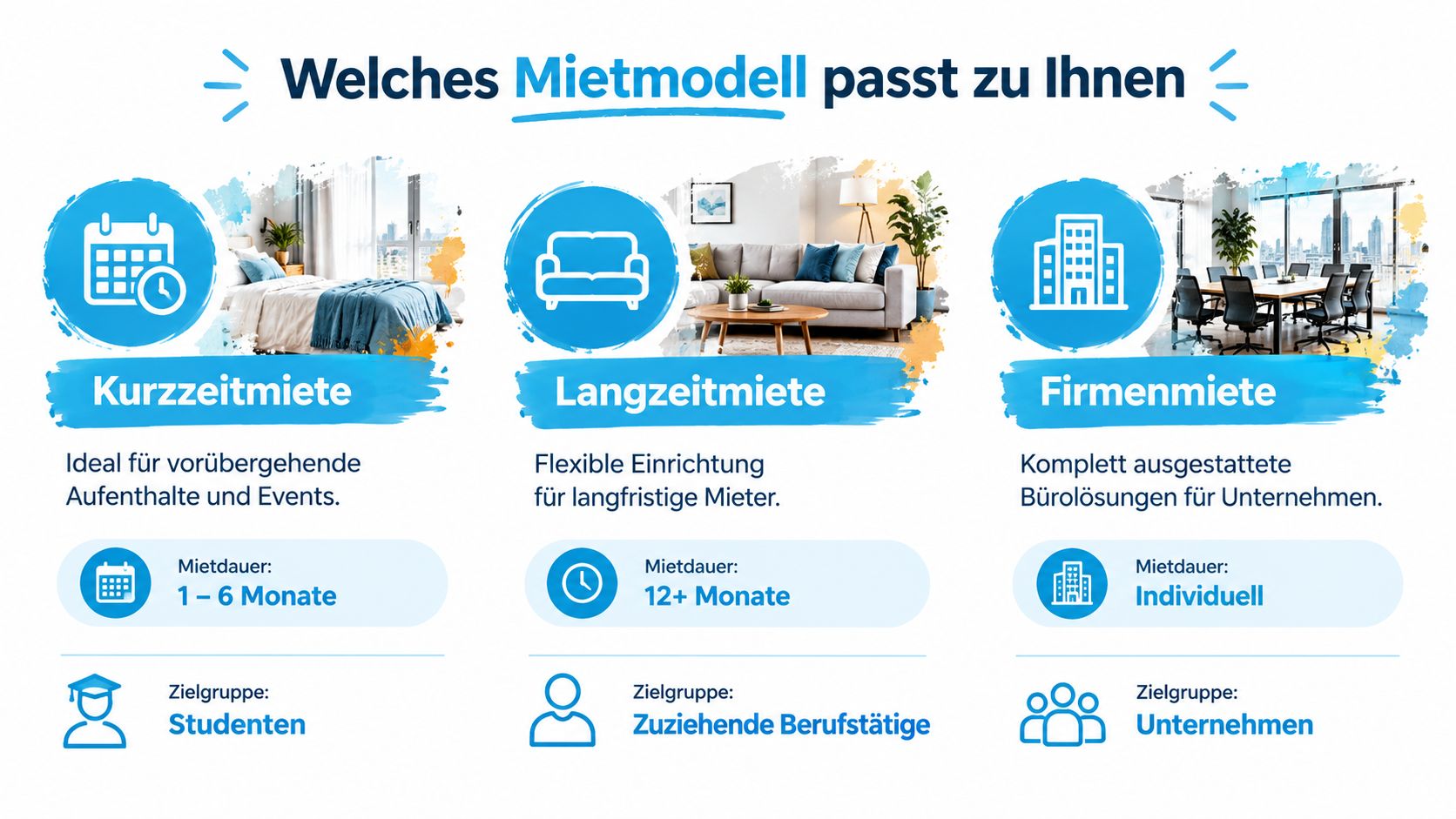
Leasing for companies
Leasing is aimed at companies that use workplaces, project offices or entire rooms for a longer period of time. It can conserve liquidity and simplify equipment replacement. Before signing, clearly agree who owns the furniture, who will pay for maintenance and damage, and how the return will work. Your fiduciary should also check the tax treatment.
| Model | Suitable for | Most important check |
|---|---|---|
| Short-term rental | Transitional apartments, events, individual assignments | Delivery, installation and return costs |
| Subscription or Long-term rental | Flexible households and temporary stays | Notice period, term and relocation |
| Corporate rental or leasing | Offices and project locations | Inventory, ownership and responsibilities |
Choose short-term rental if the date is uncertain. Take out a subscription for a predictable, mobile setup. Only opt for leasing if you have clearly calculated commercial use. Prefer providers who check furniture after it is returned, reinsert it or recycle it professionally. This reduces disposal costs and supports the circular economy.
Costs and pricing for furniture rental
If you only look at the monthly rate when renting furniture, you miss the items that really drive the final price. Delivery, access to the apartment, assembly, deposit, insurance, return and possible damage are crucial. Especially for short terms, these fixed costs often amount to more than the actual value of the furniture.
Swiss rental prices usually depend on the rental period and the type of furniture. A Swiss price list mentions for1 to 3 days 20% of the sales priceand for4 to 8 days 25% of the sales price. For longer periods, prices are quoted upon agreement. If you pick up the item yourself, you save the delivery fee, but bear the risk that disassembly and reassembly will be charged separately. The details are in theMietpreisliste für Möbel in Zürich.
A typical mistake is the false assumption that delivery automatically means to the apartment. Clarify in advance whether delivery will only be delivered to the curb, whether carrying to the floor is included and whether there will be an additional charge for narrow access. Such additions quickly move the price upwards.
How to build up the total price
Calculate the price in five positions:
- Usage fee:Monthly rate or time-dependent rental price for each piece of furniture.
- Transportation:Delivery to the address, possible additional costs for difficult access roads or several Floors.
- Assembly:Assembly, alignment and, if necessary, later dismantling.
- Return:Collection, packaging, condition check and any cleaning.
- Risks:Deposit, deductible and costs for excessive wear and tear or Damage.
Request a quote that lists each item individually. This is the only way to see whether a seemingly cheap tariff is being eaten up by additional costs. For professional assembly, it is worth taking a look at theKosten für den professionellen Möbelaufbau, because your own working time is not free.
Themalma.ai Pricing Guidecan help to classify recurring fees and alternative pricing models. But don't accept this logic blindly, because when it comes to furniture rental, location, access, quantity and contract details count. That's exactly where the expensive surprises are hidden.
Cost rule:A low rental price is not a good offer if you have to deal with transport, assembly and return separately.
When renting becomes financially sensible
Renting shows its strength when the purchase generates additional costs. These include a large capital investment, later transport, uncertain resale or expensive disposal. When it comes to high-quality furniture, renting is often the cleaner solution if you need quality but don't want a long-term commitment.
Buying is often more consistent if you can keep the piece of furniture permanently, transport it yourself and continue to use it without much effort. Contrast both scenarios directly. If you want a precise comparison, you also have to think about the logistics costs, from setup to later processing. This also fits with the circular economy, because well-rented furniture can be inspected after use, reused or professionally recycled.
Contractual issues and insurance
A furniture rental contract should regulate more than just the monthly price. Ask for clear information about the start of the rental, the end of the rental and the return standard. The consequences of late returns, damage and early termination are also crucial. If you read this carefully, you will save money and trouble later.
These points should be on the table before you sign
- Minimum term:Check whether you have to continue paying even if you move out earlier.
- Cancellation:Pay attention to deadlines, automatic extensions and the form of the Cancellation.
- Return:Have a record of who collects, who packs and how the condition is documented.
- Deposit:Clarify amount, release and possible deductions.
- Damage:Distinguish between normal wear and tear, accident, improper use and Loss.
- Accessories:Check whether spare parts, mattresses, cushions or technical components are treated separately.
The term models are structured differently in Switzerland. A neutral guide calls1 monthas a minimum rent,2 to 12 monthsas medium-term use and12 to 48+ monthsas long-term rent. Some providers have price grids from 1 month, 3 months, 12 months and 24 months. Therefore, check carefully whether the cheaper tariff is linked to a longer commitment. The models are described in theRatgeber zu Mietmöbeln und Laufzeiten.

Insurance and condition report
Make immediately upon delivery Photos. Keep a written record of scratches, stains, loose parts and visible signs of wear and have the delivery team confirm the record. Without this documentation, it will be difficult to prove previous damage later.
Also clarify the insurance. Your personal liability insurance does not automatically cover damage to rented items. Ask the provider directly about your own coverage, deductibles and exclusions. The same applies to business liability for furniture used commercially.
Contract tip:Have the return explained in writing. A clear regulation is worth more than a low tariff with open additional costs.
Delivery, assembly and disposal practically solved
The cost trap when renting furniture is often not in the piece of furniture itself, but in delivery, assembly and collection. Check the logistics first, then the rental price. If you plan access, delivery windows, carrying routes and later collection carefully, you will save yourself expensive surprises. If a cupboard doesn't fit through the stairwell, a cheap rent quickly becomes an unnecessary expense.
Start with a clear inventory. Measure room, floor, elevator, access and desired delivery date. The provider should then plan the transport, assemble the furniture on site and organize the same process in reverse when returning it, including condition checks and removal.
A practical scenario
You are moving into a temporary apartment and need complete basic equipment. Do not order furniture from multiple places individually. Specify what should be delivered room by room and request bundled delivery with assembly. A professional logistics service provider saves time, reduces coordination errors and delivers not only to the street.
It's worth taking a look at theMöbeltransport in der Schweiz when planning if you want to bring furniture directly to the place of use or have it picked up again later. Such solutions are particularly useful when several parts arrive at the same time or access is difficult.
When it comes to office furniture, Swiss providers show how far this service can go. One offer states delivery, assembly and later collection within the entire Swiss delivery area as included. The furniture will be set up ready for use on site at the desired date. You can find out more about this atSchweizer Anbieter für Büromöbelmiete.
Where professional logistics reduces costs
Central coordination prevents duplicate trips and avoids misunderstandings. You don't have to rent a van, organize additional helpers or look for a mechanic separately. This is particularly worthwhile if there are narrow entrances, lots of furniture or clear deadlines.
Disposal is part of the calculation from the start. Clarify in writing whether damaged parts will be replaced, returned or disposed of. If old furniture needs to be removed when moving out, arrange collection early. A spontaneous express solution almost always costs more than a well-planned return transport.
Ecological aspects and sustainability
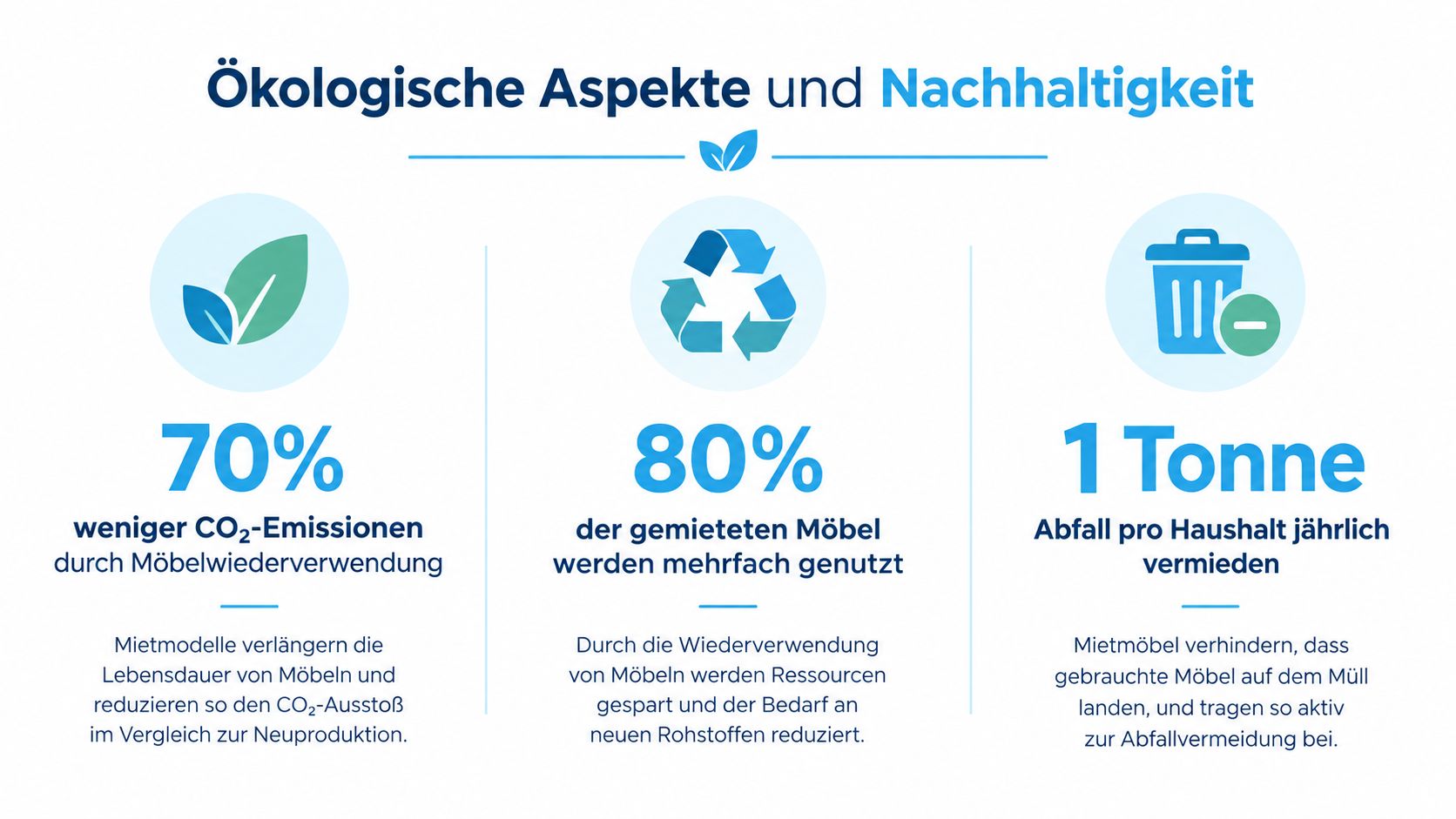
Furniture rental is truly sustainable if the provider keeps the furniture in circulation. A piece is inspected, cleaned, repaired and rented again. In this way you avoid having to buy a new one for every interim solution and you keep material consumption and waste lower.
The logistics behind it are crucial. Frequent empty trips, unnecessary return transport and poorly planned collections quickly eat up the ecological advantage. Demand bundled deliveries, clear repair processes and a clear regulation for the end of the useful life.
Reuse instead of replacing at short notice
When making a purchase, you often have to make a new decision after you move out. Selling, storing, giving away or disposing of things costs time and money. When renting, responsibility for further use usually remains with the provider, unless the contract stipulates otherwise. This is the core of the circular economy: functional furniture stays in use instead of ending up as waste.
This pays off, especially when it comes to office and project furniture. You adapt the equipment to the actual needs without purchasing new inventory for every interim solution. This reduces unnecessary procurement and avoids wasting resources.
What really determines the ecological effect
Pay attention to the preparation of the furniture, not to nice slogans. A provider is only credible if repairs are possible, transports are combined and returns are clearly regulated. TheInfografik über ökologische Vorteile von Möbelvermietung, einschließlich CO2-Reduktion, Ressourcenschonung und Vermeidung von Möbelabfall durch Wiederverwendung.shows exactly this connection.
The biggest mistake is a poorly organized return. For items that are no longer needed, you should schedule collection early and plan for proper disposal. Information aboutMöbelentsorgung in der Schweizhelps you to solve the last step as well as delivery and use in an orderly manner.
Checklist for tenants and outlook
What costs are really incurred before you rent? Check not just style and availability, but the entire process. Swiss providers often state a monthly rate, but leave delivery, assembly, return, deposit or gross rent hidden in the small print. This is exactly the gap that the SPLIT describes Delivery?Übersicht zu Mietmöbeln und PreislogikHave additional work confirmed in writing.
Who will assemble and dismantle?
- How does the return work?Clarify collection, packaging and condition inspection.
- What does the insurance cover?Check liability, deductible and exclusions.
- What happens if you extend it?Request the conditions for further months.
- How is it disposed of or reused?Prefer providers with a clear return and circular solution.
- Buying creates additional costs, a large capital investment, transport, an uncertain resale or disposal. When renting, these points are usually already included in the structure.Obtain at least one offer with a complete breakdown of costs. If the provider only states a monthly rate, the calculation is not reliable. For a temporary apartment or high-quality facility, renting can make sense if the logistics are taken into account right from the start.
- .TIXPI organizes furniture transport, delivery, optional assembly and furniture disposal in Switzerland with transparent prices and central coordination. Discuss your needs and check the right solution directly at
- Wie wird entsorgt oder weiterverwendet?Bevorzugen Sie Anbieter mit klarer Rücknahme und Kreislauflösung.
Holen Sie mindestens ein Angebot mit vollständiger Kostenaufstellung ein. Wenn der Anbieter nur eine Monatsrate nennt, ist die Kalkulation nicht belastbar. Für eine Übergangswohnung oder hochwertige Einrichtung kann Mieten sinnvoll sein, wenn die Logistik von Anfang an mitgedacht wird.
Kaufen erzeugt zusätzliche Kosten, einen grossen Kapitaleinsatz, Transport, einen unsicheren Wiederverkauf oder die Entsorgung. Beim Mieten sind diese Punkte meist bereits in der Struktur enthalten.
TIXPI organisiert Möbeltransport, Lieferung, optionalen Aufbau und Möbelentsorgung in der Schweiz mit transparenten Preisen und zentraler Koordination. Besprechen Sie Ihren Bedarf und prüfen Sie die passende Lösung direkt beiTIXPI.