
A moving company costs a median of CHF 1,450 for a 3.5-room apartment in Switzerland; in 2026, the typical range is around CHF 800 to over CHF 5,000, depending on the region and complexity. For the same apartment size, floor, elevator, distance, appointment and additional services can significantly shift the final price.
You may be sitting between moving boxes, have opened two offers and are wondering why the amounts are so far apart. The number of rooms seems identical, but one apartment is on the ground floor with a reserved parking space, the other on the fourth floor without an elevator. Exactly such differences often determine the bill more than the pure size of the apartment.
What the moving company costs in Switzerland really determines
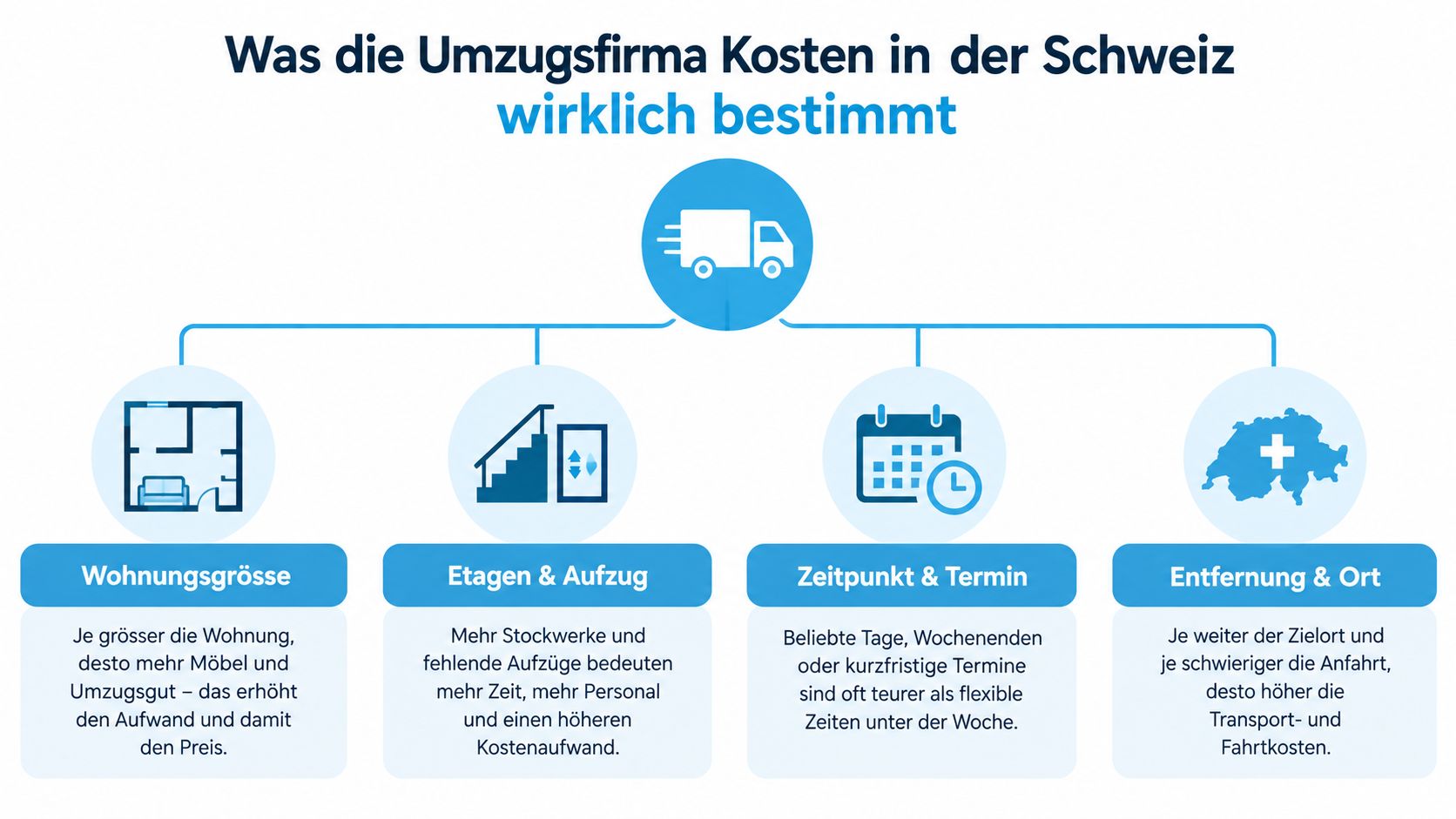
A couple moves within the same Swiss city. Both apartments have 3.5 rooms and a similar amount of furniture. At the old location, the delivery truck stops right in front of the entrance, a lift is ready and the furniture has already been dismantled. At the new location, access is through a narrow stairwell, a place to stop has to be organized and a large cupboard will only be dismantled on site. A price comparison based solely on the number of rooms would hardly be meaningful here.
Access beats the number of rooms
Floors and lift availabilitychange the workload directly. Without a lift, helpers have to move every piece of furniture up stairs, while an existing goods or furniture lift shortens the carrying distances. Especially with heavy sofas, cupboards and washing machines, it's not just the distance that counts, but every additional movement between the apartment, stairwell and vehicle.
TheParking lotalso belongs in the calculation. If the truck is parked directly in front of the house, employees can load more efficiently. If the vehicle has to be further away, the walking distance is longer. A necessary no-parking zone or a municipal permit can trigger additional costs. This position should be clearly stated in the offer instead of only appearing on the final invoice.
Practical rule:Describe the access as if a stranger had to plan the route without asking. Floor, elevator size, entrance, stairwell, parking space and sidewalk are included in the request.
Distance, travel time and location
The distance between the addresses influences not only the kilometers, but also theTravel time and scheduling. When moving within the city, traffic, narrow access routes and a lack of parking spaces can prolong the deployment. When changing cantons, however, the route itself becomes the dominant factor.
The location also has an impact on the price level. A market overview states that the average moving costs for a 3.5-room apartment are CHF 1,580 in 2023. People moving from German-speaking Switzerland paid up to23% moreas people from French-speaking Switzerland, which makes the regional differences visible (Schweizer Umzugsstudie zu Preisen und Regionen).
Date and scope of services
At the end of the month and during periods of high demand Availability may be more limited during moving times. If you remain flexible with the date, it makes deployment planning easier and often gives you more choice when it comes to providers. You should explicitly compare whether this advantage is actually reflected in the offer.
The frequently underestimated positions includeCHF 280 to CHF 650. In Switzerland, SPLIT is often used for furniture transport. The main cost driver is the logistics complexity, not the piece of furniture alone (Average moving costs by apartment size and region).Kosten für Möbeltransporte in der SchweizDismantling, reconstruction, packaging, disposal and delivery of individual furniture
Durchschnittliche Umzugskosten nach Wohnungsgrösse und Region
The number of rooms remains a useful starting point, but it only provides a rough guide. A 2026 price index based on more than2,800 completed placement ordersshows a national median ofCHF 1,450. Zurich, Geneva and Zug are among them15 to 22% above the national average(Schweizer Preisindex für Umzüge 2026).
The following table combines the available guideline values with the practical offer check. The values are not a binding offer. They show whether an offer is generally within a plausible range.
| Apartment | Low price | Median | High price | Regional surcharge |
|---|---|---|---|---|
| 1 room | CHF 300 | CHF 500 | CHF 700 | Higher in expensive cities |
| 3.5 rooms | CHF 800 | CHF 1'450 | CHF 1'900 | Zurich, Geneva and train 15 to 22% above the national average |
| 5+ rooms or house | CHF 1,800 | Not reported uniformly | CHF 4,000+ | Location, volume and access are crucial |
For a1-room apartmentSimple conditions can limit the effort. Little furniture, short distances and good access points to a lean organization. However, a single large cupboard or a difficult staircase can make the supposedly small move disproportionately complex.
With a3.5-room apartmentthe mentioned range is fromCHF 800 to CHF 1,900. The median of CHF 1,450 from the price index is therefore a better test value than a single online average. If an offer is significantly higher, it should specifically state additional working hours, long travel times, missing lift or assembly services.
For aLarger home or a housethe guideline values range fromCHF 1,800 to CHF 4,000 and more. The higher end does not automatically arise from the number of rooms. Cellars, screeds, garden furniture, long distances to the vehicle and extensive assembly work increase the volume and the duration of use.
Read regional differences correctly
Another Swiss study describes an increase in the costs for a 3.5-room apartment fromCHF 890 in 2020 to CHF 1,150 in 2026, corresponding to29%. Geneva is named there as the most expensive region withCHF 1,380and Aargau withCHF 890as the cheapest region. At the same time,87 %the customers pay exactly the agreed fixed price (Studie zu Schweizer Umzugskosten 2026).
These values come from different market overviews and therefore cannot be directly equated. What counts in practice is the source, scope of services and billing model. A good offer not only explains the amount, but also what conditions were accepted for it.
Fixed price or hourly rate, which tariff is worth it
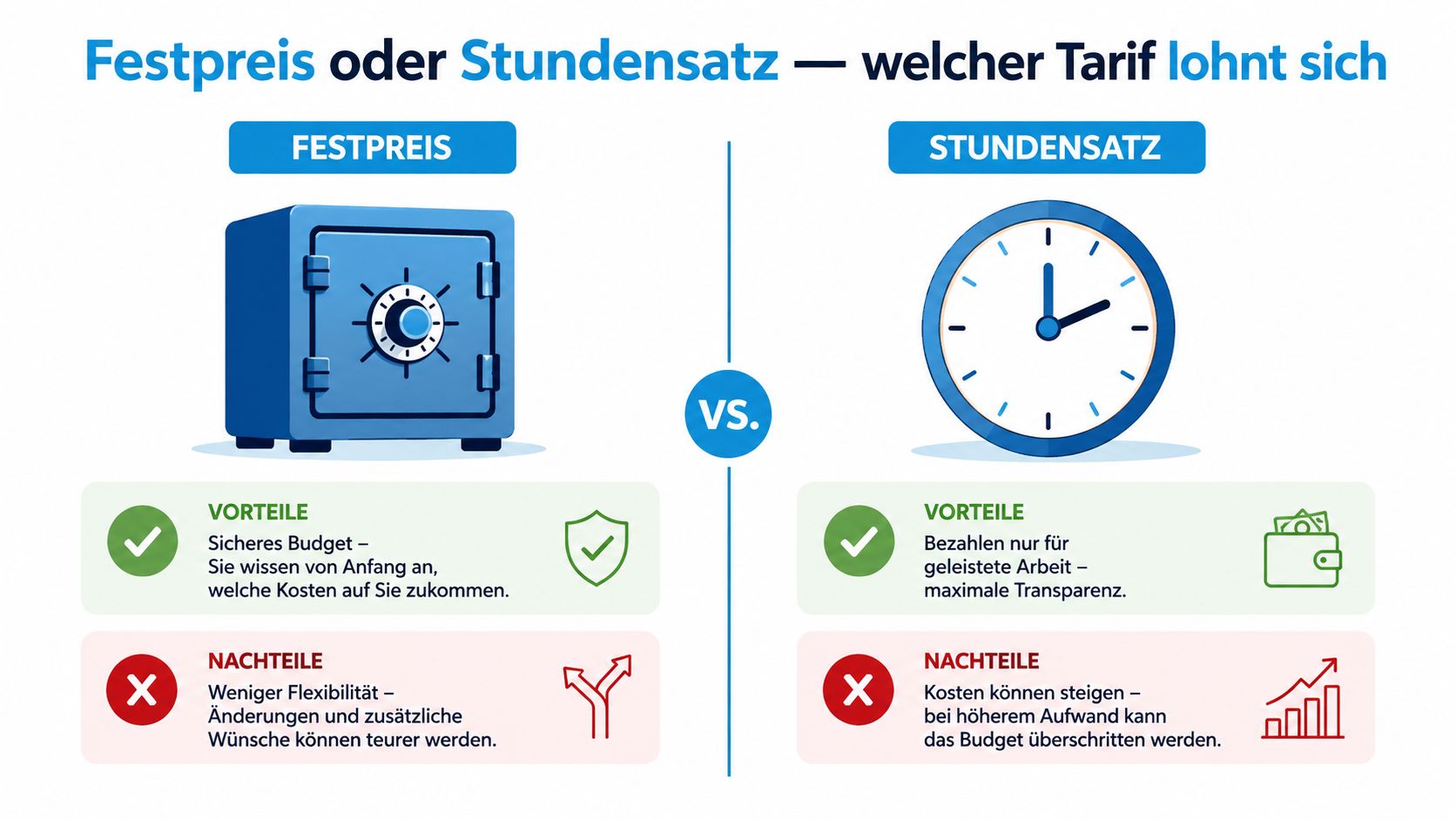
The choice between fixed price and hourly rate depends on theRisk of time deviations. An hourly rate fits a small, well-prepared move with short distances and uncomplicated access. A fixed price is more likely to protect against long distances, several difficult access points or many unclear work steps.
For a moving company, the hourly rates in Switzerland are typically aroundCHF 120 to CHF 280. Two helpers with delivery vans are given with approximately CHF 120 to CHF 150, three helpers with CHF 160 to CHF 200 and four helpers with trucks with CHF 220 to CHF 280 per hour (Stundensätze für Schweizer Umzugsfirmen).
When the hourly rate makes sense
An hourly model works well if you can largely control the process:
- Short route:Little travel time limits the variable portion.
- Good access:A parking space in front of both houses reduces walking distances.
- Prepared furniture:Dismantled furniture and packed boxes shorten the distance Duration of use.
- Clear quantity:The provider can realistically plan team size and vehicle.
The advantage lies in the flexibility. If the move is completed sooner than expected, you only pay for the time worked. The disadvantage: Any delay due to a lack of parking space, rework or unforeseen furniture increases the bill.
A neutral Swiss price overview typically statesCHF 120 to CHF 180 per hour for a team with two helpers and a transporter. For individual helpers,CHF 40 to CHF 60 per hourare often charged, a helper with a van costs correspondingly more (Übersicht zu Stundensätzen beim Schweizer Umzug).
When the fixed price provides better protection
A fixed price is the better choice if the duration is difficult is predictable. These include apartments without an elevator, addresses that are far apart, narrow old buildings, extensive dismantling or a move with many special items. It is crucial that all information is fully incorporated into the offer.
| Criteria | Fixed price | Hourly rate |
|---|---|---|
| Budget planning | Amount is fixed with a clearly defined scope | Final amount depends on the duration from |
| Flexibility | Changes can trigger additions | Additional work can be added directly |
| Risk | Provider bears the time risk within the agreed scope | Customer bears the delay risk |
| Suitable for | Long, complex or difficult-to-plan moves | Short, prepared moves with easy access |
In general, professional private moves often useCHF 800 to CHF 5,000and more in complex situations. For a small apartment, the hourly wage model is calledCHF 300 to CHF 600and as a fixed priceCHF 400 to CHF 700. For a house or apartment with five or more rooms, the guideline values range fromCHF 1,800 to CHF 3,500+in the hourly model or fromCHF 2,200 to CHF 4,000+as a fixed price (Schweizer Richtwerte für Umzugspreise).
If you want to compare offers online, you can use theKosten pro Stunde einer Umzugsfirmaas additional guidance in addition to individual offers.
How to calculate your move correct
A reliable calculation does not start with the question of the cheapest provider. It begins with a description of the order that is as complete as possible. The fewer open variables the company has to estimate, the smaller the risk of later additions.
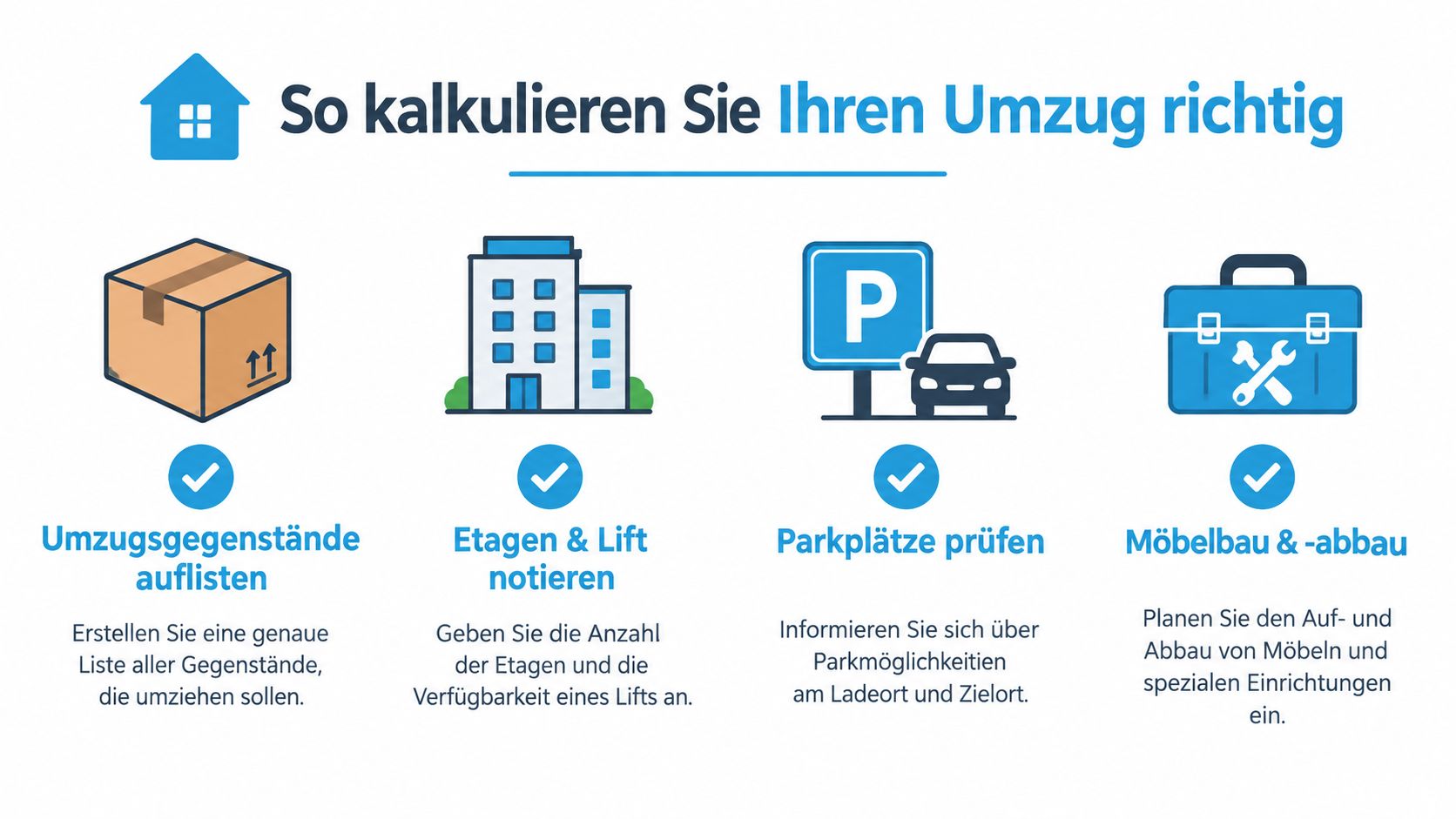
Four pieces of information determine the quality of the offer
Create inventory:List large furniture, delicate items, quantities of boxes and equipment. A single cabinet may require more planning than several small boxes if it is difficult to access or cannot be disassembled.
Document access:Note floor, lift mass, stairwell, entrance and distance from vehicle to door. Photos or a short video help the provider to identify bottlenecks in advance.
Clarify parking:Check where the delivery van can be at both addresses. Ask whether a no-parking zone or other permit is necessary and whether this is included in the offer.
Determine assembly:Write down which furniture should be dismantled and reassembled. For kitchens, cupboards or complex furnishing systems, it must be clear whether assembly is even offered.
Check offers side by side
Get at least three offers and don't just compare the final total. An offer with a lower hourly rate can end up being more expensive due to a longer minimum duration, additional travel or assembly not included. With a fixed price, however, the scope of services must be precise in writing.
| Test question | Why does it count |
|---|---|
| Is the journey included? | The vehicle distance can be charged independently of the load. |
| What team size is planned? | More helpers can shorten the duration, but increase it the hourly rate. |
| Are dismantling and assembly included? | Assembly work changes the effort significantly. |
| How are waiting times calculated? | A lack of parking spaces or delayed access can extend the operating time. |
| Are there surcharges for appointments or access? | Regional and operational conditions must be transparent remain. |
Swiss guidelines for a single furniture transport areCHF 280 to CHF 650. In addition, there is often aTravel allowancethat covers the vehicle's route and is charged regardless of the load (Richtwerte für Möbeltransport und Anfahrt). If you only have one piece of furniture transported, you should always ask for the total price including travel. AUmzugskosten-Rechner für die Schweiz.
Saving tips that really work for Swiss moves
The biggest savings occur where you shorten the operational effort can be helpful for your own counter-invoice. Less walking distance, less waiting time and a smaller transport volume usually have a stronger effect than small negotiations about the hourly rate.
The appointment is a real cost lever
Remain flexible on the moving day if your situation allows it. Dates at the end of the month and during high-demand periods may be more difficult to obtain, while less-demanded dates make selection easier. Ask the provider explicitly whether an alternative date allows for a different price.
A flexible time window also helps. If the team is not tied to an exact arrival minute, dispatching can be done more efficiently. However, let us confirm whether this will result in a fixed price or an open hourly expenditure.
Use your own contribution in a targeted manner
Packing yourself is particularly worthwhile for books, clothing and sturdy household items. Label the boxes by room and arrange them so that helpers can load without having to sort them. However, you should not move heavy or delicate furniture alone if this will cause damage or require additional help.
Reduce the transport volume before making an offer. Sell, give away, or discard things that won't be needed in the new location. For a small load, a single transport can make more sense than booking a full moving team.
A cheap moving day is of little use if boxes are left out of order and the truck has to wait due to a lack of parking.
Compare consolidated transports
When purchasing furniture or individual items, a bundled route can be an alternative to a separate vehicle. Platforms like TIXPI coordinate moves, furniture transport, deliveries and optional assembly. By combining transports, travel distances and CO2 emissions can be reduced, provided a suitable route is available.
Always compare the full scope of services. Doing it yourself can reduce the price, but requires time, suitable materials and physical resilience. Professional packing costs more, but takes a clearly defined step away from you.
Damage, liability and insurance, your protection when moving
A low price is not sufficient protection if the terms of liability remain unclear. Before signing, you should therefore check which damages the moving company will cover, which exclusions apply and which insurance applies to your specific situation.
According to Swiss transport law according toOR Art. 440 ff.the carrier's liability for damaged goods is limited toCHF 8.33 per kilogram. For a valuable, light item, this amount can be significantly lower than the actual replacement value (Schweizer Hinweise zu Haftung und Versicherung beim Umzug).

Clarify in writing before moving
Ask for the insurance conditions and read the regulations for particularly sensitive items. Clarify whether the company treats packaging, disassembly and assembly as separate services with their own liability rules. YourHousehold insurancecan cover transport damage in many cases, but not automatically.
The tenant's liability insurance can also be relevant depending on the type of damage. Don't rely on a general promise over the phone. Get confirmation as to which policy applies, which deductibles apply and whether additional transport insurance makes sense. An overview of possibleKosten einer Transportversicherungmakes comparison easier.
Document damage immediately
Check furniture and boxes after delivery. Take photos of damaged packaging, note the condition and report the damagein writing within 24 hours. The deadline is short, so you should have the contact details and the procedure ready before the move.
Keep the offer, inventory list, handover protocol and photos. These documents help to clearly document the process and the condition of the items.
TIXPI calculates removals and furniture transport online with an immediate, transparent price and organizes the order from planning to delivery, including assembly if desired. Check your specific situation and visitTIXPI to start the right transport for your Swiss move.