
You're standing under a new ceiling light, the old lamp is already in the box, and the fuse box doesn't clearly label which switch belongs to the living room. There is also the question that is particularly important in Swiss rental apartments:Can I install the lamp myself, or do I already change the electrical installation?
When it comes to the topicAssembling a lamp in SwitzerlandIt is not just the technical difficulty that decides. The decisive factor is whether you only use an existing connection or change fixed cables, switches, sockets and connections. Anyone who knows this limit, checks the tension reliably and takes the load-bearing capacity of the ceiling seriously can safely assess a simple lamp. If you are unsure, a specialist is not an exaggeration, but rather the sensible abbreviation.
Legal basis for lamp assembly in Switzerland
Swiss low-voltage law distinguishes theReplacing a lighting fixturefrom work on the fixed electrical installation. Laypersons are generally allowed to assemble and disassemble lighting fixtures in home-occupied living spaces and the associated adjoining rooms. The prerequisite is that the work is carried out without voltage and is limited to a single-phase circuit with a maximum of 230 volts, asHausinfo zur sicheren Elektrizitätexplains.
The usual change is permitted: an existing ceiling light is removed and a new one is attached to the existing connection. You layno new line, do not move the connection and do not install a switch. However, laying cables, changing a flush-mounted box, reinstalling a socket or creating a permanent connection counts as electrical work. This requires an installation permit or a correspondingly authorized specialist, asder Schweizer Do-it-yourself-Ratgeber zur Lampenmontagenotes.
Where the legal limit lies in everyday life
The fixed electrical installation is building technology. Changes to it must be checked, protected and carried out in accordance with standards. The regulatory development in Switzerland goes back to the Federal Act on Low- and High-Current Electrical Systems from24. June 1902. The Low Voltage Installation Ordinance, or NIV for short, was passed on 7. November 2001and came into force on1. January 2002. The historical overview of the Federal Office of Energy names the low-voltage installation standards that are relevant todayNIN 2020, which came into force on1. January 2020 in Kraft traten.
Tenant law also applies to tenants. The electrical connection can remain unchanged, while drilling, a heavy suspension or visible changes when pulling out still become an issue. Check the rental agreement and obtain written consent from the management for major interventions. AÜbersicht zur Kündigung des Mietvertrags in der Schweizdeals with formal questions relating to the tenancy agreement.
Practical rule:An existing connection does not allow any work on the ceiling. Changing a lamp may be permissible, but a newly laid cable to the desired location is not.
Preparation and safety measures before installation
The installation does not begin with the screwdriver, but with the decision whether you should do the work yourself. An unknown fuse box, an old installation without a recognizable protective conductor, a multi-phase connection or a heavy lamp are reasons to hand in the work early. Even a seemingly simple lamp becomes dangerous if the wires cannot be clearly assigned.
Choose the tool with sense
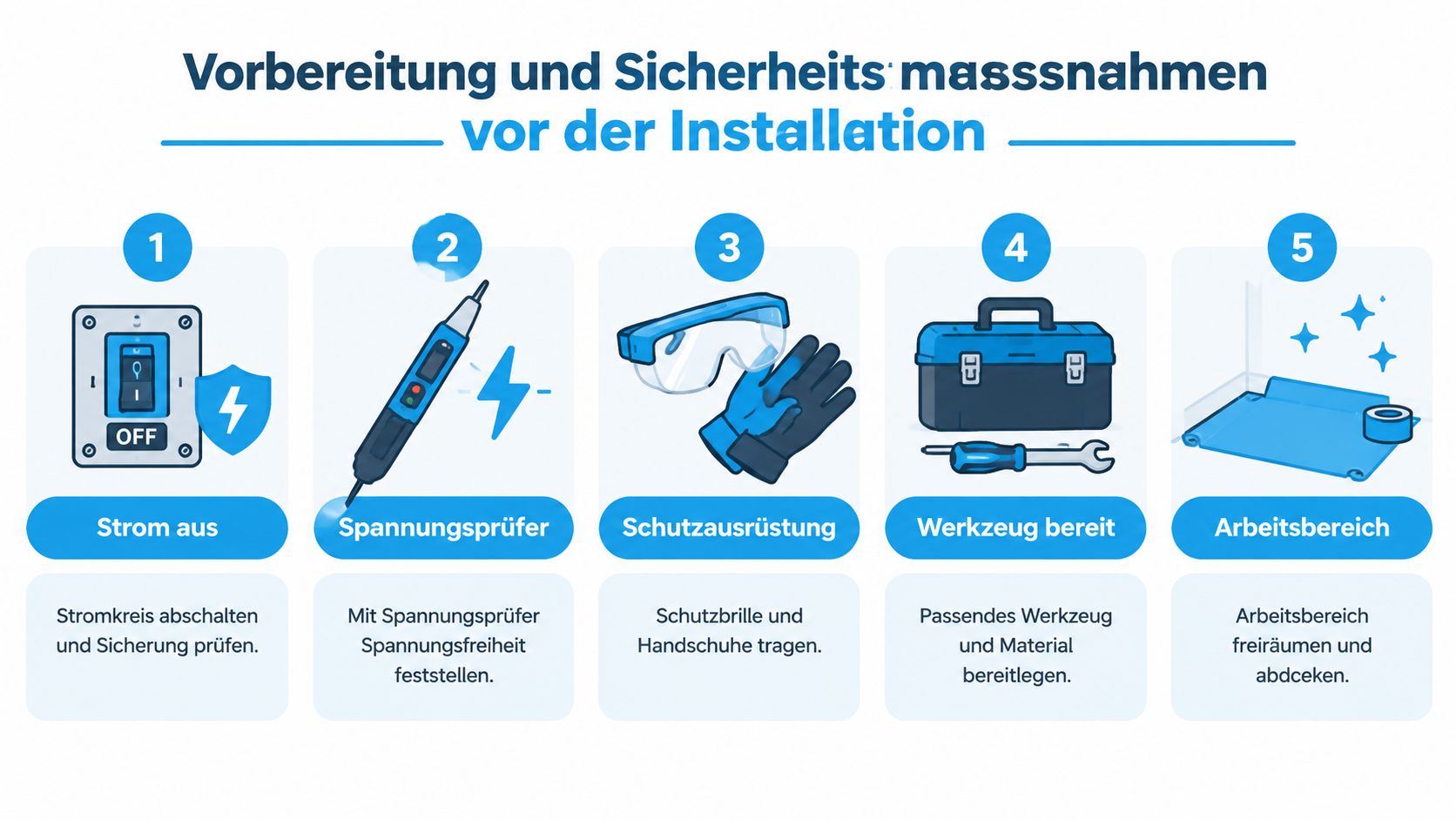
Completely prepare the equipment before turning off the power. Depending on the lamp, you will need a stable ladder, a two-pole voltage tester, insulated screwdrivers, wire strippers, suitable clamps, screws and dowels that fit the ceiling. A drill with a suitable drill bit only makes sense if you know the type of ceiling. Concrete, plasterboard, hollow ceilings and wood require different fastenings.
Safety glasses protect against drilling dust and chipping material. Insulated tools reduce the risk of accidental contact, but are not a substitute for voltage testing. A simple phase tester can help with orientation, but is not considered sufficient proof that there is no voltage. To do this, use atwo-pole voltage tester, which tests both conductors.
Switch off and check safely
Switch off the circuit breaker of the relevant circuit. The light switch on the wall is not enough because, depending on the circuit, it does not disconnect all active conductors. Also, do not rely on the labeling in the fuse box. Turn on the light on the wall switch to observe an initial reaction and then use the two-pole device to check each relevant wire.
Do not touch any wire until the absence of voltage has been determined. If the tester shows voltage, provides unclear values or you cannot interpret his display with certainty, the cover remains installed and a specialist takes over. This caution is particularly important because Swiss safety instructions for lamp assembly emphasize the use of appropriate testing equipment and insulated tools.
Step-by-step instructions for connecting lamps
Do not remove the old lamp until the circuit has been switched off and the absence of voltage has been checked. Photograph the existing arrangement for guidance only, not as a replacement for testing. In old buildings, colors, clamps and previous modifications may differ from a modern installation.
Plan the fastening carefully first
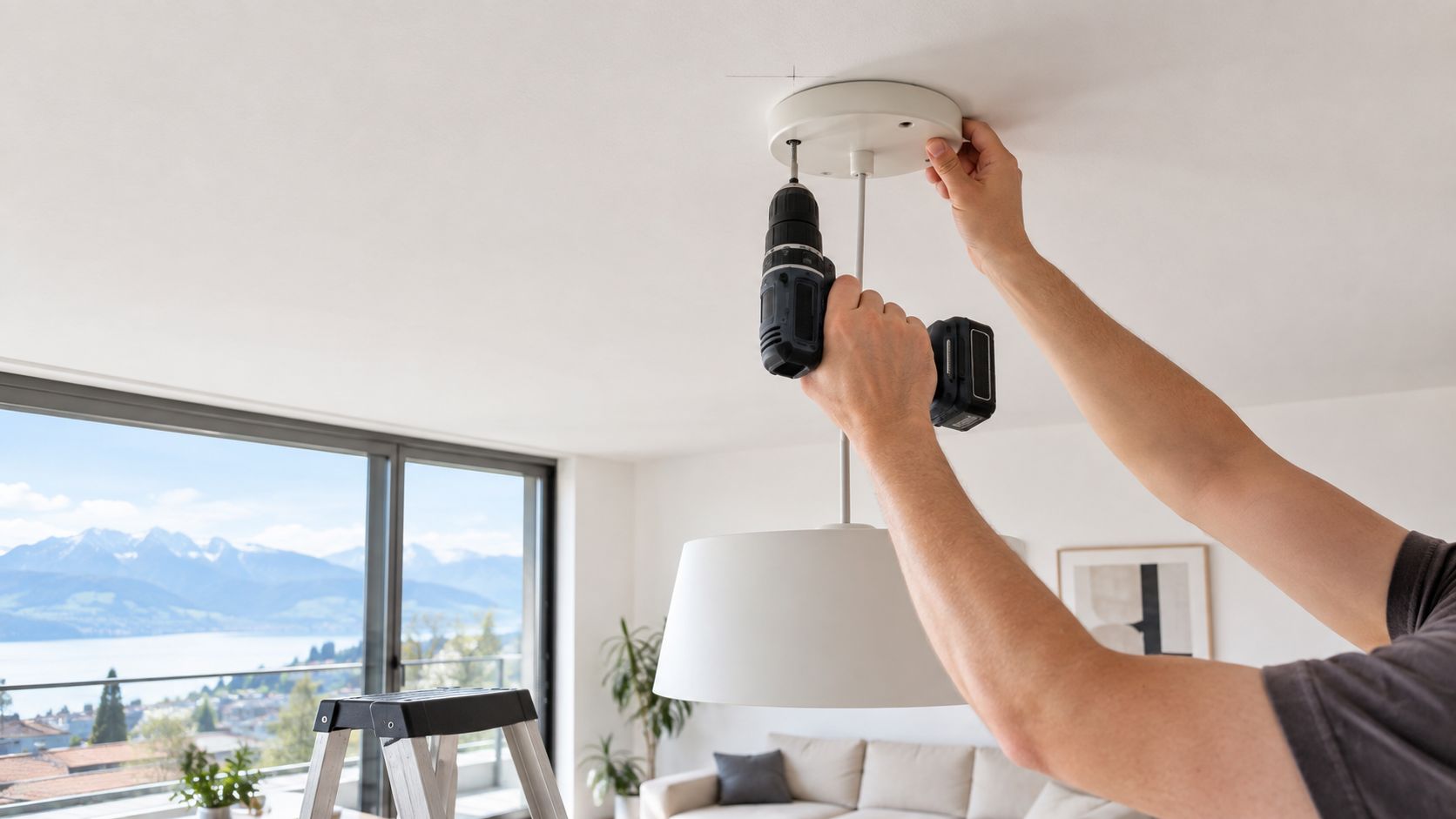
Hold the mounting plate in the desired location and mark the drilling points. Check whether there could be cables or other installations running there. Don't blindly drill into a ceiling just because the new light fixture looks good in that position. For concrete, you need a suitable stone or concrete drill and suitable dowels. In the case of plasterboard or a cavity, the fasteners must match the construction.
The suspension must permanently support the weight of the luminaire. This is especially true for pendant lights, multi-arm lights and chandeliers. A loose cover can be noticed later, but a fastening that is torn out of the ceiling comes suddenly and causes damage.
Assigning the wires correctly
In a normal installation it saysyellow-green for the protective conductor,blue for the neutral conductorandbrown, black or red for the phase. Do not connect wires based on color alone if the existing installation appears old or changed. The functional assignment must be correct and the protective conductor must not be mixed up with the neutral conductor. A clear explanation of theKabelfarben in der Schweizhelps with orientation, but is not a replacement for measurements in unclear lines.
Insert the wires completely into the terminals provided. There should be no bare copper points protruding from the connection. Tighten the terminals in a controlled manner without damaging the conductors. The lamp itself must not hang on the connection cable, but must be carried on the ceiling using the bracket provided.
Only connect the cover and lamp once the mechanical fastening is in place. You can then switch the circuit on again and check the function. If the light flickers, the circuit breaker trips or smells something burnt, switch it off again immediately and have the cause clarified.
Typical errors and how to avoid them during installation
The most common dangerous mistake is: If the light is turned off at the switch, the line is safe. That's not reliably true. A light switch may disconnect the wrong wire, the labeling in the fuse box may be incorrect, and if changed earlier the wiring may appear different than expected.
Detect electrical faults early
Test each wire with a suitable two-pole voltage tester. Do not confuse neutral and protective conductors, even if the light appears to be working. A working lamp does not prove that the protection is working correctly. In an older building the protective conductor may be missing. Then only suitable, insulated luminaires come into question, and a professional assessment is often the better decision.
Another reason for exclusion is a circuit without the required residual current protection. Swiss guides mention an FI or RCD with a maximum of SPLIT for corresponding single-phase lamp and socket circuits, as described by SPLIT. If this protection is missing or its function is unknown, laypeople should not undertake the connection work.Don't rely on the switch:30 mA nominal tripping currentdie Informationen des Beratungszentrums für BrandverhütungThe switch controls the light. It does not confirm that there is no longer any dangerous voltage on the ceiling.
For a light lamp, suitable screws and dowels may be sufficient. A heavy designer lamp, on the other hand, needs a fastening that suits the surface and the load. Cavity dowels or spring hinged dowels may be required in plasterboard if the construction is suitable for them. In the case of concrete, the dowel and drill hole must match; in the case of a suspended ceiling, the load may have to be transferred to the supporting structure.The ceiling supports the lamp, not the good will
After installation, check whether the bracket tilts, moves or the ceiling breaks out. With a chandelier, the question is not whether the light will last at the moment, but whether the suspension will remain permanent and secure. It is precisely for heavy lights that Swiss installation instructions recommend calling in a specialist if the load capacity, drilling points or ceiling structure cannot be clearly assessed, as
highlights.
Special features for rental apartments and ownersdie Kosten- und Praxisübersicht zur LampenmontageTwo rules come together for tenants. Electrical law may allow the replacement of a light on the existing connection, while the tenancy agreement requires additional consideration for drilling, visible changes and the condition when moving out. Therefore, the answer to the question “Can I mount this lamp?” not complete as long as the attachment and subsequent restoration remain unclear.
Tenant between connection and dismantling
A light luminaire on the existing ceiling connection is in practice something different from a heavy luminaire that requires several holes in the concrete ceiling. Approval may not be necessary for small, common adjustments. However, as soon as you make significant changes to the ceiling, need a new cable or want to replace a fixed electrical component, ask the administration in writing before starting.
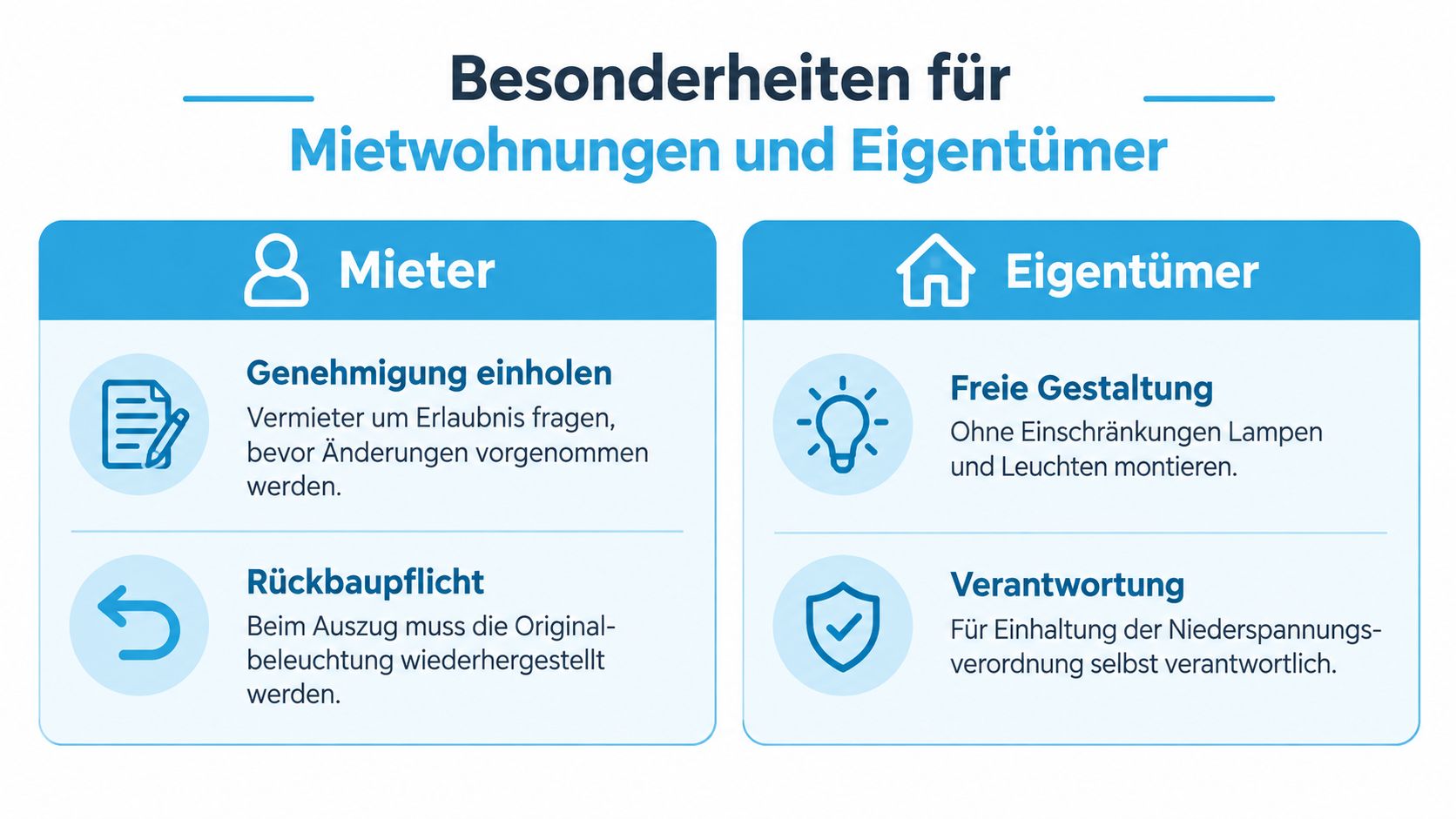
The written consent should describe as precisely as possible which light will be installed, where the drilling will be done and who will carry out the work. This does not protect against all liability, but it does provide clarity. When you move out, you can
Eine leichte Leuchte am bestehenden Deckenanschluss ist in der Praxis etwas anderes als eine schwere Leuchte, für die mehrere Bohrungen in der Betondecke nötig sind. Bei kleinen, üblichen Anpassungen kann eine Genehmigung entbehrlich sein. Sobald Sie jedoch die Decke erheblich verändern, eine neue Leitung benötigen oder eine feste Elektrokomponente austauschen wollen, fragen Sie die Verwaltung vor Beginn schriftlich.
Die schriftliche Zustimmung sollte möglichst genau beschreiben, welche Leuchte montiert wird, wo gebohrt wird und wer die Arbeiten ausführt. Das schützt nicht vor jeder Haftung, schafft aber Klarheit. Beim Auszug kann dieRestoration of the original conditionbe required. Therefore, not only remove the light, but also close the drill holes professionally if this is agreed or necessary.
| Situation | Practical consequence |
|---|---|
| Existing connection, simple light | Layman's exemption from electrical law can apply if the conditions are met are |
| Several holes for a heavy light | Clarify the administration's approval in advance |
| New cable or new switch | Expert and installation permit required |
| Unclear ceiling structure | Don't drill, have it checked first |
Owner with more design, but equal responsibility
Owners do not have to obtain consent from a landlord. You can therefore plan the lighting more freely, but remain responsible for the safety and conformity of the fixed installation. TheNIN 2020forms the current standard basis for low-voltage installations in Switzerland, as the aforementioned documentation on the development of Swiss electrical engineering classifies.
Anyone who wants to rent or sell a property later should avoid improvised cables, unclear terminals and undocumented changes. A light can be replaced. However, an improperly modified connection can become a problem in the event of a later inspection, damage or a change of ownership.
When a professional installation service is worthwhile
The DIY variant is suitable for a light luminaire, a clearly existing connection and a ceiling whose load-bearing capacity you can confidently assess. If the old building wiring is unclear, missing or unknown FI protection, a heavy light or new cables and switches, the area that laypeople should take care of ends. Doing it yourself doesn't necessarily save money. Incorrect wiring, a damaged cable or an unstable suspension can cause significantly more effort.
Simple lamp assembly is typically calledCHF 80 to 170 per piecein Switzerland. Depending on the effort, common total ranges range fromCHF 180 to 390, as theKostenübersicht für das Lampenmontierenshows. Compare these amounts with tools, clarification, purchasing, drilling, assembly and final testing. If there are several lights or a move, a coordinated order bundles these work steps.
What a service practically eliminates
An assembly service relieves the burden if there are other tasks in addition to hanging. This includes transporting a lamp or a piece of furniture, assembling it on site and coordinating several work steps.TIXPI bietet einen Möbelmontage-Servicean, who can also organize assembly for furniture deliveries upon request.
The legal limit remains clear: a service can take over the mechanical fastening and organization. Interventions in the permanent electrical installation, such as new cables, switches or changes to the connection, are the responsibility of an authorized electrician. When booking, make it clear whether you only want to attach a light to the existing connection or whether you want to carry out electrical work that requires a permit.

In a rented apartment, you should briefly coordinate drilling with the administration in writing. If the electrical installation is unclear, stop troubleshooting and have the connection checked. This means that the lamp remains securely attached, the connection complies with standards and the risk of unexpected dismantling or liability issues when moving out is low.
TIXPI organizes transport and assembly on site if a lamp or piece of furniture is to be delivered and assembled as part of a move. Check the services available if you do not want to install your lamp yourself.