Yes, of course you can use aHang a picture without drilling. There are now really good solutions for this, such as special adhesive nails, picture hooks or Velcro systems. This means everything sits securely on the wall without causing any permanent damage. Perfect for rental apartments and anyone who likes to redesign their walls.
Why drill-free solutions are ideal for Swiss rental apartments
The furniture is in place, the boxes are unpacked - but the walls? Bare and impersonal. But before you reach for the drill, it's better to pause for a moment. Especially in Switzerland, where rental contracts often contain very precise clauses regarding the maintenance of the apartment, drill-free alternatives are much more than just an emergency solution. They are a really smart decision.
The desire to avoid drilling holes is deeply rooted in the Swiss rental culture. There are at least around68% of the tenants, and the topic of “hanging pictures without drilling” has gained enormous importance in recent years. In fact, cities like Zurich, Geneva and Basel are now consciously using drill-free methods to avoid hassles when handing over the apartment and deductions from the deposit.Protecting the deposit and avoiding disputes60% of the population are tenants
Every single drilling hole means potential effort when moving out. Take out the dowels, fill the holes professionally and often enough the whole wall has to be repainted. If this is not done perfectly, the landlord can quickly withhold part of the deposit for the repairs.
Drill-free methods take this risk away from you right from the start. They provide a clean solution that keeps your walls spotless and makes handing over your apartment much more relaxed. In our guide
we explain exactly what pitfalls can lurk in the delivery protocol.https://tixpi.ch/de/wohnungsubergabe-2-0-die-tucken-des-abgabeprotokolls-und-wie-sie-sich-schutzen/Maximum flexibility for your wall design
Does your taste change or do you like to decorate seasonally? With drill holes you commit to one position and any redesign becomes laborious. Drill-free systems, on the other hand, give you the freedom to be creative and just try something out.
The real strength of drill-free solutions lies in their flexibility. They allow you to dynamically design your living spaces and rearrange works of art or family photos at any time without leaving any lasting traces.
No matter whether you are planning an entire gallery wall or just want to hang a single large picture - the modern alternatives adapt to your ideas, not the other way around. In this way, you not only preserve the value of your walls, but also your creative freedom.
The best methods without drilling in direct comparison
Anyone who thinks that hanging pictures without a drill is complicated is seriously mistaken. The world of drill-free fastenings is surprisingly diverse, but clearly, not every solution suits every picture or every wall. To make the right choice, you need to know the options. We look at the most common techniques and help you find the perfect method for your home.
The decision actually only depends on three things: the
whoConsistency of your walland howflexibleyou want to stick with the design. A light canvas on smooth plaster has completely different requirements than a heavy mirror on a woodchip wallpaper.H3: Gluing instead of drilling: Perfect for light to medium weightsWeight of your picture
Adhesive strips and adhesive nails are probably the best-known helpers when it says:
Klebestreifen und Klebenägel sind wohl die bekanntesten Helferlein, wenn es heisst:Hanging a picture without drilling. They are simply ideal for quick and uncomplicated projects. These products usually consist of a hook or a small plate that has a super strong, but removable adhesive surface on the back.
Their greatest strength lies in their simplicity and low cost. They work great for most standard wall types in Swiss homes – such as painted plaster or even smooth wallpaper. But be careful with structured surfaces such as woodchip: Here you have to resort to special variants, as the standard strips do not find enough contact surface and do not hold properly.
H3: Velcro systems and magnets for maximum flexibility
Are you one of those people who like to redesign their decoration more often? Then Velcro systems are a really smart choice. The principle is simple: a strip of Velcro goes on the wall, the counterpart on the picture frame. This means you can swap pictures, realign them or hang them out for a moment at any time without having to remove the base on the wall.
An even more creative alternative are magnetic paints or self-adhesive magnetic strips. After the wall is painted with the special paint, small magnets stick directly to the surface. This is perfect for light, unframed photos and posters in the study or children's room and ensures a playful look.
H3: Gallery rails for professional demands
For real art lovers or anyone who wants to create an entire picture wall, gallery rails are the highest quality and most flexible solution. Here a rail is mounted directly under the ceiling - usually with just a few drill holes. From this moment on you enjoy absolute freedom. Pictures are hung on almost invisible Perlon or steel cables and can be moved horizontally and vertically as desired.
Although the initial setup of the rail requires a small intervention, in the long run it saves you countless individual drilling holes and offers a flexibility that no other method even comes close to.
Comparison of drill-free hanging methods
To make your decision easier, we have summarized the most important features of the The most common methods are summarized for you in a clear table. This way you can see at a glance which solution is the right one for your project.
| Method | Max. Load capacity (approx.) | Suitable surfaces | Advantages | Disadvantages |
|---|---|---|---|---|
| Adhesive strips/nails | 0.5 - 8 kg | Smooth walls, wallpaper, partly woodchip (special products) | Simple, inexpensive, Can be removed without leaving any residue | Limited load capacity, not for all surfaces |
| Velcro systems | 1 – 7 kg | Smooth walls, painted plaster, wood | Very flexible, pictures can be easily exchanged | Slightly more expensive than simple ones Adhesive strips |
| Gallery rails | 15 – 50 kg+ | All wall types | Extremely flexible, professional look, high load capacity | Requires one-time assembly with drilling, higher Costs |
| Lean/set up | Unlimited | Floor, shelves, sideboards | Absolutely no damage to walls, casual look | Requires floor space, pictures can tip over |
As you can see, there is a suitable drill-free method for almost every requirement. Simply weigh up what is most important to you: load capacity, flexibility or price.
How adhesive solutions really work in practice
Adhesive strips etc. are often the first choice if you want to put a picture on the wall quickly and without a drill. To ensure that the whole thing is really bombproof and the wall stays intact, it is important to use it correctly. From preparation to later removal - with just a few simple steps it's guaranteed to work.
The absolutely crucial step happens before you even pick up the adhesive strip: preparing the wall. A clean, dry and grease-free surface is essential for strong adhesion. Take a clean cloth and a little rubbing alcohol to thoroughly clean the area.
Be sure to stay away from bathroom or household cleaners. They often contain silicones or caring substances that leave an invisible film and massively weaken the adhesive strength.
The correct application for maximum hold
After the wall is clean, mark the exact position for your picture with a light pencil line. Now press the adhesive strip or adhesive nail onto the wall according to the manufacturer's instructions - usually for at least30 secondsand nice and firm and even. This pressure activates the adhesive and creates a full-surface connection.
An often underestimated point is the curing time. It's tempting to hang the picture right away, but give the glue time to develop its full strength. Depending on the product, this can take between one and 24 hours. This patience pays off because it makes the attachment much safer and more durable.
Little pro tip:The specified maximum load capacity only applies under ideal conditions. For rough surfaces such as woodchip or in damp rooms such as the bathroom, you should always choose a product that is explicitly suitable for this purpose. Play it safe and choose one that can hold a little more weight than your picture actually weighs.
This decision tree will help you quickly find the right method for the weight of your picture.
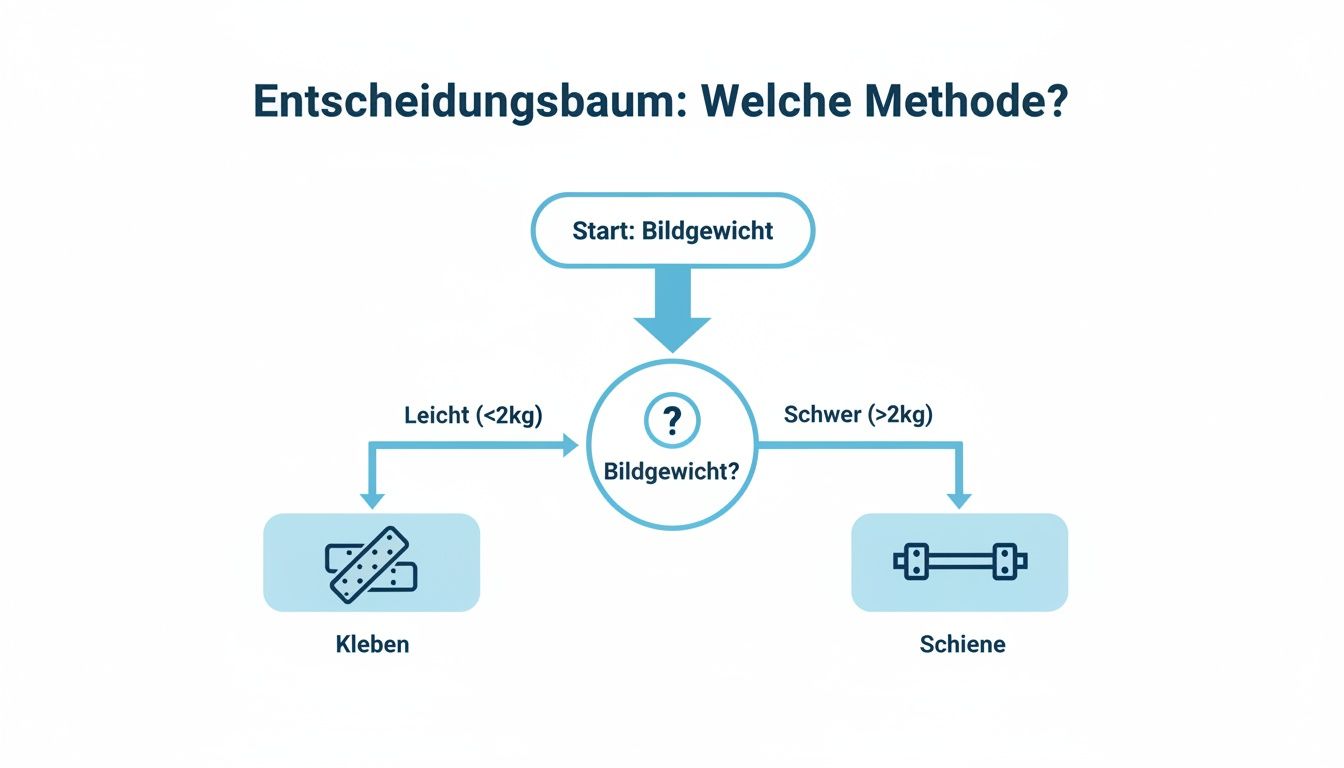
As the graphic shows, adhesive solutions for lighter objects up to about2 kgare ideal. For heavy pictures, rail systems are a much safer alternative.
Remove without leaving a trace and protect walls
Adhesive systems are so popular in Switzerland because they can usually be removed without leaving any residue. This is a huge advantage, especially when moving. Studies on the Swiss furniture market show that 62% of customersprefers drill-free solutions. Especially in the canton of Zurich,47% of householdsrelies on adhesive systems that hold up to7.2 kgand can be removed again. Tests have shown thateinige Produkte über 95% der Anwendungen ein ganzes Jahr lang hielten.
To remove the adhesive, pull the tab down very slowly and parallel to the wall. Under no circumstances should you tear the hook directly away from the wall - this could damage the wallpaper or plaster. You can find further tips on how you canGegenstände, Böden und Wände richtig schützenin our guide.
Use gallery rails for maximum flexibility
If you have an entire gallery wall in mind or would like to rearrange your art collection, gallery rails are the most professional and by far the most flexible solution. What is often familiar from museums has long since become established in private living spaces. It's the unbeatable way to hang pictures without ever having to use a drill again.
Sure, installing the rail itself requires a few drill holes once. But this small effort pays off a thousandfold in the long run. Once the rail is hanging, your walls will remain untouched forever. Every future image change is then a matter of minutes – completely tool-free and clean.
The real benefit lies in this limitless adaptability. You can rearrange images, hang them higher or lower, swap them or change the spacing at any time. Perfect for dynamic living spaces, growing collections or if you simply like to redecorate seasonally.
Wall or ceiling track - making the right choice
The first decision you need to make is between wall and ceiling tracks. Each variant has its own strengths, which depend on the architecture of your room and your design goals.
- Wall railsare attached directly to the wall, usually just below the ceiling. They are often the more discreet option and integrate almost invisibly into the room. Installation is usually straightforward as long as the wall is stable enough.
- Ceiling railsare, as the name suggests, mounted on the ceiling. They are the ideal solution for rooms with sloping ceilings, stucco ceilings or walls into which you cannot or are not allowed to drill. Another plus point: They even allow pictures to be positioned freely in the room.
For most applications in Swiss apartments, the wall rail is the most common and practical way. It looks discreet and still offers the full flexibility of the system.
And this is how it works in detail
Once the rail is installed, it becomes child's play. The pictures hang on special ropes, which come in two main versions:Perlon ropes(transparent and almost invisible) orSteel ropes(for a cool, industrial look and higher load capacities). These ropes are simply clicked or pushed into the rail at any point.
You can then attach adjustable picture hooks to these ropes. The highlight is that the height of the hooks can be adjusted continuously. You can adjust the position of your pictures with millimeter precision without having to remove the picture from the wall.
Once installed, a gallery rail system allows you to change your wall design spontaneously and without any tools. This is the ultimate form of the “hanging a picture without drilling” principle for the future.
No matter whether you are staging a single large work of art or planning a complex hanging in St. Petersburg - with a gallery rail there are no limits to your creativity.
Creative ideas beyond classic hanging
Not every picture necessarily has to hang on a nail. Quite the opposite: Sometimes the strongest impact comes when you break the rules and choose a completely unconventional placement. This is how you take the principle of “hanging a picture without drilling” to a completely new level.
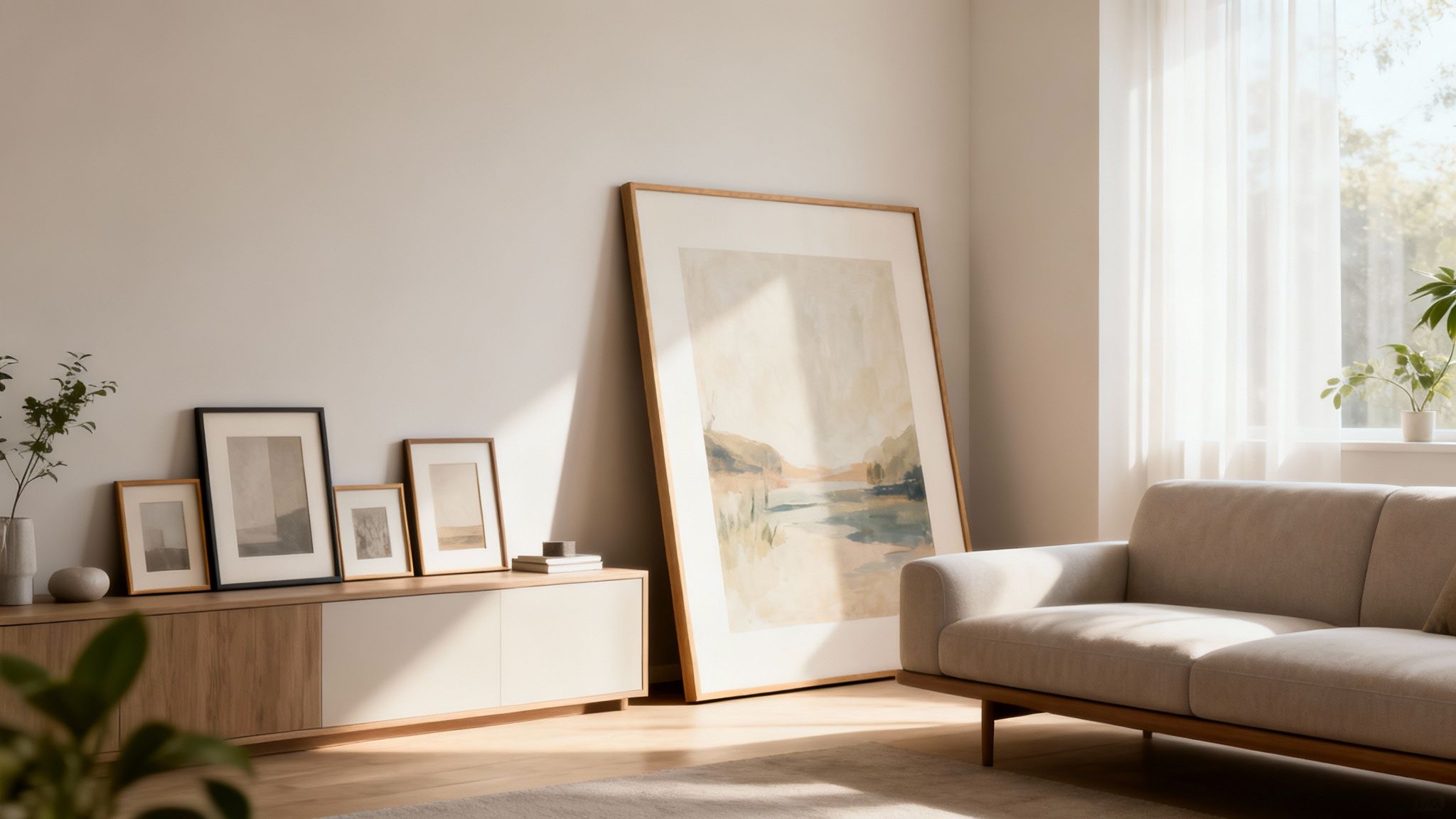
The so-called«Gallery Lean»is a fantastic method for giving a room a casual, curated look. Large, framed works of art are simply placed on the floor and leaned casually against the wall. This looks particularly cool behind a sofa, a sideboard or in an otherwise empty corner and immediately gives the room more depth.
This technique is worth its weight in gold for large-format works of art or heavy mirrors, the weight of which would be too high for most adhesive solutions anyway. The result is a conscious, studio-like charm that appears uncomplicated and incredibly stylish at the same time.
Showcasing pictures on furniture and shelves
Another very charming alternative is to consciously place pictures on existing surfaces. Instead of using the wall, simply make your furniture a stage for the art. For example, think of:
- Fireplace mantels:A real classic. Here you can put together several small frames in different sizes to create a personal, small collage.
- Open bookshelves:Between books and decorative objects, small pictures break up the overall picture and add personal accents.
- Sideboards and chests of drawers:A medium-sized picture leaned against the wall, combined with a vase or a few candles - a stylish ensemble is ready.
This method is not only wonderfully flexible, but also ideal for theEinrichtung für kleine Wohnzimmer, as it cleverly uses existing space without overloading the walls.
Arranging pictures on furniture tells a story. It's less about the perfect hanging and more about the interaction of art, objects and the piece of furniture itself. This is exactly what creates a particularly homely and personal atmosphere.
Minimalist poster bars for a modern touch
Poster bars are a stylish and simple solution for unframed prints, posters or even beautiful fabric panels. These systems usually consist of two wooden or metal strips that hold the poster in place magnetically or by clamping.
The great thing about it: You often only need a single, very light adhesive hook to attach the whole thing to the wall. This is how you give your pictures a minimalist, modern touch - a great alternative to the classic frame that can be exchanged in no time.
If you are looking for further inspiration that goes beyond just hanging, you might find it here, even if the context is different: Discoverinnovative Dekoideen für Ihre Wände.
When you should rely on professional help
Hanging pictures without drilling is one Brilliant thing, but as with almost everything in life, there are limits. Sometimes it is simply wiser and, above all, safer to let a professional take care of it right from the start instead of taking unnecessary risks. Even the strongest adhesive solutions reach their limits at some point, especially when things get difficult or the walls don't cooperate.
Whether you do it yourself or get help actually only depends on two things: the weight of your picture and the condition of your wall. If you're even a little unsure, err on the side of caution. This is even more true when it is a valuable or irreplaceable piece.
Where drill-free methods reach their limits
There are very clear situations in which gluing is simply not an option. Always remember: The load capacity specified by the manufacturer usually only applies to absolutely perfect conditions - i.e. smooth, clean and stable surfaces. The reality is often different.
Here are a few typical cases in which you should call a professional:
- Really heavy things:Large mirrors, heavy works of art in solid wooden frames, or other objects that weigh more than8-10 kg. Such calibers need a secure, mechanical anchoring in the wall. There's no way around it.
- Bitchy walls:Crumbling plaster in old buildings, heavily structured wallpaper or walls where the old paint is already peeling off - none of this is a reliable basis for glue.
- Valuable works of art:With an expensive original or a highly emotional picture You shouldn't dare to experiment. A professional will ensure that it is hung safely and professionally.
- Mounting on the ceiling:Anything that needs to be on the ceiling is a case for the experienced craftsman. This is simply about safety.
A good assembly service, such as the TIXPI crew, takes a close look at the wall on site and then decides which fastening is the right one. This gives you the certainty that even demanding objects will hang perfectly and permanently - without you having to worry about falling pictures or broken walls.
So instead of trying around yourself and perhaps even causing damage in the end, an expert ensures a flawless and safe result. So you can enjoy your beautifully decorated home without any compromises or stomach aches.
Frequently asked questions (FAQ)
After all the tips and tricks, there are often still a few very specific questions left. This is completely normal. Here I have compiled the most common concerns that I come across again and again in practice in order to clear up any remaining uncertainties.
These answers come directly from experience and will help you avoid the typical small mistakes.
Do adhesive solutions also work on rough walls?
This is probably one of the most important questions of all, and the honest answer is: It depends. The normal adhesive strips are made for smooth surfaces, such as smooth plaster or fine wallpaper. But if you have a structured wall like woodchip, you needspecial products.
These stronger versions usually have a more flexible adhesive that can really “claw” into the uneven surface. Therefore, always read carefully what the manufacturer writes on the packaging. The rule of thumb is: the rougher the wall, the lower the maximum load-bearing capacity that the adhesive creates.
A professional tip: Clean the area on the wall thoroughly beforehand. After you have applied the adhesive strip, press it firmly. This gives the glue the best chance to bond optimally to the structure.What is the safest method for a child's room?60 seconds
In a child's room, safety is the top priority, there are no compromises. Heavy pictures that lean loosely against the wall are an absolute no-go here. For light posters or small, self-painted works of art, magnetic paint or a self-adhesive magnetic tape is an ingenious and playful solution.
If you want a framed picture, it's best to use high-quality adhesive nails that have some kind of locking mechanism. Another very safe option is a gallery rail system. This is mounted high up, far out of the reach of curious children's hands.
How do I really remove adhesive hooks without leaving any residue?
Modern adhesive systems such as those from Command™ or tesa® are specially designed to disappear without a trace. The whole trick lies in the right technique. Just never simply rip the hook off the wall! This is the most common mistake and almost always results in paint or wallpaper tearing off.
Instead, most of these adhesive strips have a special tab. Drag this all the way down. This causes the adhesive to stretch, lose its adhesion and separate cleanly from the surface - without any sticky residue or unsightly marks.
Slow and parallel to the wall will take care of this for you – safely, professionally and without stress. Find out more atDo you need help mounting heavy works of art or installing a gallery rail system? The experienced teams at
.TIXPITIXPIhttps://tixpi.ch.