
They are sitting at the kitchen table, the notice of termination of the Swiss apartment has been signed, and the truck is supposed to roll towards Milan in six weeks. At the same time, questions about the municipality, consulate, tax residence, health insurance and rental apartments are still on the table. It is precisely here that it is decided whether the new start begins in an orderly manner or whether the first few months are lost in contradictory information and missing documents.
Emigrating to Italy does not begin on the day of the move. What is crucial is a sequence in which Swiss departure, Italian registration, tax audit and transport logistics fit together. If you plan these points separately, you will quickly overlook dependencies. If you connect them on a timeline, you can see early on which documents, appointments and decisions depend on each other.
Why moving to Italy needs to be well planned
The central question is not just whetherobYou want to move to Italy. It is: Which steps have to happen in which order so that the apartment, authorities, taxes and the moving day fit together?
A common mistake is to organize the Italian apartment and book the transport before the Swiss move is properly prepared. Another is to mistake the registration at the Swiss consulate for an Italian residence registration. Both lead to gaps because two states require different procedures and evidence.
The right approach begins with dependencies
Start with the Italian entry and residence conditions. You then clarify your final move with your Swiss municipality of residence. Only then will the deregistration confirmation and home certificate be available for further steps. At the same time, you check your tax residence, employer model, health insurance and the availability of the new apartment.
The transport only gets its permanent place when the most important key data are in place. This includes the handover of the Swiss apartment, access to the Italian address, possible access restrictions and the date for handing over the keys. A convenient transport date is of little help to you if the apartment in Italy cannot yet be taken over.
Practical rule:Don't plan backwards from the truck. Plan backwards from the handover of the apartment, official deadlines and the actual move-in date.
A good everyday perspective also helps. If you want to know what life can feel like between formalities, a change of apartment and a new environment, you will find personal suggestions atFluesta Einblicke in den Alltag. Such impressions do not replace information from the authorities, but they sharpen the view of the practical questions behind the change of location.
Typical mistakes before moving away
- Wrong order:The Italian registration is prepared while Swiss documents are still missing.
- Unclear Income:A Swiss employment contract, remote work, pensions or real estate income are not considered together for tax purposes.
- Transportation schedule too tight:Handover, temporary storage and move-in are scheduled for the same day, although an appointment can be canceled.
- Missing evidence:De-registration confirmation, residence permit, rental agreement and identity documents are not in an easily accessible file folder.
- Unverified address:The new apartment is for the Moving van, registration or utilities not adequately prepared.
My advice is clear: create a single departure file, digitally and on paper. This includes deadlines, contact persons, documents, key dates and the transport plan. In this way, the desire to emigrate to Italy becomes a manageable process instead of a series of individual emergency solutions.
Italy as a destination for Swiss emigrants
Italy is not a niche destination for Swiss emigrants. At the end of 2025, 838,600 Swiss citizens outside Switzerland lived. This was used by53,100 people in Italy, i.e. around6.3%of all the Swiss abroad, as theAuslandschweizerstatistik des EDAshows. This makes Italy one of the most important European target countries, after France and Germany.
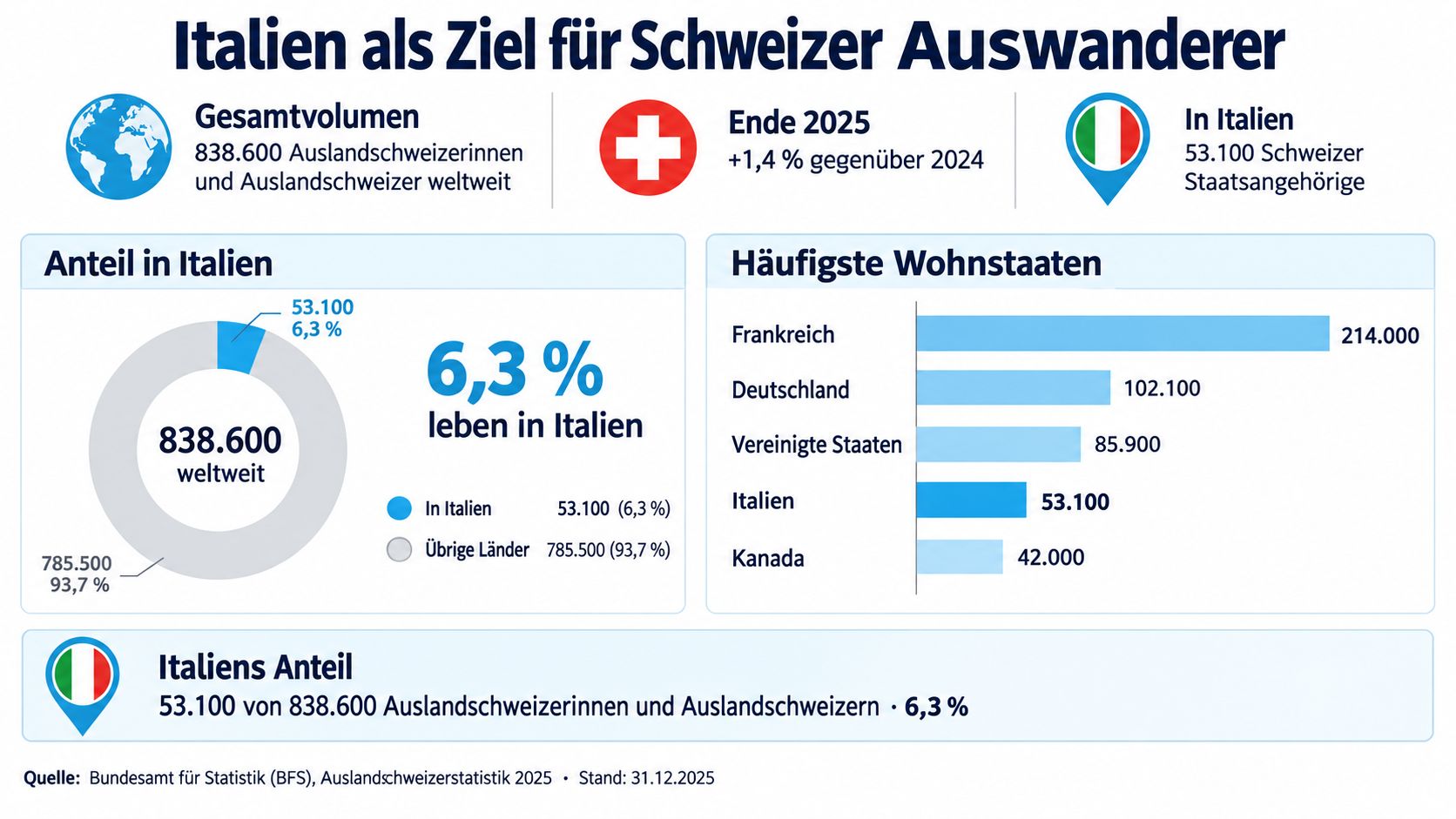
The regional distribution is more important for planning than the total number. In the province of Milan lived6,800 Swiss citizens, in Como4,400and in Varese3,900. Rome recorded3,700 people, while in the province of Lecce around1,300 Swiss citizens Swisslived. The figures therefore show two different life models: the well-connected north with proximity to Switzerland and the move to southern regions, which is more focused on local integration and a different infrastructure.
Why Lombardy is particularly relevant
Milan, Como and Varese form an obvious search area for many Swiss households. The proximity to the border, existing transport connections and a dense economic environment make the transition easier. Anyone who continues to work with Swiss companies or has to go to Switzerland regularly should not only consider the purchase or rental price, but also actual commuting times, cross-border traffic and accessibility of the workplace.
At the same time, the figures show thatImmigrating to Italycannot be equated with moving to a traditional big city. Smaller communities in Lombardy regions close to the border can be more attractive for families, the self-employed or people with a flexible working model. To do this, they have to plan the local authorities, language skills and supply options more realistically.
| Region | Swiss citizens |
|---|---|
| Province Milan | 6'800 |
| Como | 4'400 |
| Varese | 3'900 |
| Rome | 3'700 |
| Province Lecce | around 1'300 |
This regional presence also has a historical basis. Italian citizens continue to make up the largest foreign population group in Switzerland. Their number fell from381,500 in 1990 to 325,300 in 2020, as theBundesamt für Statistik zur Migration zwischen der Schweiz und Italienshows. The family, linguistic and economic network that has grown over decades can make the start easier, but does not replace your own check of residence, work and official duties.
Swiss deregistration and Italian registration in the correct order
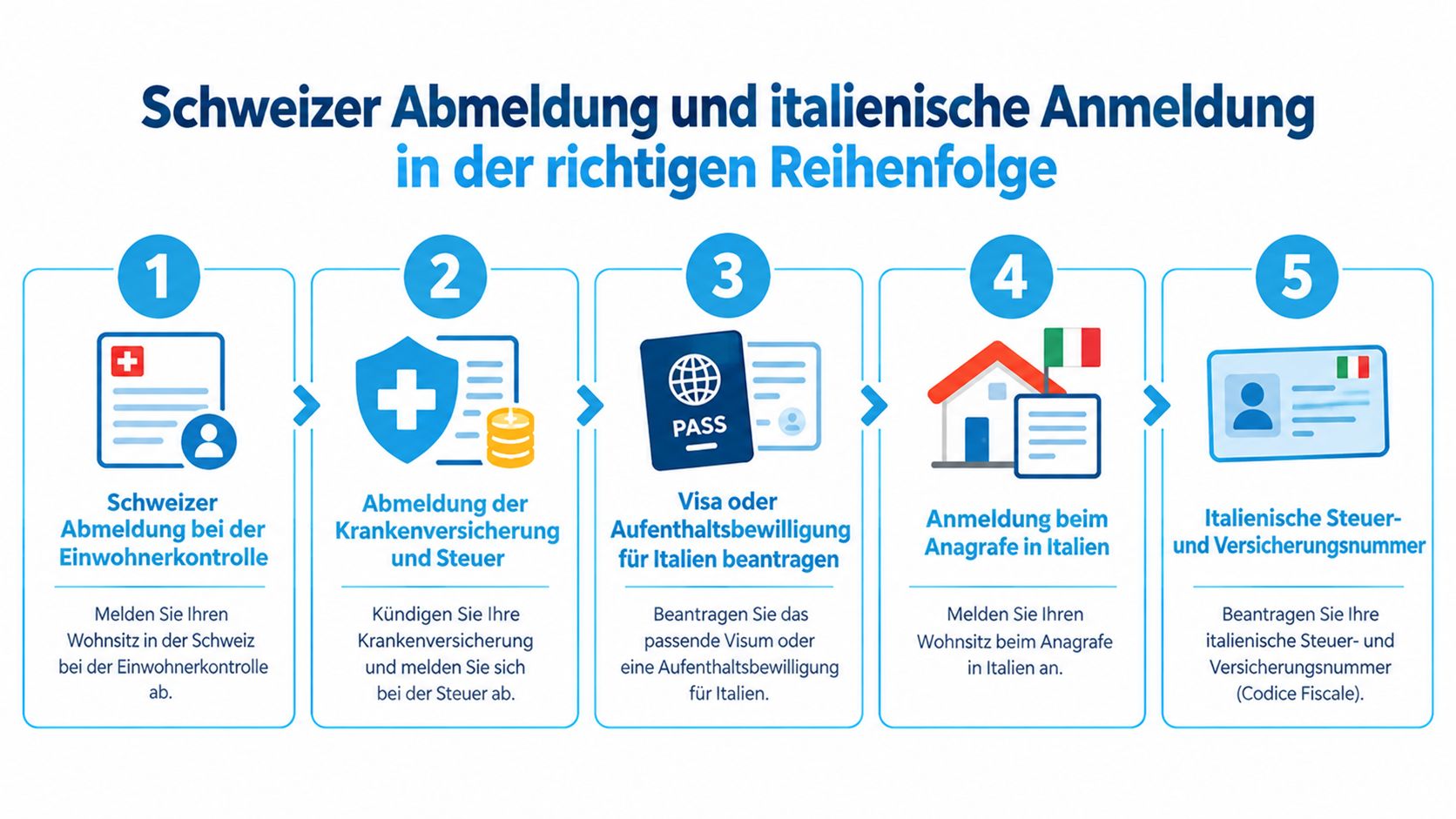
Don't start with the Swiss consular registration and expect Please note that the Italian registration is now complete. These procedures are separate. Switzerland registers its citizens abroad, while Italy deals with residence, municipal registration and tax issues according to its own rules.
Put the Swiss side first
First check the Italian entry and residence conditions with the responsible Italian representation. If you permanently move away, you will then deregister with your Swiss municipality of residence. In principle, a permanent departure is considered to be when you give up your accommodation, your stay abroad lasts longer than three months and you do not plan to return in the near future.
In particular, you need the following from the municipality:
- Confirmation of deregistration:Keep the original and a digital copy.
- Home certificate:This document is used for registration abroad required.
- Other evidence:Ask the municipality early on whether additional documents are required for your personal situation.
After moving, you must register at the relevant Swiss consulate or embassy within 90 days. To do this, you will need at least a valid Swiss passport or identity card, confirmation of de-registration and, if available, your residence permit. You should check theVorgaben zur Anmeldung im AuslandschweizerregisterYou should check it again before departure because authorities can change their procedural details.
Prepare the Italian registration separately
On the Italian side, the focus is typically on the municipal registration with the Anagrafe, the Codice Fiscale and the residence registration certificate. Which documents are specifically required depends on the reason for residence, employment situation and municipality. That's why the responsible municipality belongs on your contact list, not just the consulate.
For a stay of more than three months, Italy can require EU citizens to register with the responsible authority. The national deadline must be at least three months from the date of entry; The authority then issues a registration certificate with name, address and registration date. This EU rule does not automatically apply in the same form to Swiss citizens. Swiss persons must specifically check the bilateral agreements and Italian residence regulations.
Place the documents in three separate folders:
- Switzerland:Deregistration, residence permit, insurance and tax documents.
- Consulate:Passport or identity card, deregistration confirmation and Registration.
- Italy:Rental agreement, Codice Fiscale, Anagrafe and local suppliers.
TheCheckliste zur Abmeldung bei der Gemeinde also offers helpful preparation. What remains crucial is that Swiss registration expressly does not replace Italian official procedures. You remain responsible for initiating it yourself.
Tax residence in Italy and what the double taxation agreement really regulates
A rental agreement in Italy does not solely determine tax residence. According to Italian regulations, natural persons are generally considered to be resident in Italy for tax purposes if they are registered in the Anagrafe for at least 183 days per tax year, or184 days in a leap year, or have their place of residence or center of life in Italy within the meaning of Italian civil law. Just one of these criteria can establish tax residency, as theitalienische Steuerbehörde in ihrer Auslegung zur steuerlichen Ansässigkeitexplains.
Three questions that you have to answer separately
First: Where are you actually staying? Second: Where is the center of your life? Third: Where and under what conditions do you earn your income? A person with an apartment in Italy, a Swiss employer and regular work in both countries therefore needs an individual assessment. The distance between the place of residence and the border is not enough.
For people whose permanent residence is abroad, there is generally only limited tax liability in Switzerland. Anyone who works in an EU or EFTA country usually pays tax on their income there. However, Swiss real estate, pensions, dividends or interest can still remain relevant in Switzerland. The double taxation agreement assigns the taxation rights to the respective types of income. It does not automatically eliminate declarations, evidence or coordination between employers and authorities.
| Criteria | Italy | Switzerland after departure |
|---|---|---|
| Anagrafe | An entry can be relevant for tax residency. | Deregistration does not automatically end every Swiss Tax liability. |
| Days of residence | At least 183 days in the tax year, 184 days in a leap year, can establish residency. | Days of stay must be checked together with income and remaining ties. |
| Center of life | Residence or center of life in Italy may be sufficient. | Swiss real estate and certain income can remain tax-relevant. |
| Working model | Employer, actual place of work and activity influence the Assessment. | Remote work from Italy is not a purely technical home office issue. |
My recommendation:Have the working model checked in writing before moving. This is particularly true if you work completely from home for a Swiss employer, hybrid work, self-employment or multiple sources of income.
Collect your employment contract, working days per country, proof of rental or ownership, travel days, pay slips and documents on Swiss assets. Additionally, check social security, withholding tax, employer approval and proof of your place of residence. A hasty statement such as “After moving away, I will only pay taxes in Italy” is not technically reliable.
Health insurance, bank account, apartment and initial local administrative procedures
After the fundamental decision, everyday life begins with a series of practical dependencies. Health insurance, code fiscal, housing, bank account and anagraph should not be treated as isolated tasks. Often a job requires exactly the document that you did not apply for in a previous step.
First the insurance, then the contracts
Clarify the health insurance before the move. A Swiss solution may work differently for a temporary assignment than for a permanent resident in Italy. The “A1” form belongs to the area of temporary posting and should not automatically be understood as a permanent solution. Depending on the situation, switching to the Italian Servizio Sanitario Nazionale may be an option.
Have the responsible insurance company confirm in writing which system applies to your work and living model. Do not cancel your Swiss health insurance before the follow-up solution has been clarified and effective. This point is one of those topics where a seemingly small time error can have immediate practical consequences.
The Codice Fiscale is central to many processes. Apply for it as early as possible, as banks, rental agreements and local authorities may require it. Once you have the number, opening an Italian bank account becomes easier. Compare account management, CHF conversion and the question of which account rent, utilities and taxes are paid from.
Check the apartment before handing over the furniture
An Italian rental agreement should not only state the rent. Check the term, deposit, additional costs, registration, handover condition and information about the property. Get the relevant catasto data and clarify whether the contract will be registered.
A deposit in cash without a clear receipt is an unnecessary risk. Only pay with verifiable proof and keep a record of who hands over which keys. When handing over, take photos of each room, any existing damage, meter readings and the number of keys. A short written list of statuses prevents disputes later.
For stays of more than three months, Italy can require EU citizens to register with the responsible authority. After submitting the required documents, a certificate will be issued with your name, address and registration date. Swiss nationals should separately confirm the rules that apply to them with the relevant Italian authority, as the EU information on residence registration makes clear.
Then plan the registration with Anagrafe, garbage and television fees, telephone and internet, car re-registration and the preparation of the tax return. For the Swiss Post, aNachsendeauftrag bei einem Wegzugmakes sense so that important letters are not left at the old address.
The moving day with TIXPI
Let's take a typical process: A couple moves from Bern to Milan. The Swiss apartment has been canceled, the Italian address has been confirmed, and the transport date is after the apartment has been handed over in Bern. Before booking, the volume, pickup address, destination address, floors, elevator, access and desired additional services are recorded.
A fixed price provider can simplify the process because the price is visible before the binding booking. For consolidated routes, direct transportation can be more efficient than a completely separate trucking company. This depends on the transport volume, the addresses and the available route. If you want to dismantle furniture or have it assembled at your destination, you should specify this service when planning.
On the morning of the handover, document the condition of the Swiss apartment, take photos of meter readings and record the key return in writing. The transport service takes over, protects and loads the agreed items. In Milan, access, parking and possible traffic restrictions in historic areas must be clarified in advance.
After you arrive, check the Italian apartment again. Photograph catasto information, gas, electricity and water meters as well as new or existing damage before furniture is placed in its final place. This means that handover, transport and move-in remain traceable.
The process can also be traced visually. Watch the following video only after the actual schedule has been planned so that the booking does not become a substitute for the official preparation.
Your 90-day departure plan and the most frequently asked questions
A workable schedule distributes the work instead of postponing it to the last week.
Three months before the move
- Italian entry and residence conditions check.
- Secure the apartment and rental agreement.
- Get advice on the working model, tax residence and social security.
- Prepare health insurance and Code Fiscale.
- Record transport volumes and check addresses.
Six weeks before the move
- Definitive de-registration with the Swiss municipality of residence Organize.
- Secure confirmation of deregistration and residence permit.
- Agree on the handover date in Switzerland and the move-in date in Italy.
- Prepare bank account, supplier and translations.
- Book transport bindingly.
Two weeks before the move
- Dispose of unneeded items or Store.
- Prepare photo report and meter reading form.
- Confirm keys, access, lift and parking facility.
- Transport originals and copies of the most important documents separately.
- Check forwarding order and ongoing contract terminations.
After arrival
- Italian registration with the responsible office
- Complete the Fiscal code, bank account and health care.
- Register the Swiss consulate or embassy within 90 days.
- Document the apartment, meter readings and transport damage.
- Conclude tax and social security obligations with specialists.
Can I continue to work in Switzerland as a cross-border commuter?
This depends on the location, actual working days, employer, type of income and center of life off. Check not only the commute distance, but also tax and social security obligations.
Can I take my Swiss family vehicle with me?
Yes, but taking it with you must be checked separately with regard to registration, insurance, import and use in the Italian country of residence. Involve the relevant Italian and Swiss authorities at an early stage.
From when is a Swiss AHV pension abroad affected for tax purposes?
There is no general answer to this. The decisive factors are residence, type of pension, other income and the applicable rules of the double taxation agreement. Have the specific constellation assessed before you move away.
TIXPI organizes Swiss moves, furniture transport and individual deliveries with a transparent fixed price, coordinated crew and optional assembly. If your move to Italy depends on the handover of the apartment, temporary storage and moving in, plan the transport directly withTIXPIand bring the logistics into the same schedule as your official tasks.