If furniture has to be disposed of in Switzerland, that doesn't mean that everything ends up on the street as bulky goods. On the contrary: many pieces still have value, be it financial or ideal. If you do it cleverly, you can sell it, donate it or recycle it - thisSPLIT|||saves resources and saves costs on top of that.
What to do with old furniture? The best options at a glance
Are you faced with a mountain of old furniture and don't know where to start? Many people know that feeling. The desire for change or a tidy home is often the trigger for aumfassendes Aufräumen des Lebens.
The very first and most important step is always an honest inventory: What is still usable and what really needs to go? A conscious decision at this point is worth its weight in gold because it avoids unnecessary waste and can even make others happy.
This decision tree will help you quickly assess the condition of your furniture and find the right solution.
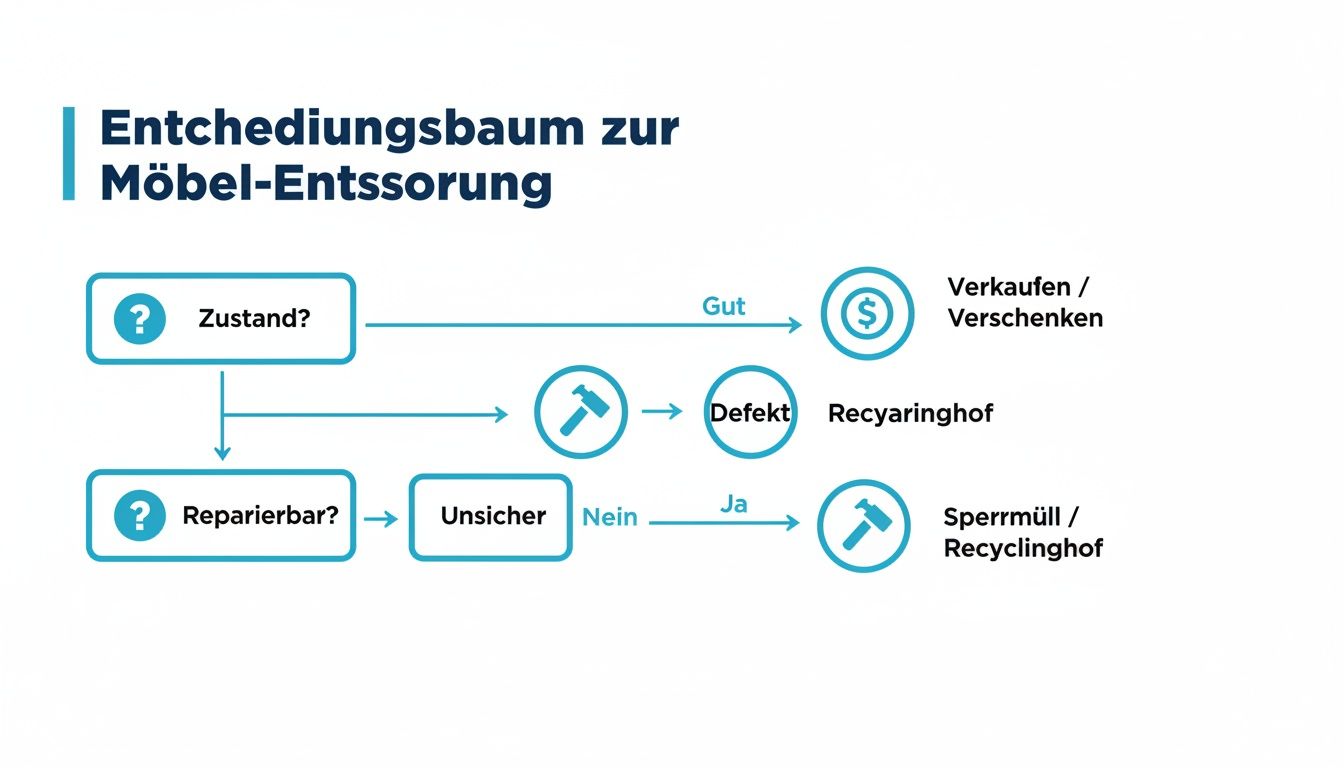
The graphic makes it clear: going to the recycling center or even incineration should always be the last option. Reuse and repair are clearly a priority.
Assess the condition objectively
The right strategy depends entirely on the condition of each individual piece of furniture. Instead of lumping everything together, it's worth taking a closer look.
- Well-preserved furniture:Pieces without major defects that are still fully functional are perfect for selling on online platforms or as a donation to a Brockenhaus.
- Furniture with small defects:A scratch in the paint or a loose screw is not a death sentence. A small repair is often enough to get the piece of furniture back on track.
- Severely damaged furniture:If a repair no longer makes economic sense, the only option is to dispose of it properly - either through the municipal recycling center or a professional service provider.
The crucial point is to extend the life cycle of a piece of furniture instead of hastily disposing of it as a piece of furniture to label waste. Every reused piece actively protects our environment.
This idea is particularly relevant in Switzerland. The per capita volume of municipal waste is around 670 kilograms – an amount that has tripled since 1970. This is exactly where we at TIXPI see great potential for specifically reusing or recycling furniture instead of simply burning it.
Sometimes when clearing out, you realize that some valuable pieces have to go, but are definitely too good for the trash. In such cases, an interim solution may make sense. Learn more about the safe and flexibleEinlagerung von Möbeln.
Quick check for your old furniture
This table will help you quickly evaluate your furniture and find the best strategy for disposal.
| Condition of the furniture | Recommended action | Potential Effort | Sustainability factor |
|---|---|---|---|
| Like new / very good | Sell (online platform, flea market) | Medium (photos, advertisement, communication) | Very high |
| Good, with slight signs of wear | Donations (Brockenhaus, social Furnishing) | Low to medium (arrange transport) | Very high |
| Functional, but with defects | Give away (circle of friends, online portal) | Low (create advertisement) | Very high |
| Repairable | Repair (DIY or specialist) | Low to high depending on the damage | High |
| Severely damaged / broken | Dispose of properly (recycling yard) | Medium (dismantling, Transport) | Medium |
| No longer salvageable | Bulky goods removal or disposal service | Low to medium | Low |
With this classification it is easier to find the right path for each piece - away from the throwaway society and towards a more conscious use of our resources.
From the attic into good hands: preparing furniture correctly
Before you simply label your old furniture as bulky goods, it is worth pausing for a moment. Many pieces that at first glance appear to be obsolete are actually far too good to be thrown away. A quick, honest check will help you understand the true condition of your belongings and make sustainable decisions.
An objective assessment is the key here. Take a look at each piece of furniture individually: Is the old wooden table just dusty and has a few scratches, or are the legs hopelessly broken? Does the sofa only have one spot that can be cleaned or is the frame completely worn out? It is precisely this distinction that decides the further path of your furniture.
Sell and donate what still brings joy
Well-preserved furniture often deserves a second life. Functional and attractive pieces easily find new owners, which not only helps the environment but also your wallet. Instead of paying for disposal, you might even be able to make a small profit or just do good.
There are countless ways to offer your furniture:
- Online marketplaces:Platforms likeRicardo,Tuttior theFacebook Marketplaceare perfect for reaching many people. Good photos and an honest description are important here - that creates trust.
- Local Brockenhäuser:Social institutions and Brockenstuben are very happy about well-preserved furniture donations. In this way, you often support charitable projects directly in your region.
- Circle of friends and acquaintances:Sometimes there is someone in your immediate area who is looking for exactly what you want to get rid of. A quick message in a chat group can work wonders.
Every piece of furniture that is reused is an active contribution to avoiding waste. It not only saves the resources for producing a new product, but also the energy for recycling or incineration.
However, transport is often the biggest hurdle when it comes to donations. If you would like to save yourself this effort, there are specialized service providers. Find out more here about an uncomplicatedAbholung von Möbelspenden that does all the work for you.
Proper separation for recycling
Not everything can be saved. For broken furniture that is really no longer worth repairing, recycling is the next best option. Careful preparation is the be-all and end-all here to secure valuable raw materials and keep disposal costs under control.
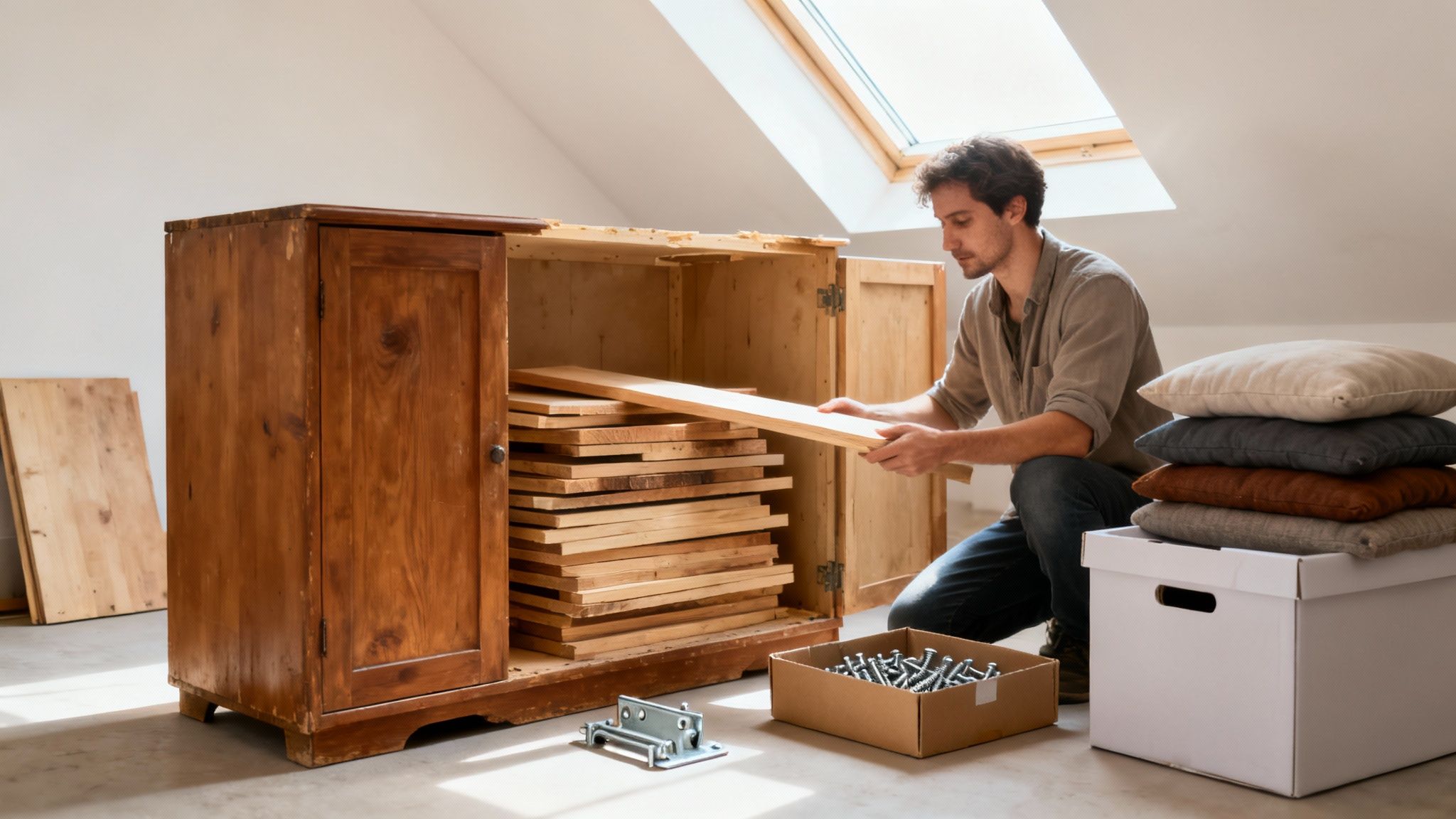
Tack it up and dismantle the furniture into its individual parts. Separate the different materials consistently from each other. Metal screws, hinges and handles belong in the metal scrap, while untreated wood is collected separately. You should also dispose of glass or plastic elements separately.
This little preparatory work makes processing much easier for the recycling centers. This ensures that valuable raw materials such as metal or wood can return to the cycle instead of simply being burned. A small additional effort with a big impact on the environmental impact of your furniture disposal.
Bulky goods and recycling centers: Take advantage of the municipal offers
If a piece of furniture has really reached the end of its life, the way to dispose of it properly is through your community's services. In Switzerland, bulky goods collection and recycling centers – often also called factory yards – are primarily responsible for this. But be careful: every community cooks its own soup here. There is no uniform regulation across the country.
What applies in Zurich can work completely differently in Bern or Lucerne. That's why the first and most important step is always to find out directly from your own municipality or city administration. You can usually find all the information on their website under keywords such as “waste calendar”, “disposal” or “bulky goods”.
Register and provide bulky goods correctly
Bulky goods collection is of course the most convenient option – the furniture is picked up directly from your front door. But this convenience has its rules and its price. Simply putting the old cupboard on the street is forbidden almost everywhere and can result in a hefty fine.
As a rule, you have to pay attention to the following:
- Registration:Many municipalities require registration by telephone or online. Sometimes there are fixed collection days, sometimes an individual appointment is arranged.
- Bulky goods brands:The system with fee stamps or vignettes is widespread. You buy these in advance (e.g. in the community center, in supermarkets) and stick them on the piece of furniture in a clearly visible place. The costs often depend on weight or size.
- Maximum size and weight:Be sure to pay attention to the regulations. In Zurich, for example, a piece of bulky goods may weighmaximum 40 kgand be no longer than2.50 meters. You have to disassemble everything above that.
A typical error in practice: incorrectly calculated fee stamps. Find out exactly how many brands are needed per kilo or piece. If there is insufficient franking, your bulky goods will simply remain standing.
The recycling center as an alternative
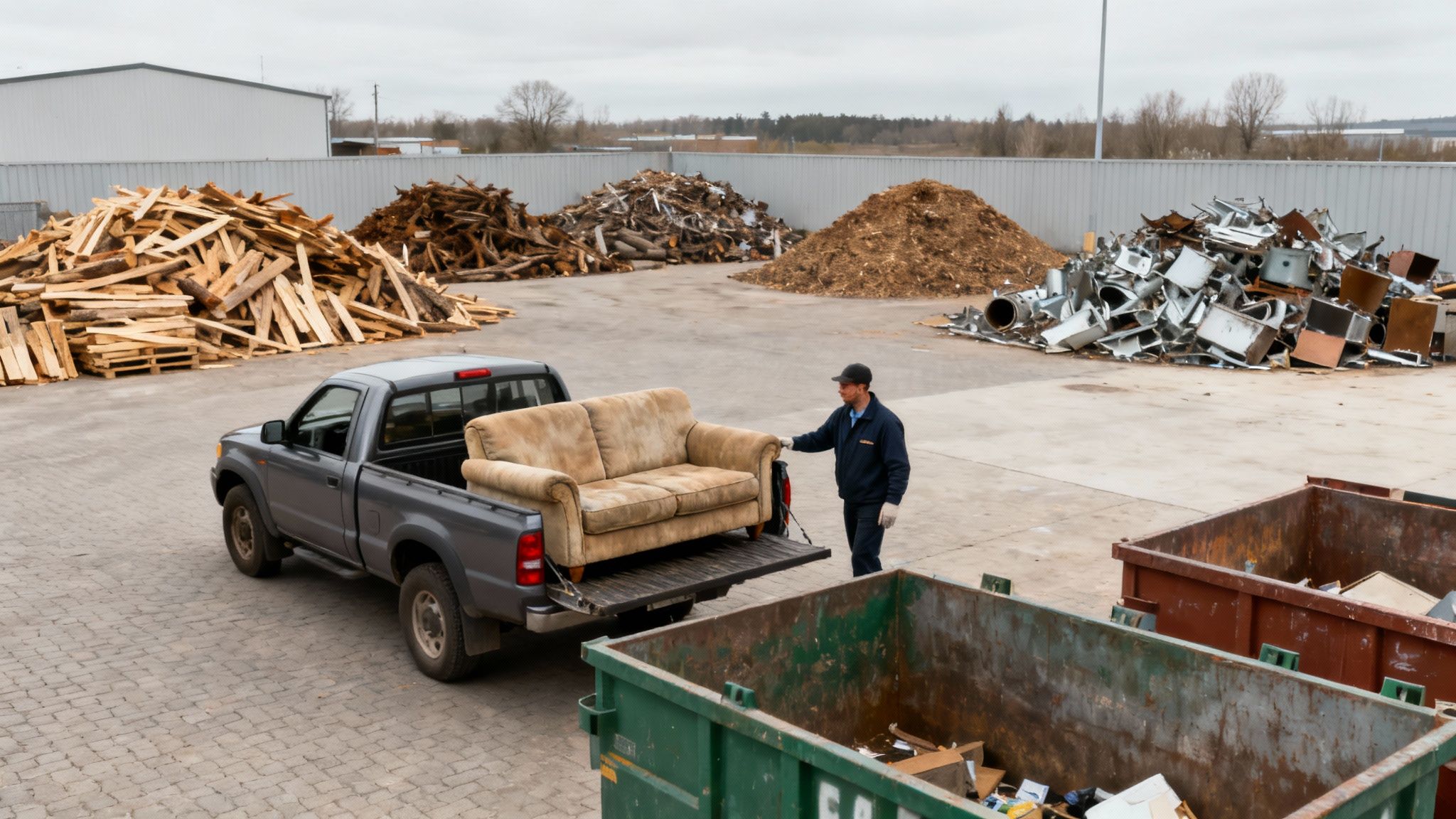
The recycling center is the right address if you want to get rid of several different materials at the same time or if the furniture is simply too big for the bulky goods collection. Here you can throw the separated recyclables such as wood, metal or plastic directly into the appropriate containers.
The big advantage of the recycling center is its flexibility. You are not tied to fixed dates and can take care of the disposal yourself. This fits perfectly with the high recycling mentality in Switzerland. It is not for nothing that the country achieves an impressive recycling rate of52 percentfor municipal waste, making it one of the best in Europe. More about theKennzahlen des Schweizer Recyclingsystems finden Sie auf swissrecycle.ch.
What to do with problematic materials?
Particular caution is required for furniture with built-in electronics or other delicate materials. A bathroom cabinet with lighting or a bed with an electrically adjustable slatted frame does not simply belong in bulky items.
These parts are considered electronic waste and must be disposed of separately. So remove electronic components, lamps or batteries beforehand. You can usually hand these in free of charge at points of sale or directly at the recycling center. Not only is it better for the environment - ignoring these regulations can also be expensive.
Costs and environmental aspects of furniture disposal
If you want to get rid of old furniture, you are faced with a decision that not only affects your wallet, but also the environment. Of course, the costs vary greatly depending on whether you do it yourself or let a professional do it. But at the same time, each method has its own ecological footprint.
At first glance, it worksSelf-deliveryAt the recycling center it is often the cheapest option. You only pay the municipal fees, usually based on weight or volume. But be careful of the hidden costs: the rent for a van, the fuel and, above all, your valuable time.
On the other hand, there is theprofessional collection. Although it has higher initial costs, it takes all the stress away from you. This not only saves time and nerves, but can even be surprisingly resource-efficient thanks to clever logistics and bundled trips.
The ecological footprint of your decision
The greatest lever for sustainability lies in the choice of disposal method. Every piece of furniture that is recycled or given a new purpose instead of simply ending up in the incinerator is a real win for the climate.
The recycling systems in Switzerland are already incredibly effective and save money overall every year559,000 tons of CO2 equivalents. To make this more tangible: This corresponds to a car journey of around3.9 billion kilometers.
Service providers like TIXPI, who rely on bundled transport, can make a huge difference here. Instead of everyone driving to the disposal yard individually, furniture is taken efficiently and directly to the correct recycling centers. More about this impressiveLeistungsbilanz erfahren Sie auf swissrecycle.ch.
Sustainable furniture disposal is more than just recycling. It begins when you consider whether a piece of furniture can perhaps still be repaired, given away or sold. Every avoided transport and every extended life cycle counts.
Conscious, environmentally friendly disposal does not have to be complicated. It can often be perfectly combined with larger projects such as moving. If you would like to know how you can make your entire apartment move more sustainable, you will find valuable tips in our guide on the subject The table shows where the respective strengths and weaknesses lie.Umzug und NachhaltigkeitDisposal method
Average costs (CHF)
Estimated CO2 balance
| Advantages | Bulky goods collection (municipality) | 20 – SPLIT Collection | 100 – 250 |
|---|---|---|---|
| Low (through route optimization) | Stress-free, time-saving, professional | Donate / Sell | 0 |
| Positive (avoids new production) | Sustainable, social, more potential Revenue | The table makes it clear: reuse is unbeatable in terms of costs and environmental impact. But if that is no longer an option, a professional service through bundled trips can be an amazingly ecological and efficient alternative to the tedious individual trip to the recycling center. | Do it yourself or call the professionals? When is a service really worth it |
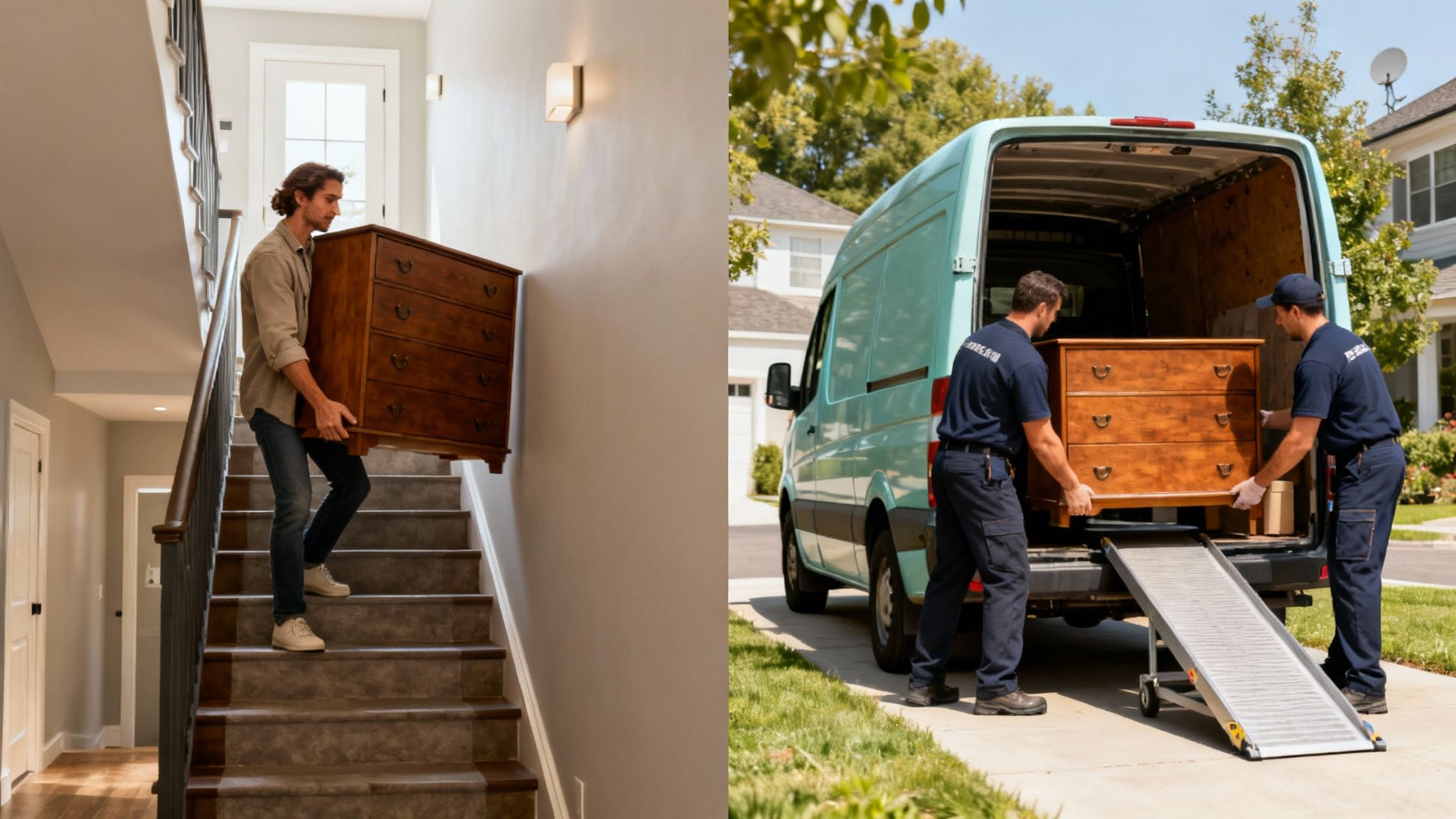
| The old chest of drawers has to go, the sofa has had its day - and you're faced with the classic question: Do I do it myself or do I hire a professional? At first glance, the “do-it-yourself” approach seems to be the cheaper option. But anyone who has ever tried to maneuver a bulky cupboard through a narrow stairwell knows: the devil is in the details. | Who | Gering (durch Routenoptimierung) | Stressfrei, zeitsparend, fachgerecht |
| Spenden / Verkaufen | 0 | Positiv (vermeidet Neuproduktion) | Nachhaltig, sozial, potenzieller Erlös |
Die Tabelle macht es deutlich: Wiederverwendung ist in Sachen Kosten und Umweltbilanz unschlagbar. Wenn das aber keine Option mehr ist, kann ein professioneller Service durch gebündelte Fahrten eine erstaunlich ökologische und effiziente Alternative zur mühsamen Einzelfahrt zum Recyclinghof sein.
Selber anpacken oder Profis rufen? Wann sich ein Service wirklich lohnt
Die alte Kommode muss raus, das Sofa hat ausgedient – und schon steht man vor der klassischen Frage: Mache ich das selbst oder beauftrage ich einen Profi? Auf den ersten Blick scheint der «Do-it-yourself»-Ansatz die günstigere Variante zu sein. Doch wer schon mal versucht hat, einen sperrigen Schrank durch ein enges Treppenhaus zu manövrieren, weiss: Der Teufel steckt im Detail.
Wer dieDisposal of furnitureIf you take it into your own hands, you have to be prepared for a lot. It not only takes pure muscle power, but also the right vehicle. A three-door wardrobe rarely fits in your own car, so a van is necessary. That means rental costs, paperwork and a trip to the rental station.
The pitfalls of doing it yourself
Once the piece of furniture is finally in the van with everyone together, the journey really begins: off to the recycling center. Depending on where you live and the traffic situation, this can quickly turn into a half-day trip. And then there are the municipal regulations, which vary greatly from municipality to municipality. Separated incorrectly or missed the opening times? That means frustration and, in the worst case, a second trip.
If you try it yourself, you should be honest with yourself:
- The logistics:Do you have a suitable vehicle? And even more important: who is lending a hand? It's almost impossible to move a sofa on your own, especially from the third floor without a lift.
- The time required:Don't underestimate that. Dismantling, loading, driving, unloading – that quickly eats up an entire Saturday afternoon.
- The physical strain:Lifted incorrectly once and your back will complain for weeks. The risk of injury when lugging heavy furniture is real.
When a professional service is worth its weight in gold
A professional disposal service takes all of these worries away from you. The advantages are obvious: you save time, protect your nerves and, above all, your back. The professionals take care of the entire process - from dismantling in your apartment to safe transport and professional disposal.
Especially for larger quantities, such as a complete apartment clearance, a professional is almost always the smarter choice. He knows exactly which materials belong where and drives directly to the right collection points.
A professional service not only means convenience, but also security. You can rely on your old furniture being disposed of in an environmentally friendly manner and in accordance with all the rules, without you having to fight through the jungle of local waste regulations yourself.
Modern service providers like TIXPI even go one step further. Thanks to transparent fixed prices, you know exactly what it costs right from the start - no hidden fees, no unpleasant surprises. But the biggest highlight lies in intelligent logistics: transports are bundled and routes are cleverly planned.
In concrete terms, this means that the collection of your furniture is combined with other orders in the area. This not only reduces unnecessary journeys and thus theCO₂ emissions, but also often makes the service cheaper for you as a customer. This makes the professionalDisposal of furniturea solution that is not only stress-free, but also surprisingly economical and environmentally friendly.
Any questions? Here are the answers to furniture disposal
When disposing of old furniture, the same questions always arise. No wonder, because the rules can vary from community to community. So that nothing goes wrong for you, we have summarized the most important points for you here.
Can I just put old furniture on the street?
The short and clear answer is:No, definitely not. It may be tempting to simply leave that bulky cupboard or old sofa on the side of the road in the hope that someone will take it or that the garbage disposal will dispose of it.
Unfortunately, that is a fallacy. Unauthorized parking of furniture in public spaces is considered illegal disposal and can be punished with hefty fines. Always take the official route - either through your municipality's registered bulky goods collection service or by bringing the furniture to the depot yourself.
How much does it cost me to dispose of furniture in Switzerland?
That's the big question, and the answer is: it depends. The costs vary greatly depending on the method and municipality.
For municipal bulky goods removal, you usually pay by weight or per item. This requires special fee stamps, and the costs are often in the range of CHF 20 to CHF 60for a few medium-sized pieces.
If you drive the furniture to the workshop yourself, you may save the fee stamps, but you have to take into account the costs of renting a van and of course your own time. Professional disposal services calculate their effort, but in return they actually do everything for you.
A little tip from experience: Don't just look at the pure disposal price. Also take your own effort into account. After all, your time, stress and lugging have a value.
Which pieces of furniture are not allowed in bulky items?
An important rule that is often forgotten: Everything that has a plug or contains batteries belongsnotin normal bulky items. This also applies to furniture with permanently installed electronic parts.
Typical examples of this are:
- Beds with an electrically adjustable slatted frame
- Mirror cabinets that have integrated lighting
- Modern armchairs with built-in massage function
These pieces are considered electronic waste and must be disposed of properly usually at special collection points. If at all possible, remove the electronic components and dispose of the parts separately.
Do I have to disassemble my furniture for disposal?
It depends entirely on the regulations in your municipality. Many waste disposal companies have clear specifications for the maximum mass of bulky goods, for example no longer than2 metersor no heavier than30 kg.
A large wardrobe or a double bed quickly exceeds these limits. In such a case, you will have to disassemble the piece of furniture first. This ensures that the collection employees can load the parts safely and without problems. A quick look at your municipality's website will provide clarity here.
Is theDisposal of your Furnituretoo complicated for you or do you simply not have the time for it?TIXPIwill organize the entire collection for you - transparently, stress-free and at a fair fixed price.Buchen Sie jetzt Ihre professionelle Möbelentsorgung auf https://tixpi.chand leave the hard work to the professionals.