
A move is coming up, and one of the first questions is usually: How much will it all cost? As a general rule, it can be said that the costs for a moving company in Switzerland are usually betweenCHF 120 and CHF 280 per hourlay. But this range is only half the truth, because the final price depends heavily on the number of helpers and the size of the truck. A smaller move with two people is logically cheaper than a large family move with a team of four.
What a moving company really costs per hour in Switzerland
When you hold an offer in your hands, you see more than just a number. You see the result of a precise calculation based on personnel, logistics and even regional conditions.
Think of the hourly rate like a restaurant menu: a simple dish with few ingredients is cheaper, while an elaborate menu with more components and effort has a higher price. The situation is very similar when you move. The size of the team and the vehicle are the main ingredients that determine the base price.
For a small city apartment, a maneuverable delivery van with two movers is often sufficient. For an entire house, on the other hand, you need a well-coordinated, large team and a spacious truck.
The typical price ranges at a glance
To give you a feel for the numbers, we have summarized the usual hourly rates here. The costs vary significantly depending on team size and vehicle.
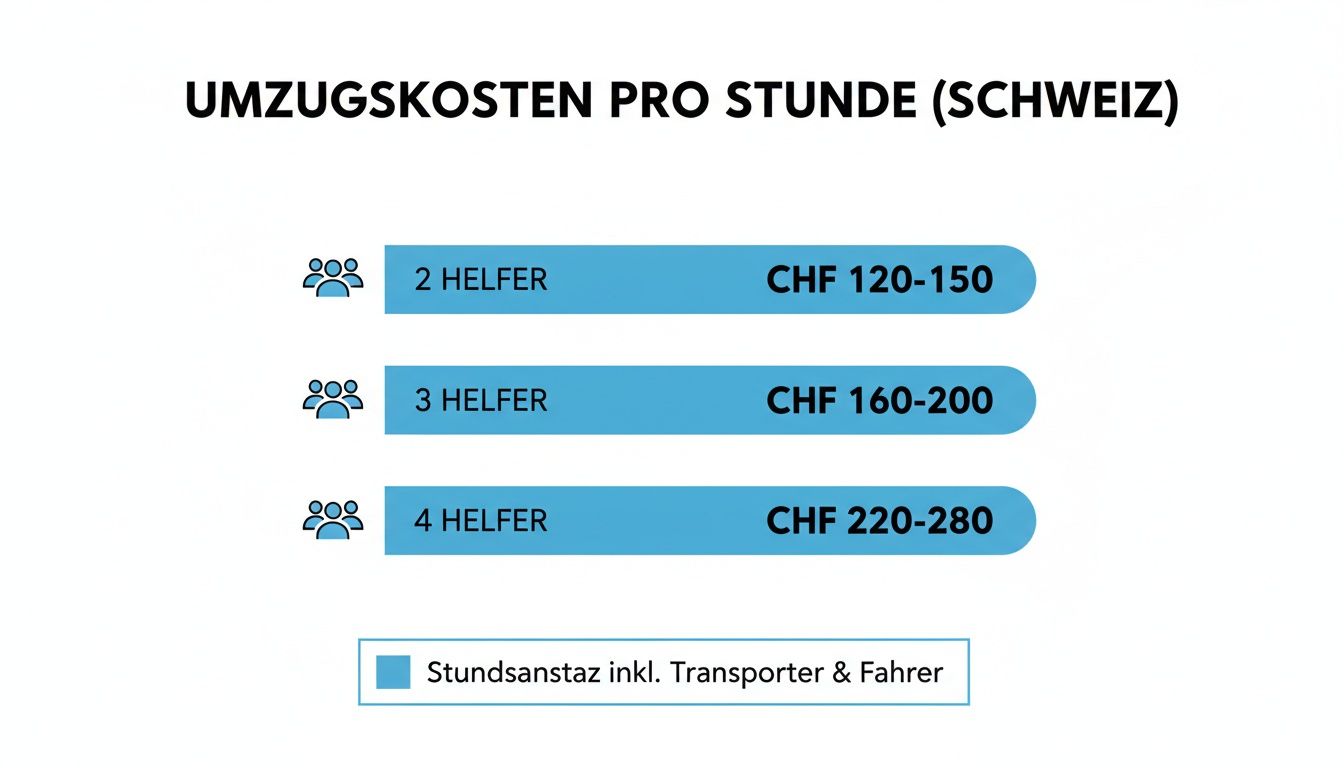
For a typical private move with two helpers and a delivery truck, you can use120 to 150 francs per hourcalculate. If you need three helpers, the costs are between160 and 200 francs per hour. For really big moves that involve four helpers and a large truck, the hourly rates range between220 and 280 francs per hour. You can also find more details about the cost breakdown from the professionals atumzugexpress.ch.
These price ranges are a great guideline for quickly assessing offers. This way you can immediately recognize overpriced offers and plan your budget realistically.
The following table gives you a quick overview of the expected costs.
Overview of average hourly rates for moving companies
This table shows the typical cost per hour based on the number of movers and type of vehicle.
| Team size and vehicle | Average cost per hour (CHF) |
|---|---|
| 2 helpers + delivery van | CHF 120 – 150 |
| 3 helpers + delivery van | CHF 160 – 200 |
| 4 helpers + truck | CHF 220 – 280 |
As you can see, the price increases with each additional helper - a logical consequence of the higher personnel costs.
Regional differences in hourly rates
It is also important to know: Switzerland is not the same price everywhere. In urban centers likeZurich, Geneva or Zugprices tend to be higher. This is due to the higher operating costs on site - from wages for staff to rent for storage space.
Moving to a big city often brings its own challenges: heavy traffic, hardly any parking spaces and narrow stairwells. All of this can increase the time required and therefore the costs, which is of course reflected in the prices.
These regional differences are another reason why a flat rate rarely works. A detailed offer that is tailored precisely to your situation is therefore worth its weight in gold. With this knowledge, you are well equipped to realistically estimate the costs of your move and find the right offer.
How the hourly rates of moving companies are made up
A moving company's hourly rate is much more than just a random number. There is a precise calculation behind this that ensures that your move goes smoothly. To understand exactly what you're paying for, it's worth taking a closer look at these costs. Like a Swiss clockwork, different cogs interlock here.
Behind every franc you invest per hour there are tangible business items. The company not only has to pay its employees fairly, but also finance vehicles, insurance and materials. A transparent breakdown will help you compare offers better and see whether a price is really fair.

The four pillars of hourly rate calculation
Essentially, the hourly rate is based on four large cost blocks. These form the basis for every serious moving offer and make up the largest part of the price.
- Personnel costs:That is often the biggest chunk. It not only covers the gross wages of the movers, but also social security contributions, insurance and further training. Good, experienced staff are worth their weight in gold and ensure that nothing breaks.
- Vehicle costs:This includes purchase, depreciation, maintenance, repairs, insurance and of course the fuel for the truck. A well-maintained fleet of vehicles is essential to getting your belongings safely to their destination.
- Insurance premiums:Every professional moving company must be fully insured. This includes theTransport insurancefor damage to your removal goods and theBusiness liability insurancein case a wall in the stairwell gets scratched.
- Material and operating costs:This includes not only blankets, belts or protective films, but also everyday things such as office rent, marketing and the entire administrative organization in the background.
Additional factors affecting price
Beyond these basic costs, there are a number of variable surcharges that can affect the final price depending on the situation. These depend heavily on the specifics of your move and should be clearly stated in a transparent offer.
It is best to discuss these potential additional costs when making your inquiry. This way you avoid unpleasant surprises on the final bill.
A reputable company will ask you about specifics. Whether it's a heavy piano, delicate designer furniture or a tricky parking situation - open communication right from the start is the key to a fair and realistic price.
Frequent surcharges and additional costs
Some services go beyond a standard move and are therefore billed separately. Pay attention to the following points in your offer to ensure the entireMoving company costs per hour Switzerlandto correctly assess:
- Heavy transport:Transporting a piano, safe or large art objects requires special equipment and often more staff. This logically leads to a surcharge.
- Weekend and public holiday tariffs:Moves on Saturdays, Sundays or public holidays are often more expensive. The reason is the higher wage supplements for employees. If you're flexible, moving during the week can save you money.
- No-parking zones:If the moving company has to apply for a special parking permit from the municipality, these fees will be passed on to you.
- Furniture assembly and disassembly:Dismantling and assembling complex pieces of furniture such as a large wardrobe or a special bed is time-consuming and is often charged additionally.
- Disposal of old furniture:The professional disposal of furniture that you no longer need is a separate service that is billed based on effort and type of material.
If you understand this cost structure, you can approach planning in a much more relaxed manner. You can critically examine offers, ask the right questions and ensure that you receive a fair price for a professional service.
Why moving costs vary from canton to canton
Anyone who moves in Switzerland quickly notices: a move in Zug is rarely the same price as one in Geneva. TheMoving company costs per hour Switzerlandare highly dependent on the respective canton. This is no coincidence, but the result of tangible economic and logistical circumstances.
The most obvious reason is the cost of living. In cantons with high rents and wages, such as Zug or Zurich, moving companies have to cover completely different operating costs - from employee salaries to rent for storage space. These expenses are of course included directly in the hourly rates.
Economic power and competition as price drivers
The economic strength of a region plays a major role. Cantons with many financially strong companies and a population with purchasing power simply have a higher price level, which also affects services such as removals. Demand is greater and the willingness to pay for good service tends to be higher.
At the same time, the competition is also shuffling the cards. In urban areas with many providers, competition can drive prices down somewhat. However, in more rural areas with less choice, the few established companies have a stronger market position, which keeps prices more stable.
Several factors cause the cantonal price differences:
- General living costs:High rents and wages in the cities directly increase the operating costs for moving companies.
- Local purchasing power:Where money is looser, service prices tend to be higher.
- Transport and Logistics:Heavy traffic, a tricky search for a parking space and narrow streets in big cities eat up time - and time is money when moving.
- Competition density:Many providers often mean better prices for the customer. Few providers can dictate the prices.
Specific cost differences between the cantons
The best way to see the cantonal differences is to look at the numbers. Data analysis shows quite a range in the average total cost of a move.
In the canton of Zug the costs areover 2,000 francs per movehighest, while in Geneva the average is only about1,500 francsis there. The cantons of Zurich, Basel, St. Gallen and Bern have moving costs of around1,750 francsin midfield.
But it's not just about money. Cantonal regulations can also influence the effort. Organizing a no-parking zone or observing certain rest times varies in complexity and cost depending on the canton. If you know your way around, you can avoid unpleasant surprises. Find out more aboutin our comprehensive guide most important cantonal peculiarities and regulations when moving.
Every region has its pitfalls. A move in the center of Basel with its narrow streets requires completely different planning than a move in a sprawling suburb of Bern. A reputable company will take this into account in their offer right from the start.
The following table gives you a clear overview of how the average costs for a standard move differ in different cantons. Use these numbers as a rough guide to better assess offers from your region.
Comparison of average moving costs by canton
An overview of the typical total costs for moving in different Swiss cantons.
| Canton | Average total costs (CHF) |
|---|---|
| Train | ~ 2,050 |
| Zurich | ~ 1,750 |
| Basel-Stadt | ~ 1,750 |
| St. Gallen | ~ 1,750 |
| Bern | ~ 1,750 |
| Geneva | ~ 1,500 |
These numbers show it in black and white: where you live has a noticeable influence on the moving budget. Knowing these regional differences is the first and most important step to planning your move smartly and stress-free.
This is how much your apartment move could cost: concrete examples
Theory is all well and good, but at the end of the day it's what's on the bill that counts. Abstract hourly rates help with rough orientation, but only concrete examples give you a real feeling for what budget you should plan for. Ultimately, you want to plan your move safely and not experience any unpleasant surprises.
So let’s take a look at three typical moving scenarios. I calculated for you how much moving a 2.5, 3.5 and 4.5 room apartment would cost. See these examples as realistic guidelines that will help you better assess your own effort.
Example 1: Moving a 2.5 room apartment
A classic for singles or couples. The moving volume is usually still quite manageable and the effort is limited. Nevertheless, one should not underestimate the time that the whole thing takes.
A small team of two movers and a delivery truck is usually sufficient for such a move. Experience shows that the time required for loading, transport within the same city and unloading is4 to 6 hours.
- Team:2 reinsmen + 1 delivery van
- Average hourly rate:CHF 140
- Estimated working time:5 hours
- Additional costs (travel fee, material):approx. CHF 100
Invoice:(5 hours x CHF 140) + CHF 100 =CHF 800
This is a solid basic calculation. But if things like a long journey from the truck to the front door or the dismantling of furniture are added, the number of hours and therefore the price quickly rises.
Example 2: Moving a 3.5 room apartment
Things are getting a lot bigger here. In a 3.5-room apartment, which is often inhabited by couples or small families, a lot of household goods come together. More furniture, more boxes, more personal items – that requires a larger team and more time.
For this size of apartment, I would always recommend a team of three movers. This speeds up the process enormously because someone can always carry boxes while the others take care of the heavy furniture. The time required here usually ranges between6 and 8 hours.
- Team:3 reinsmen + 1 van/small truck
- Average hourly rate:CHF 180
- Estimated working time:7 hours
- Additional costs (travel, materials, etc.):approx. CHF 150
Invoice:(7 hours x CHF 180) + CHF 150 =CHF 1,410
These numbers show how quickly costs can rise. It's easy to misjudge how long loading and unloading really takes. At this point, many people ask themselves whether moving professionally is still worth it. If you are unsure, take a look at ourCost-benefit analysis on the topic of professional moving versus doing it yourself.
Example 3: Moving a 4.5 room apartment
Moving from a 4.5 room apartment or a small house is a real project. Here we are talking about a complete family household with a lot of inventory, often including a full basement or attic.
A project like this calls for a strong, well-coordinated team. There are usually four reinsmen and a large truck in use here. The time required can quickly fill an entire working day, so8 to 10 hours.
- Team:4 reinsmen + 1 large truck
- Average hourly rate:CHF 250
- Estimated working time:9 hours
- Additional costs (travel, material, insurance):approx. CHF 200
Invoice:(9 hours x CHF 250) + CHF 200 =CHF 2,450
Of course, these calculations are based on average values. The actualMoving company costs per hour Switzerlandcan vary depending on the provider and canton. But experience and statistics show that these estimates are a pretty good basis.
For comparison: moving a 2.5-room apartment costs aroundon average in Switzerland CHF 1,290. For a 3.5 room apartment you have to pay an average ofCHF 1,580calculate and for a 4.5 room apartment the average cost isCHF 1,850, like data from platforms likeofri.chshow.
These examples make one thing clear: a realistic assessment of your own household contents and good planning are the be-all and end-all for keeping costs under control.
How you can cleverly reduce your moving costs
A professional move doesn't have to plunder your account. With the right tactics and a little advance planning, you can noticeably reduce costs without sacrificing quality. The key is almost always preparation, because every minute the moving team saves is money for you in the end.

The most effective method, theMoving company costs per hour in SwitzerlandPressing is actually taking initiative. The better everything is prepared, the more quickly and efficiently the professionals can do their work.
Preparation is half the budget
A top organization before the big day can easily reduce the team's working hours by several hours. This is reflected directly on your final bill and gives you back control over the costs.
Here are a few tried and tested tips that you can easily take into your own hands:
- Dismantling furniture:Disassemble large pieces of furniture such as cupboards, beds or shelves before the team arrives. A little tip: Pack the screws and small parts for each piece of furniture in labeled bags so that the reconstruction goes smoothly.
- Pack systematically:Finish packing all boxes and label them clearly with the target space and contents. Stack the boxes so that the walkways remain clear and the heaviest boxes are at the bottom.
- Secure walking routes:Make sure stairwells, hallways and doors are clear and easily accessible. This not only prevents unsightly accidents, but also speeds up transport considerably.
Remember: every minute that a reinsman spends looking for the right tool or clearing a path will be charged to you at an hourly rate. Careful preparation is the best investment in a cheap move.
Plan wisely and choose the right time
In addition to your own effort, timing also plays a crucial role. With a little flexibility when it comes to moving dates, you can benefit from significantly cheaper rates and avoid unnecessary surcharges.
The biggest mistake? Schedule the move for the weekend or the end of the month. At these times the moving companies are busy, which of course drives up the prices.
- Curb during the week:Many companies offer cheaper hourly rates from Monday to Thursday because demand is simply lower. A day off during the week can be financially worthwhile.
- Get offers early:Compare different offers at least three to four weeks before the planned date. This gives you enough time to check prices and services at your leisure without being under time pressure.
Clean out and rely on innovative models
Any item you don't take with you saves space in the truck and valuable time carrying it. Moving is the perfect opportunity to finally free yourself from unnecessary baggage.
Sell, give away or throw away everything you no longer need in your new home. Less moving goods means a smaller transport volume – and therefore directly lower costs.
There are also modern approaches beyond classic hourly billing that offer great savings potential. Models likeCombination ridesare particularly clever here. Providers likeTIXPIFor example, bundle several transports on one route. This not only saves CO₂ emissions, but also reduces costs for each individual customer, as several parties share the travel costs. These intelligent logistics solutions not only protect the environment, but also your wallet.
The alternative to hourly billing: TIXPI fixed prices
Classic hourly billing may feel flexible, but it involves an incalculable risk. An unexpected traffic jam on the highway, a broken elevator in the new building or a narrow stairwell - all of these are beyond your control, but inevitably drive up the costs. Every unforeseen minute ultimately ends up on your bill.
This uncertainty makes moving day unnecessarily stressful. Instead of looking forward to your new home, you constantly look at the clock with worry. Fortunately, there is a modern and secure alternative that relieves you of this worry: binding fixed-price offers like those offered by TIXPI.
This is how the fixed price model
works The principle behind it is refreshingly simple and transparent. Instead of a vague hourly estimate, you will receive a binding offer with a guaranteed maximum price. This price is calculated precisely based on your information – i.e. your inventory list, the distance and the accessibility of the apartments.
The highlight: This maximum price is set in stone. It will not be exceeded under any circumstances, no matter how long the move actually takes.
A fixed price offer turns an uncertain variable into a reliable constant. It gives you the absolute financial planning security you need for a relaxed moving day. You know from the first second what the maximum cost of your move will be.
This model eliminates the risk of unpleasant surprises on the final bill. Hidden fees or unexpected surcharges are now a thing of the past. Everything is regulated clearly and fairly from the start.
The advantages of TIXPI's fixed prices
The biggest advantage is obvious: full cost transparency and budget security. But TIXPI’s fixed-price model can do even more. By intelligently bundling transports on similar routes, the final price can even beunderthe agreed maximum price.
These so-called combination trips are not only good for your wallet, but also protect the environment through reduced empty trips and CO₂ emissions. So you benefit twice: financially and with a clear conscience. Find out more about it in our articlewhy a transparent fixed price offer from TIXPI gives you security.
In summary, the TIXPI offers you a fixed price:
- Absolute cost security:The agreed maximum price is guaranteed not to be exceeded.
- No hidden costs:You pay exactly what was agreed upon in advance, without any unpleasant surprises.
- Stress-free planning:You can concentrate fully on your new home without constantly having to think about the running costs.
- Potential Savings Potential:By intelligently bundling transport, your final price can be even cheaper.
With this approach, TIXPI positions itself as a fair and contemporary solution that puts the focus back on the essentials: a smooth and worry-free start to a new phase of life.
Answers to your final questions about moving costs
As the moving day approaches, the last small but important questions often arise. We have collected the most common ones for you and answered them in a practical way so that you can start your move well informed and without any uncertainties.
Is it customary to tip the reinsmen?
Yes, absolutely. A tip is a widespread and highly valued gesture in Switzerland. The movers do hard physical work, and a little recognition shows that you were satisfied with their performance.
There is no fixed rule, but as a guideline,10 to 20 francs per personproven. By the way, a little snack in between is often just as welcome - cool drinks on a hot day or a small snack can do wonders for the team's morale.
Which insurance pays if something breaks during the move?
Professional moving companies are usually double insured so that you are not stuck with the costs in the event of damage. But it's good to know which insurance company is responsible for what.
- Transport insurance:This applies if your belongings are damaged during transport - i.e. during the journey or when loading and unloading.
- Business liability insurance:This comes into play if the moving team causes damage to the building, for example scratches in the stairwell, on the parquet or on a door frame.
Be sure to ask about the coverage amounts before signing the contract. If you have particularly valuable items such as works of art or antiques, additional insurance may be worthwhile.
Small but important note:If you organize your move privately with friends, their private liability insurance is usually not liable for damage that they accidentally cause. You often bear this risk yourself.
How do I recognize a reputable moving company?
A trustworthy company can usually be recognized at first glance. Take a moment to look for a few clear characteristics that speak to professionalism and fairness.
A good starting point is a professional website with a complete legal notice and ideally an entry in the commercial register. A reputable provider will also always suggest a free inspection or at least a very detailed inventory list in order to correctly assess the effort and make a fair offer.
A transparent offer without vague wording or hidden items is the be-all and end-all. Positive reviews on independent portals and membership in a trade association such as ASTAG (Swiss Commercial Vehicle Association) are further strong signs of a partner you can trust.
Are you ready to move without the risk of costs? AtTIXPIYou will receive a guaranteed maximum price for absolute planning security. Get your transparent fixed price offer now and experience a relaxed move.Find out more at TIXPI.