
If you want yourCalculate moving costsyou should have a lot more on your list than just the transport costs. A typical move in Switzerland quickly results in 1,500 CHF to 4,000 CHF. Expenses for packaging, insurance or additional services can unexpectedly blow up the budget.
A clean calculation right from the start is therefore worth its weight in gold in order to avoid unpleasant financial surprises.
What a move in Switzerland really costs
Planning a move almost always starts with the big question about the budget. Many people only focus on the costs for the moving company and the truck. But the reality is usually different.
The total is a puzzle made up of many small and large pieces that quickly add up to a considerable amount.

If you don't plan realistically from the start, you risk seriously overspending your budget. A precise calculation protects against unnecessary stress and unexpected bills on moving day.
A realistic look at expenses
The financial range when moving is enormous. This is also impressively shown by theUmzugsstudie der Post CH aus dem Jahr 2023: Around two thirds of those surveyed spent more than2,000 francson their move.
Sure, there were also the 7 percent who got by with less than 500 francs - but these were mostly young people moving out of their parents' house. What is really revealing is that the entire group of movers even invested over SPLIT. This underlines how important careful budget planning really is.These numbers make it clear: A move is more than just transport from A to B. The following items are included in the overall calculation:25 percentThe moving company is often the biggest chunk.10,000 CHF
Professional Help:
- Packaging material:Cartons, adhesive tape, cushioning film - it's worth it.
- Additional services:Furniture assembly, packing and unpacking service or the disposal of old furniture costs extra.
- Insurance:Transport insurance is essential to protect your belongings in the event of damage protect.
- Administrative costs:Fees for re-registration or a forwarding order should not be forgotten.
- Modern providers likeA well-planned move begins with an honest and complete statement of costs. Only those who know all potential expenses can set their budget realistically and maintain financial control.
create clarity here from the outset. Instead of relying on vague estimates, you get a transparent, fixed price. This way you know exactly what to expect and can plan your finances with confidence. This transparency is the basis for a smooth and stress-free move.
Overview of the average moving costs by apartment sizeTIXPITo give you an initial idea of what you could face financially, we have put together an overview of the average costs here. This table serves as an initial guide to your budget and shows how the size of the apartment influences the costs and effort.
Apartment size (number of rooms)
Average costs (CHF)
| Estimated time required (hours) | 1.5 – 2.5 rooms | 800 – 1'400 |
|---|---|---|
| 4 - 6 | 2.5 - 3.5 rooms | 1'300 - 2'000 |
| 6 - 9 | 3.5 - 4.5 rooms | 1'800 - 2'800 |
| 8 - 12 | 4.5 - 5.5 rooms | 2'500 - 3'500 |
| 10 - 15 | 5.5 rooms and more | 3'000+ |
| 14+ | Remember that these are estimates. Factors such as distance, floors without a lift or special additional services can of course influence the final price. | 14+ |
Denken Sie daran, dass dies Schätzwerte sind. Faktoren wie die Distanz, Stockwerke ohne Lift oder spezielle Zusatzleistungen können den Endpreis natürlich noch beeinflussen.
Which factors really determine your moving costs
When you decide yourCalculate moving costs, it is crucial to know the individual adjustment screws that shape the final price. Often it's not just the obvious points like the size of the apartment, but a mixture of several, sometimes inconspicuous, details. Anyone who analyzes these factors carefully lays the foundation for a realistic budget.
In essence, three major pillars determine almost every offer: the volume, the distance and the local conditions. But only the interaction of all components gives the complete picture of your costs. Let's take a closer look at these building blocks.
The triad of main costs: volume, distance and access
TheMoving volume, measured in cubic meters (m³), is probably the most fundamental cost factor. It decides how big the moving wagon has to be and how many helpers are needed to do everything efficiently. More household goods not only means more to carry, but also more time for loading and unloading.
Immediately after that comes theTransportation distance. Sure, moving within Zurich is cheaper than moving from Zurich to Geneva. It's not just the pure kilometers for fuel that play a role here, but also the team's working time during the journey.
Lastly, and this is often underestimated, theLocal conditionsare crucial. This point can drive up the costs considerably. A small practical example makes this clear:
- Apartment A:On the 3rd floor without a lift, in a narrow alley with no parking directly in front of the door.
- Apartment B:On the ground floor with direct access and a reserved parking zone for the moving van.
Although both apartments could have exactly the same moving volume, moving from apartment A will be noticeably more expensive. The longer carrying distance, the tedious climbing of stairs and the additional effort for parking lot logistics simply eat up time - and therefore money.
Hidden cost drivers that are often overlooked
In addition to the three big factors, there are a whole series of other items that have to be included in the calculation. If you are not careful here, you will quickly experience a financial surprise, because these details add up.
If you only think about pure transport, you are planning outside the budget. The true costs of a move are often in the details - from the right packaging to the professional assembly of the beloved pieces of furniture.
Think of the15-25% more expensive, for example. In Switzerland, moving on a Saturday or at the traditional end of the month is quicker than on a quiet Tuesday in the middle of the month. Flexibility in choosing a date is therefore a direct lever for reducing costs.The desired onesTime of your move
are just as important. Need help packing and unpacking? Does the large wardrobe have to be dismantled and reassembled in the new location? Should old furniture be disposed of properly? Each of these services is charged separately and should be planned for from the start.Here is a brief overview of the most important additional factors:Additional services
The need for boxes, protective films and adhesive tape is almost always underestimated. Special packaging is required, especially for fragile things such as dishes or pictures.
- The disassembly and assembly of complex pieces of furniture such as a large cupboard or a bed requires time and know-how.Packaging material:
- The costs for the disposal of bulky waste or the final cleaning of the old apartment with acceptance guarantee must definitely be included Budget.Furniture assembly:
- Entsorgung und Reinigung:Disposal and cleaning:
- Special transport:A piano, a heavy safe or valuable art? This requires special equipment and trained personnel, which of course costs extra.
If you are unsure whether a professional move or a do-it-yourself solution is the better choice, you will find a detailed comparison in our guide. You can find out more about this in our article Umzug in Eigenregie vs. Profi-Umzug: eine Kosten-Nutzen-Analyse. This analysis helps you make the most economical decision for your situation and forms the basis for reliable budget planning.
How to calculate your personal moving budget
Okay, the cost drivers are clear - now it's time to get down to business. We'll show you how you can realistically set up your personal budget. To calculate theTo calculate moving costs, there are two proven methods that are perfect depending on the planning phase.
For a quick initial orientation, a simple rule of thumb based on the size of your apartment is often sufficient. But if you know it exactly and want to avoid financial surprises, there is no way around a detailed line-item calculation.
This infographic summarizes the three central factors that form the foundation of your calculation.
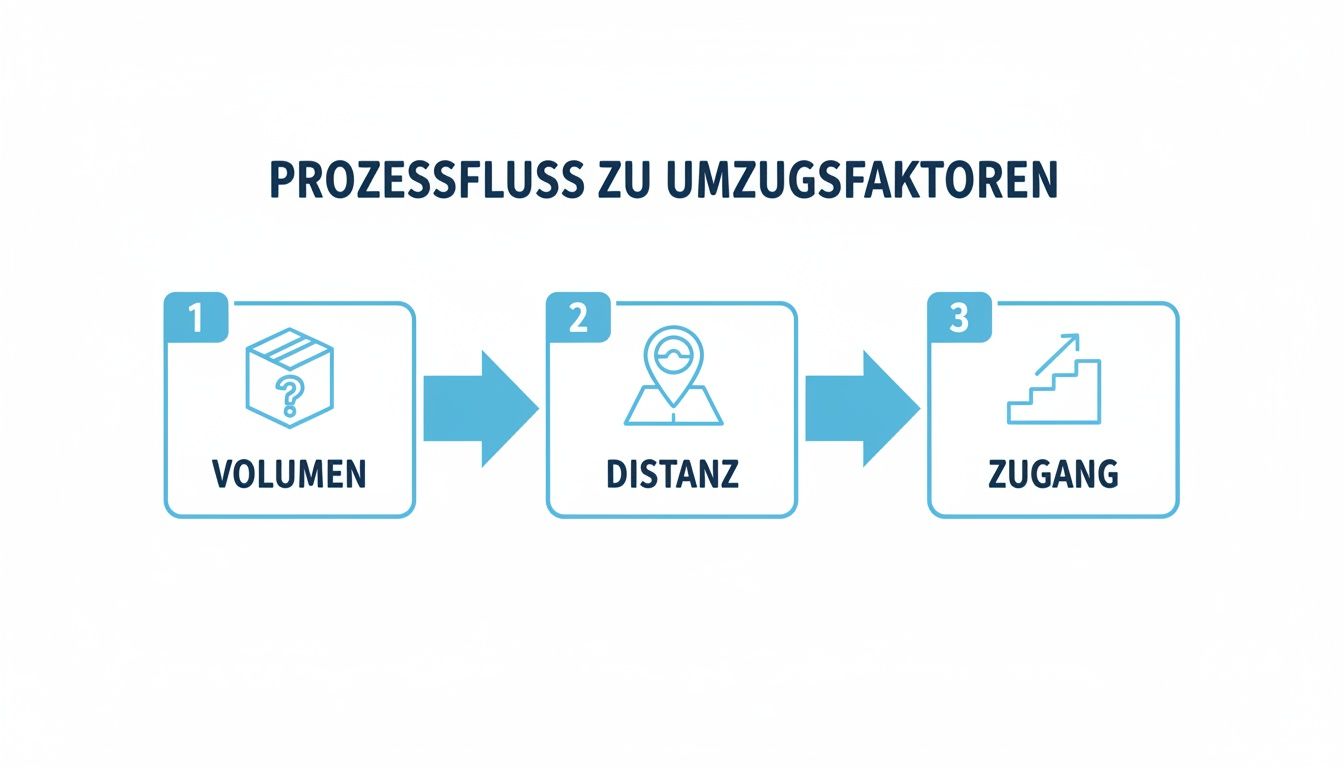
As you can see, there are three pillars on which the cost calculation is based: the volume of your household goods, the transport distance and how easily the apartments are accessible.
Quick estimate with the Rule of thumb
Are you considering different apartments and need an initial rough cost estimate? Then the rule of thumb is your best friend. It gives you a quick feeling for the financial framework.
The simplest variant is based on the size of the apartment and an average price per square meter.
- Rule of thumb:Living area in m² x approx. 25-35 CHF = estimated moving costs
Let's take a classic3-room apartment with 80 m²as an example. The calculation is simple: 80 m² x 30 CHF =2,400 CHF. This amount is a solid guideline for a standard move with a professional company.
Another common method estimates the moving volume. Here you can expect about 45 to 60 m³ per room. For our 3-room apartment that would be around50 to 70 CHF. For a professional company, a cubic meter of moving goods costs approximatelyThese are estimates, not a fixed price. They cover a standard move, but not special services such as complex furniture assembly or piano transport. Use these numbers as a starting point, not as a final total.15 to 20 cubic meters (m³)
The detailed line item calculation for maximum accuracyImportant:
As the moving date approaches, it is time for a detailed list of all costs. This is the only way to get a truly reliable budget. This is a little more effort, but it effectively protects you from unpleasant surprises.
Start listing all conceivable cost items. Here is a typical list:
Get specific offers. Pay attention to whether you are billed based on effort or at a fixed price. You can find out more about this in our guide to the
- Estimate how many boxes (approx. 1 per m²), rolls of adhesive tape, protective films and blankets you need..Kosten einer Umzugsfirma pro Stunde in der SchweizCosts for the moving company:
- Plan costs for furniture dismantling and reassembly, packing service or the Final cleaning with acceptance guarantee.Packaging material:
- Don't forget about re-registration fees and the forwarding order at the post office.Additional services:
- Always planAdministrative fees:
- Buffer for unforeseen events:Your estimated budget as a reserve. Better safe than sorry.10-15%Ihres geschätzten Budgets als Reserve ein. Sicher ist sicher.
When planning your liquidity, don't forget to keep an eye on the deadlines and conditions fordie Rückzahlung der MietkautionYour old apartment.
Moving on your own: the hidden costs
At first glance, moving on your own seems like the cheapest solution. But be careful, there are often hidden costs lurking here that quickly make the supposed bargain expensive.
A realistic comparison is therefore essential.
| Cost point | Moving on your own (estimated) | Professional moving (example) |
|---|---|---|
| Van rental (1 day) | 200-300 CHF | Inclusive |
| Kilometer flat rate/fuel | 50-100 CHF | Inclusive |
| Insurance (liability) | 50-150 CHF | Inclusive |
| Moving helper (private) | Food (approx. 100 CHF) | Inclusive |
| Packaging material | 150-250 CHF | 150-250 CHF |
| Total costs (approx.) | 550-900 CHF | From 1,300 CHF (example) |
What this table doesn't show: the immense personal effort, the stress and the risk of damage, for which you ultimately have to pay yourself.
Interestingly, most moves in Switzerland take place over relatively short distances. The Federal Statistical Office (BFS) has determined that the average moving distance is just 13.5 kilometers. This means that it's not the kilometers that eat up the budget, but rather the amount of work and the volume. This is exactly where professionals score points with their efficiency.
Practical tips to reduce your moving costs
A precise budget is half the battle, but active saving really makes the difference. If you want to optimize yourCalculate moving costsand the result, there are a surprising number of levers you can use - and without having to compromise on quality.
With these tried-and-tested strategies you can noticeably reduce your expenses and make the move as financially lean as possible.
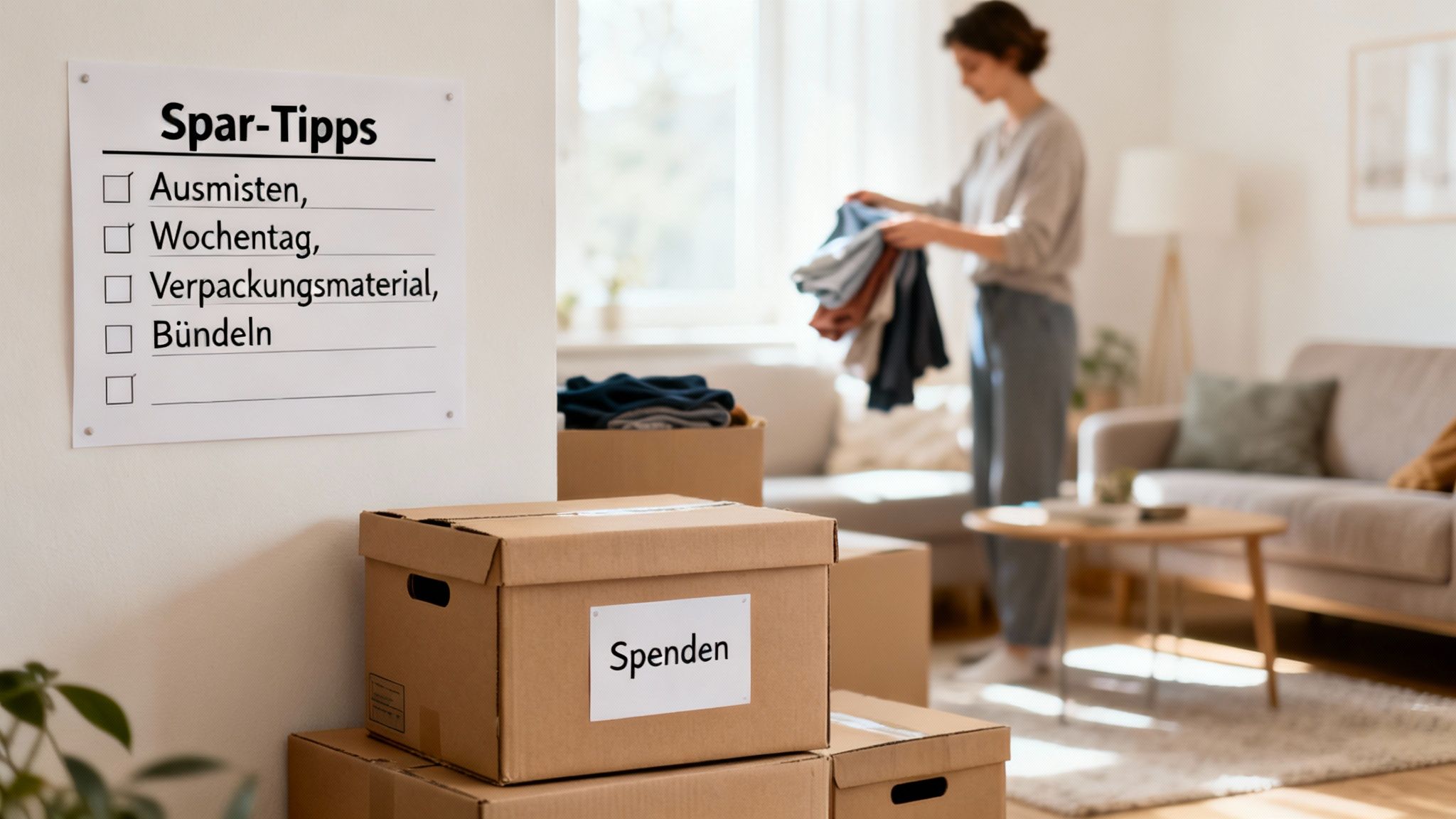
Less is more: clearing out reduces this Transport volume
Probably the most effective way to reduce moving costs begins weeks before the actual moving day: withConsistent clearing out. Every book, every piece of furniture and every box that you don't take with you reduces your transport volume. A lower volume means a smaller moving truck, fewer working hours and therefore lower costs.
It's best to go through room by room and ask yourself honestly: Do I really still need this? Many items can be sold, donated or disposed of properly.
- Online marketplaces:Furniture or electronics in good condition can often be turned into cash.
- Brockenhäuser and donations:Give clothes, books or household goods to charities. That feels good and helps others.
- Disposal yard:Clarify what you can dispose of free of charge in your community to avoid expensive bulky waste fees.
This process not only saves money, but also ensures a wonderfully fresh start in your new home - without any unnecessary waste Ballast.
Flexibility when it comes to moving dates pays off
The timing of your move has a massive influence on the price. The greatest demand from moving companies is on weekends, especially Saturdays, as well as on the official moving days at the end of the month. If you are flexible here, you can save a lot.
Moving during the week, ideally between the5. and 20th of a month, is often the caseup to 25% cheaper. The moving teams are then less fully booked and you have a larger selection of available dates. When getting a quote, it's worth asking specifically about the price differences between different days of the week.
Packing cleverly without high material costs
Packaging material can quickly add up to a considerable cost. But there is great savings potential here if you get a little creative. Instead of buying expensive new boxes, you can use inexpensive or even free alternatives.
The best savings potential often lies in the little things. Instead of paying for every little thing, use existing resources wisely. This not only protects the budget, but also the environment.
Just ask supermarkets, bookstores or friends for sturdy boxes. By the way, banana boxes are an insider tip and are ideal for heavy items. Instead of expensive cushioning film, you can use towels, bed linen or clothing to safely pack fragile things. This way you can kill two birds with one stone.
Choose the right service mix
A complete move in which the company takes care of everything from A to Z is convenient, but also the most expensive option. Think carefully about which tasks you can do yourself and where professional help is essential.
- Pack it yourself:You can easily pack and unpack the boxes yourself. This will immediately save you many hours of work for the moving team.
- Furniture assembly:Smaller furniture can often be easily disassembled and reassembled yourself. Book the professionals specifically for heavy or complicated pieces such as a large cupboard or the bed.
- Book a partial move:Concentrate the professional help on just transporting the heavy furniture and boxes. You can do the rest with friends or family.
With this modular approach, you retain full cost control and only pay for the services you really need. Even though the following article focuses on event catering, it offers interesting perspectives on how you can generallyKosten senkenby planning resources efficiently.
Another important aspect that can ease the burden on your budget is tax deductibility. Find out in our guide how you can bundle yourUmzugskosten clever absetzen und bei der Steuererklärung sparen.
transports and benefit from consolidation
A modern and particularly smart saving method is the bundling of transports. Providers likeTIXPIuse intelligent route planning to cleverly combine several small transports or moves on a similar route.
The principle is simple: the moving truck not only drives for your order, but also picks up or delivers other loads along the way. The cost of the trip is spread across several customers, which lowers the price for each individual. At the same time, CO₂ emissions are reduced - a real benefit for your wallet and the environment.
So, what is the best way to calculate moving costs? Now that we've examined the classic methods, let's look at a completely different approach - one that turns the entire process on its head. Forget the tedious process of obtaining various offers and waiting days for feedback. With TIXPI you can do this directly and absolutely transparently.
With TIXPI there is no need for annoying waiting. Instead, you will immediately receive a clear, fixed price for your transport or move online. This immediate clarity not only makes budget planning faster, but also much more relaxed.
Immediate transparency with the maximum price principle
One of TIXPI's most important promises is absolute cost security from the first second. The secret behind it? TheMaximum price principle. The price you see when booking is the absolute maximum you will pay. There are no hidden fees or nasty additional charges. Point.
This approach removes the greatest uncertainty from the entire moving calculation. You know exactly what budget you need to plan for and can be confident that the final amount will never exceed this maximum price.
The maximum price principle is more than just a number. It is a promise of financial predictability and trust. It takes the stress out of budget planning and gives you back full control.
And it gets even better: If we can make your transport more efficient through clever route planning, your bill could even end up beinglowerout. This means you can benefit directly from our logistical advantages without taking any risk yourself.
Intelligent route planning reduces costs and CO₂
A huge advantage of the TIXPI model is the intelligent bundling of transports. Instead of each truck only driving for a single customer, our system combines orders that are on similar routes. This consolidation has two brilliant effects.
Firstly, journeys become much more efficient. Empty kilometers are avoided, which means theCO₂ emissions per transport massively reduced. Secondly, the costs for the entire route are spread across several customers. What this means for you is that the costs for your order often drop noticeably.
Current data shows that in Switzerland moving is mostly over short distances. The moving rate was recently just9.3 percentand the average distance was just13.4 km. More about theseEntwicklungen auf dem Schweizer Umzugsmarkt erfahren Sie auf srf.ch. This trend towards local transport plays perfectly into our model’s hands. By bundling such trips, we achieve maximum efficiency and can pass on the cost advantages directly to you.
A practical example of shared costs
Imagine you want to transport a single, large wardrobe from Zurich to Bern. With a traditional provider, you would have to cover the full cost of the transporter and the team's working time for this route alone.
With TIXPI, things look completely different:
- Your order:A cupboard from Zurich to Bern.
- System analysis:TIXPI finds another customer who wants to transport a chest of drawers from Aarau to Friborg - a route that is perfect overlaps.
- Consolidation:The truck first picks up your closet in Zurich, then grabs the chest of drawers in Aarau and delivers both on an optimized route.
The costs for the trip, fuel and working time are now fairly divided between you and the other customer. This means your final price will be significantly cheaper than if the truck had been on the road just for you. It is precisely this flexibility - from transporting a single item to a complete move - that makes TIXPI a smart, efficient and environmentally friendly alternative.
Any questions? Here are the answers.
Finally, we would like to clarify a few questions that we often come across in connection with moving planning. Consider it a final little checklist to give you final peace of mind when planning your budget.
How early should I book a moving company?
The right time is crucial here if you want to secure the best prices and your desired date. Especially on the highly sought-after moving dates at the end of the month or on weekends, the calendars of good companies fill up in a flash.
As a rule of thumb, it's proven itself: Ideally, book your moving companysix to eight weeksin advance. In quieter phases of the year, four weeks is often enough. Those who plan early not only have more choice, but often also get better conditions.
Are my things insured during the move?
Yes, one less thing to worry about! Professional moving companies in Switzerland must have a Transport and liability insurance. This kicks in if damage occurs that can be proven to have been caused by the moving team.
But be careful:Take a close look at the scope of coverage. There are often upper limits per cubic meter or per claim. For particularly valuable items such as art, heirlooms or expensive electronics, additional private transport insurance can really be worthwhile.
Always have the insurance details confirmed in writing by the company before you get started. This way you are on the safe side and know exactly what is covered if the worst comes to the worst.
Can I deduct the moving costs from my taxes?
That's the best news at the end: Under certain circumstances, you can deduct the moving costs in Switzerland from your taxes and thus noticeably reduce the burden on your budget. The most important requirement is that the move isA professional reason exists, for example, if:is for professional reasons
You are moving to another city for a new job.
- Your commute will be significantly shorter as a result of the move.
- Your employer is moving you to a new location offset.
- Simply collect all receipts - from the invoice from the moving company to the costs for the final cleaning. You can then declare these as professional expenses when filing your tax return.
You can see: with the right planning and a reliable partner, calculating your moving costs becomes a manageable project.
not only takes away the uncertainty through immediate price transparency, but also ensures a professionally organized move.TIXPITIXPI
Planen Sie jetzt Ihren Umzug stressfrei und zum Festpreis mit TIXPI