
Anyone who wants to buy a self-occupied condominium in Switzerland usually needs20% own funds, of which10% as non-pledged liquid assets. In addition, you should plan3 to 5% of the purchase pricefor notary, land register and transfer tax, because these two cost blocks are most often underestimated by first-time buyers.
Many just calculate the purchase price and the mortgage, and end up then in the first case with the reservation contract. In Switzerland, buying an apartment is not a single act of purchase, but a sequence of financing, valuation, cantonal fees, approval issues and only then moving in. If you set this up properly, you not only save yourself stress, but often also save yourself from expensive wrong decisions.
Why buying an apartment in Switzerland is not a standard product
The first mistake is banal and expensive. Many people look at the advertisement, add up their savings and believe that the way is clear. Things work differently in Switzerland: financing first, viewing second. Anyone who twists this order will fall in love with an apartment that later fails because of the bank, loan value or approval.
Practical rule:First clarify the financing, then view it. Anyone who looks first and only then calculates is negotiating too late financially.
Before the first viewing, a clear preliminary clarification is required. This means that income, current obligations and the source of equity must be on the table. The 10% hard own funds are particularly sensitive because they cannot come from occupational pension plans when it comes to owner-occupied residential property.
The order in which the purchase is concluded, moved in and approved is just as important. Anyone who only judges an apartment based on its location and floor plan quickly overlooks the fact that the purchase is not reduced to a notary appointment. In many cases, there are cantonal transfer taxes, practical moving issues and, depending on the status, licensing issues. This must be clarified before the commitment is made, not after.
The second error in thinking concerns the bank's internal value. The bank does not base itself on the desired price, but rather on its own loan-to-value ratio. If this is lower, financing immediately becomes tighter and the difference must come from additional equity. That's exactly why a nice advertisement is never enough as a basis for a purchase.
ThisLowest value principlemakes purchasing in Switzerland conservative, and consciously so. This is inconvenient for buyers, but fair. The bank protects itself against overpayment, and you have to expect a valuation that can be below the market price.
If you want to properly prepare the closing, you first check the financing, approval and moving logistics, and only then the apartment itself. The next section shows how exactly equity, loan-to-value and affordability interact.
Equity, loan-to-value and affordability understand
When it comes to a condominium in Switzerland, it is not the listing price that decides, but rather the banking logic. If you notice this too late, you lose time, negotiating power and often the apartment you want. In practice, the following applies to owner-occupied residential property:20% equity, of whichat least 10% of the purchase pricefrom non-pledged, liquid assets. Anyone who cannot clearly prove this hard equity ratio will quickly fail the preliminary examination.
The second stumbling block is thisMortgage lending valueThe bank values the property internally, and this value may be lower than the purchase price. The bank then finances only on the basis of its accepted value, not on the basis of your offer. This is precisely where a financing gap often arises, which can only be closed with additional equity. Anyone seriously preparing for the deal therefore clarifies financing, move-in and permit questions before making the reservation payment, not afterwards.
How the lower-of-cost-or-market principle applies
Thelower-of-cost-or-market principlemakes buying property in Switzerland a conservative affair. It protects the bank from overpaying, but forces you to take a realistic view of the market. In hot locations this is particularly unpleasant, because market prices rise quickly while the bank's valuation remains lower.
The practical consequence is clear. A mortgage only covers the value accepted by the bank, and the difference has to be cushioned with your own funds. Anyone who cuts it too fine here puts the entire transaction at risk.
Affordability is not assessed using your effective interest rate
What counts for affordability is not your current offered rate. Lenders calculate with an imputed interest rate of around4.5 to 5%, plus amortisation and maintenance. The burden should generally not exceed one third of gross income. For owner-occupied residential property, FINMA cites a limit of33% of sustainable gross income FINMA-Faktenblatt zum Hypothekarmarkt.
| Item | Benchmark | Note |
|---|---|---|
| Total equity | 20% | Standard for owner-occupied residential property |
| Hard liquid funds | 10% | Not pledged, not from an occupational pension withdrawal |
| Loan-to-value ratio of the mortgage | max. 80% | Based on the accepted mortgage lending value |
| Imputed interest rate | around 4.5 to 5% | For the affordability calculation |
| Affordability | around 33% | Interest, amortisation and maintenance combined |
Anyone who already has other obligations needs to do this calculation early on. Existing debt also counts. For thorough preparation, it helps to take a look atTipps zur DSCR-Verbesserung, not because it involves the same financing framework, but because the same logic avoids the same mistake of planning too tightly.
Mortgage models in direct comparison
Choosing a mortgage is not a lifestyle decision, but a risk profile. First-time buyers usually want security, but they often underestimate how much effort, flexibility and interest rate risk differ from model to model.
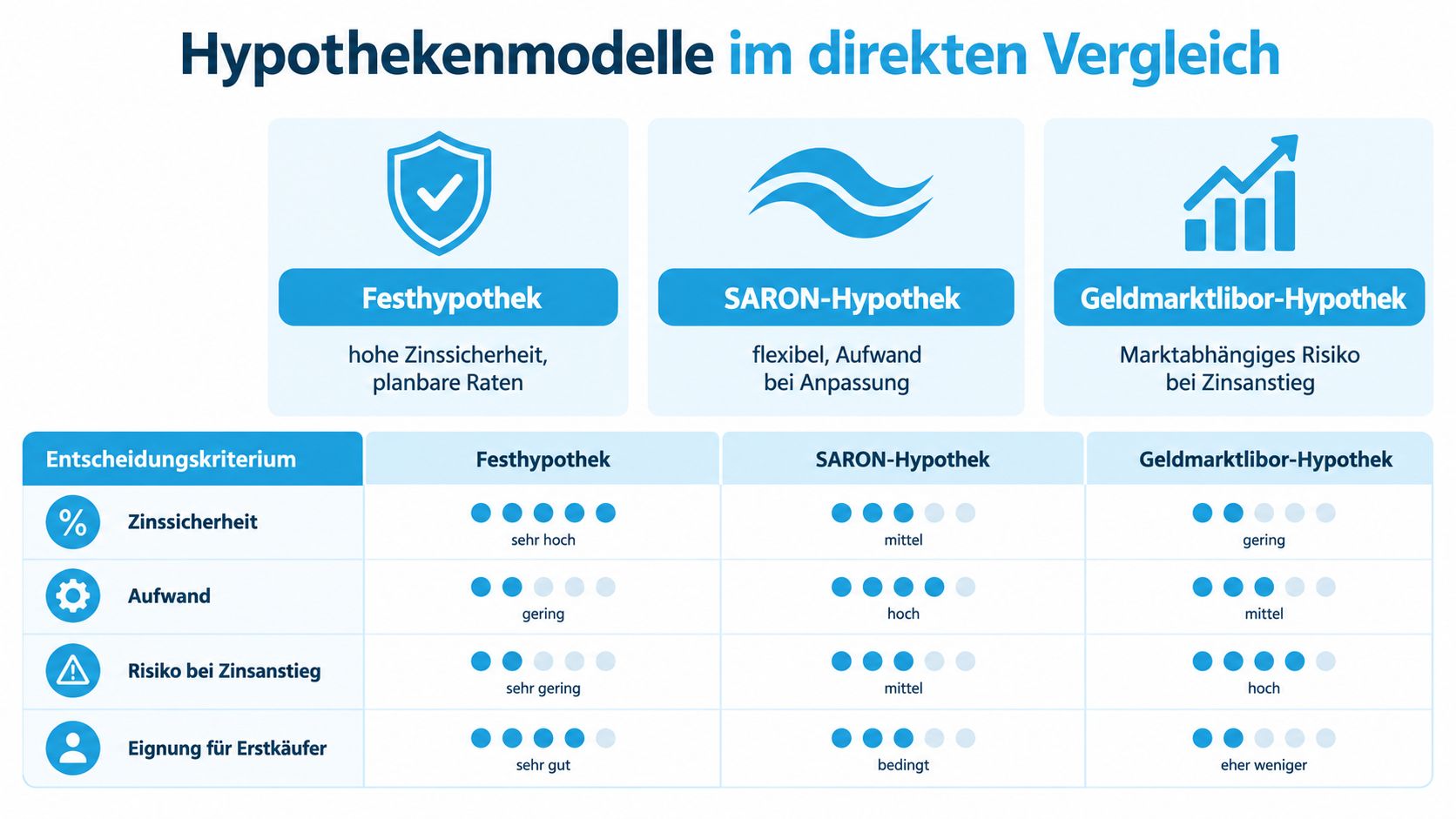
A fixed-rate mortgage is the cleanest start for many first-time buyers
Thefixed-rate mortgageprovides planning certainty. Anyone who wants to keep their monthly burden stable and predictable is usually best served here. The price for this is less flexibility, because you commit to a fixed term and cannot simply benefit from falling interest rates.
That is not a bad choice. On the contrary, for buyers with tight affordability or little buffer it is often the most sensible solution, because it clearly limits the interest rate risk.
SARON and money market Libor are more flexible, but more demanding
TheSARON mortgageis more flexible, but requires more attention. It suits buyers who can cope with interest rate movements and actively keep an eye on their financing. In practice, the classicmoney market Libor mortgageis the older comparison model that reflects the same logic of a market-based interest rate, meaning closer ties to the market, but also more uncertainty when rates rise.
For first-time buyers, a simple order of priorities therefore applies. If the reserve is small, security wins. If your income is stable and you can absorb fluctuations, a more market-oriented model can make sense – but not as a reflex, rather out of conviction.
Don't misread the amortisation
From a higher loan-to-value ratio onwards, amortisation becomes relevant, and this is exactly where many buyers make mistakes. They only see the monthly instalment, but not the repayment pressure in the background. Indirect amortisation via pillar 3a can make sense if you want to preserve liquidity while keeping things clean from a tax perspective.
Clear recommendation:First stress-test affordability, then choose the mortgage. Anyone who does it the other way round often optimises the interest rate and worsens the risk.
Budget realistically for the incidental purchase costs
An apartment has been signed for, the notary appointment is set, and only then do many buyers realise that the incidental costs are what really create the pressure. This is exactly where a seemingly clean budget quickly becomes a tight corridor, especially when the move, initial adjustments and regional permit questions are also on the agenda.
The incidental costs consist ofnotary fees,land registry feesand thecantonal property transfer tax. These items often determine whether the purchase is still comfortably financeable or whether liquidity becomes too thin afterwardsPreisüberwacher zu Grundbuch- und Beurkundungsgebühren,ESTV zur Handänderungssteuer.
Why the 3 to 5 percent is only a starting value
As a rough guideline, people often cite3 to 5% of the purchase price. In practice, that only works as a first filter. The actual burden depends heavily on the canton, and the fee logic is structured differently depending on the locationPreisüberwacher zur Kostenlogik.
With an apartment costingCHF 1,000,000we are quickly talking aboutCHF 30,000 to 50,000on top of the equityZurich zur Budgetierung von Kaufnebenkosten. Anyone who doesn't set this amount aside in advance comes under pressure at closing. The question therefore belongs before the signature, not after.
The assessment basis is not always the purchase price
The property transfer tax is generally calculated on the basis of the purchase price. In special cases, however, the market value may become decisivePreisüberwacher zur Kostenlogik. This applies, for example, to transactions with unusual pricing, gifts, or constellations in which the contract price differs significantly from the market value. A flat percentage calculation is therefore only a preliminary step, never the final figure.
In Switzerland, it is particularly worth taking a look at the canton. In certain cantons, land registry fees are calculated on a degressive basis. This noticeably changes the budget logic, because the share of transaction costs differs depending on the purchase pricePreisüberwacher zu Grundbuch- und Beurkundungsgebühren.
The cost matrix belongs before the reservation
A clean cost overview is needed before the reservation. It brings together the purchase price, fees, renovation reserve and moving costs. Anyone who doesn't put this calculation in writing only sees the purchase price and overlooks the follow-up costs that arise directly upon moving in.
- Purchase price:Starting point, not final total.
- Fees:Notary, land registry, property transfer – clarify at cantonal level.
- Reserve:For renovations, special levies and surprises.
- Move:Moving in also costs money.
A clear structure is better suited to preparation than a rough estimate. A practicalBudget-Vorlage für den Wohnungskaufhelps to pull the figures together cleanly before the notary appointment.
From the reservation agreement to the transfer of ownership
Anyone in Switzerland who reserves an apartment purchase too early often ends up paying twice – through delays, additional costs or a withdrawal made under pressure. The legal process is sober, but it determines money, time and the move-in. Check first, then reserve.
Which documents must be on the table before you sign
Before paying the reservation fee, you should have theland register extract, theeasements, therules of the condominium owners' association, the minutes, therenovation fund, the annual accounts and the ancillary costs on the table. Anyone who does not request these documents is buying not only living space, but also obligations that can become expensive later on.
Also check the documents relating to the viewing and the condition of the property, for example with theCheckliste für die Wohnungsbesichtigung. This is exactly where defects, renovation needs and vague promises come to light first.
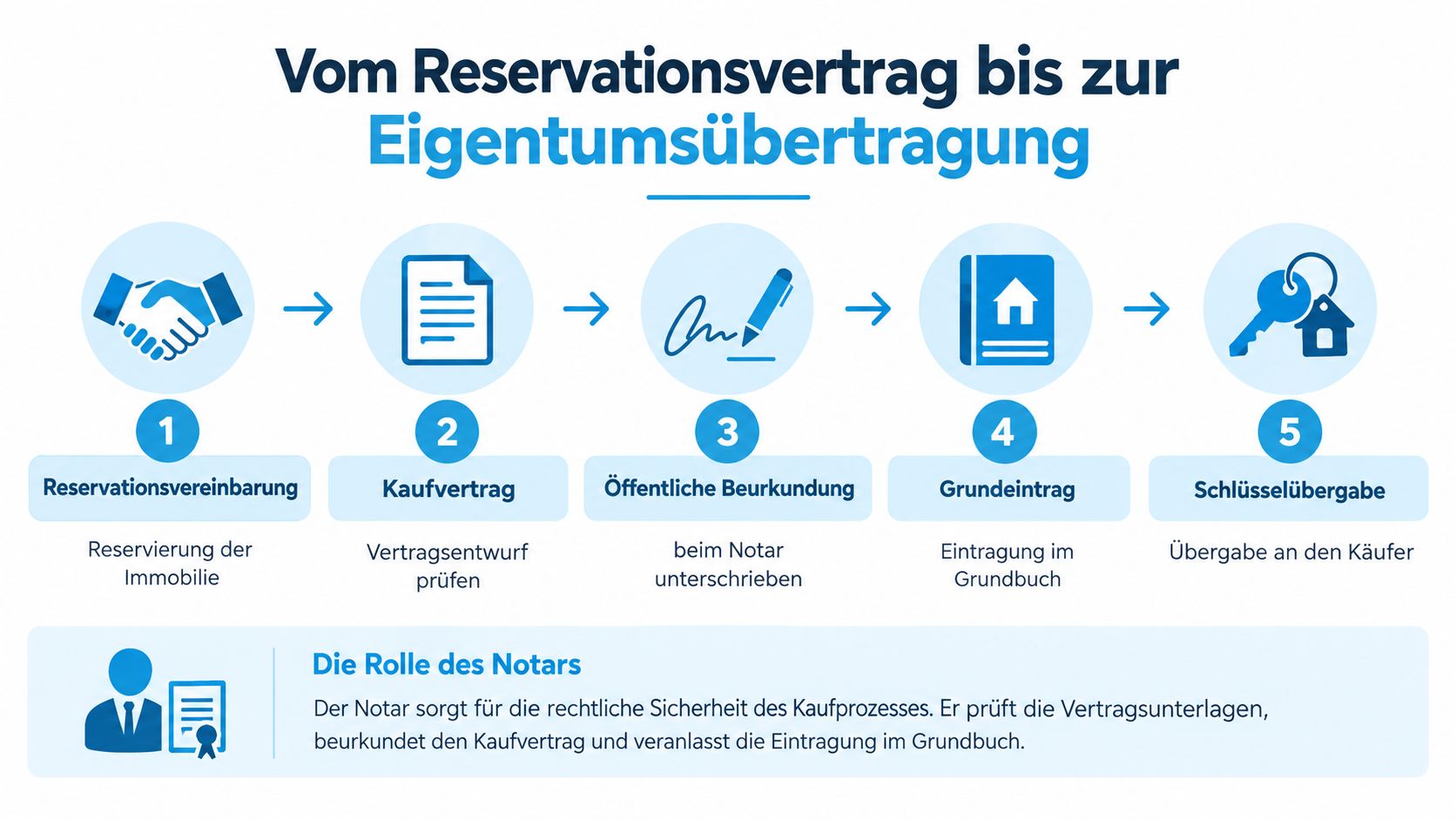
The notary handles the public notarisation and the legally secure transfer. Registration in the land register is carried out by the competent cantonal office. Depending on the canton, notarisation fees, land register fees and in some cases property transfer taxes apply – this is no small matter and belongs in the budget from the outset (Price Supervisor).
The five steps without chaos
- Reservation agreement:The apartment is reserved – which only makes sense once financing is clarified and the permit situation is clean.
- Purchase contract:Check the draft carefully, especially encumbrances, deadlines, handover and special arrangements.
- Public notarisation:The contract is signed at the notary's office and recorded in a legally valid manner.
- Land register entry:Only with this entry does ownership transfer properly.
- Handover of keys:This is the practical change of possession. From here, the move-in logistics begin with furniture, tradespeople and any renovations.
Anyone who mixes up the move, renovation and contractual situation creates unnecessary risks. This applies especially when delivery dates are already running or tradespeople have been booked.
Practical tip:Never reserve on trust alone. Financing, dossier and permit status must be clearly set out in writing before payment.
Clarifying permits and status questions
Nationality alone is not decisive. Place of residence, permit status and the type of property determine whether the purchase is possible at all. Anyone who does not check this properly before the reservation risks a signed contract without a clear basis.

What federal law actually provides for
The acquisition of real estate by persons abroad is generallysubject to cantonal authorisation Bundesamt für Justiz. For EU/EFTA nationals resident in Switzerland, simplified rules often apply. Third-country nationals without a C permit are usually considerably more restricted. This is not a marginal issue – it can stop a purchase immediately.
The planned revision increases the pressure further. Following the planned revision, this is also to apply to the purchase of a main residence by third-country nationals. Anyone buying now must therefore also consider the next step in their status, not just their current permit.
The right order before paying the reservation fee
First check the residence permit, then submit a written enquiry to the competent authority, and only then reserve. Anyone who pays too early is tied to a property before the permit question has been clarified.
- Check residence status:B, C, EU/EFTA or third country – this has direct consequences.
- Contact the cantonal authority:For example the Zurich Land Registry Office or the Bern permit authority, ideally with a written preliminary clarification before paying the reservation fee. Expect around 2 to 4 weeks for a reply.
- Assessing the permit risk:Not every canton checks with the same strictness, and practice is not identical everywhere.
- Coordinating move-in and relocation:For practical preparation, it helps to have an overview ofUmziehen in die Schweiz, especially when the permit, delivery dates and move-in all fall closely together.
Anyone who only clarifies the status after signing loses time and often bargaining power as well.
From the signed contract to a move-in-ready apartment
The purchase contract is not the move-in. Between signing and a habitable home lie the handover protocol, delivery windows, access checks, furniture assembly and usually the disposal of old furnishings too. Anyone who organises this at the last minute almost always pays for it with stress.
What specifically needs to be checked before moving in
First comes thehandover protocol. Doors, floors, connections, lift and access routes have to work before suppliers arrive. Then come the handover of keys, measuring the routes and the question of whether the furniture will even fit through the stairwell or into the lift.
This is exactly where it is decided whether a combined transport makes sense. If delivery, assembly and disposal are bundled into a single process, you often save unnecessary duplicate trips and reduce the coordination effort. That is not only practical, but often also the cleaner solution for a new owner-occupied apartment.
A sober 14-day move-in logic
- Day 14 to 10:Handover protocol, record defects, measure access routes.
- Day 9 to 7:Confirm delivery windows, schedule furniture assembly.
- Day 6 to 4:Dispose of old furnishings or have them collected.
- Day 3 to 2:Clarify short-term storage in case the move-in date falls through.
- Day 1 to 0:Handover of keys, final inspection, move-in.
This sequence prevents you from ordering furniture before you really know the access situation. Especially with owner-occupied apartments with a lift, a narrow access road or special rules set by the property management, this is crucial.
Why price developments nevertheless remain relevant
According to PwC, the median transaction price for owner-occupied apartments in Switzerland in February 2026 wasCHF 920,000, and Raiffeisen reported a year-on-year increase of4.2% PwC zu Eigentumswohnungen 2026for owner-occupied apartments up to the second quarter of 2026. Above all, this shows one thing: a stable median does not mean that your property or your region is stable. So budget for the move-in on a regional basis and not by gut feeling.
TIXPI helps you exactly where many guides stop, with the actual move-in. If you need a clean solution for transport, delivery, assembly or disposal after your purchase, go directly toTIXPIand plan your move-in so that the purchase really does turn into a habitable home.