
Moving in Switzerland is more than just packing boxes and transporting furniture. It is an administrative and logistical process that requires precise and careful planning to avoid stress, unexpected costs and administrative pitfalls. Anyone who knows the specific Swiss conditions - from the registration deadlines with the municipality to the cantonal rules for disposal - secures a decisive advantage for a smooth process.
This comprehensiveSwiss moving checklistis your practice-oriented companion that will guide you chronologically through all the important phases of your change of residence. We have structured the essential tasks for you: from planning weeks in advance to the crucial steps on the day of the move itself to the final tasks in the new home. Each point is designed to give you concrete, actionable instructions so that you don't overlook anything.
We show you how to avoid typical mistakes, save not only costs but also CO₂ through clever planning and keep a complete overview at all times. Regardless of whether you want to organize the move yourself or rely on the expertise of professionals to help you with individual tasks such as furniture transport, assembly or disposal: this guide will ensure that your start to your new home is as efficient and relaxed as possible. Let's start with the first and most important step, solid and forward-looking planning.
1. Obtain moving offers and compare prices
The first and probably most crucial point on everyChecklist for moving in Switzerlandis obtaining and comparing moving offers. Early and careful planning in this phase lays the foundation for a smooth and budget-friendly apartment move. It's about creating transparency and finding a reliable partner for your big day.
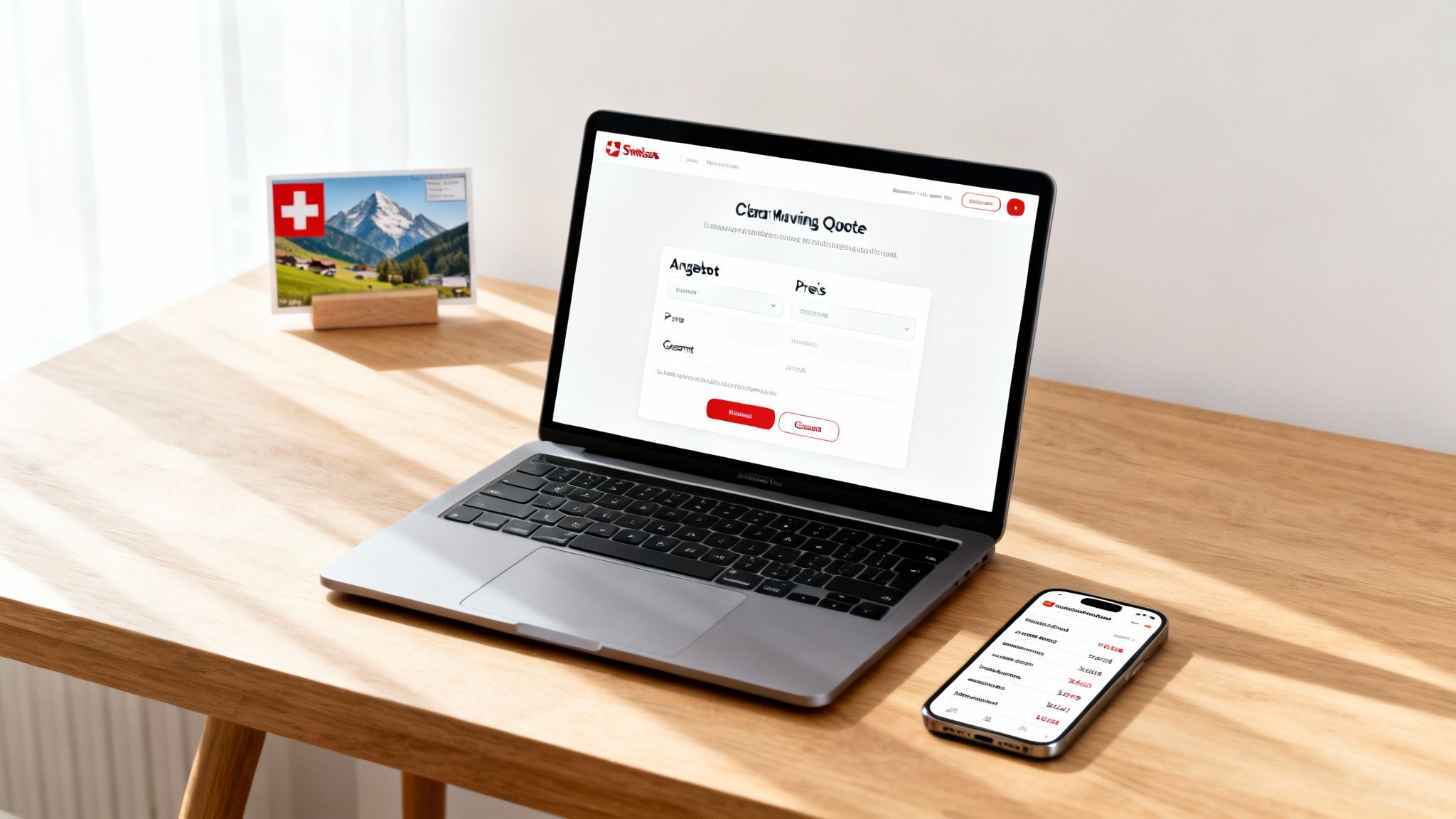
Instead of waiting for traditional, often time-consuming offers, modern platforms like TIXPI offer immediate price calculation. You simply enter your key data such as volume, distance and special items (e.g. a piano) online and you will immediately receive a transparent maximum price. This eliminates uncertainty and enables precise budget planning right from the start.
How to proceed strategically
An accurate inventory list is essential for a precise offer. List all pieces of furniture and the estimated number of moving boxes. Not only will this help you get an accurate quote, but it will also serve as a checklist when packing and unpacking.
Practical Tips for Comparing Quotes:
- Detailed inventory list:Make a comprehensive list of all the items you need to transport. Many online calculators, like TIXPI's, will walk you through this process.
- Check scope of services:Don't just compare the final price. Pay close attention to which services are included. Are packing materials, disassembly/assembly of furniture or final cleaning included?
- Use flexibility:Check whether the provider offers discounts for flexible moving dates. Moving during the week or outside the end of the month is often cheaper.
- Ask about consolidation:Platforms that bundle several moves on similar routes can offer significant cost advantages. Actively ask about suchCarbon and cost-saving options.
- Read reviews:Research other customers' experiences with the company in question to ensure reliability and quality of service.
2. Report a change of address to the authorities
A central and legally binding point on everyChecklist for moving in Switzerlandis the official notification of your new address. Any change of residence must be reported to the relevant authorities. This re-registration at the residents' registration office in your new municipality is not just a formality, but a legal obligation, the failure of which can lead to fines.
In Switzerland, the registration system is regulated cantonally, which is why the exact processes can vary depending on where you live. Basically, you have to deregister from your old municipality and register with the new municipality within a legal period, usually 14 days. This administrative step ensures that your data in the residents' register is correct, which is crucial for taxes, voting and other official matters.
How to proceed strategically
Inform yourself about the specific requirements of your new residential community before you move. Some municipalities, such as the city of Zurich, allow convenient online registration via a city portal. Others, such as Geneva, require a personal visit to the responsible office (Contrôle des habitants). In Bern, registration is often coordinated directly with the tax administration. An early clarification saves you stress and ensures a timely re-registration.
Practical tips for re-registration:
- Observe deadlines:As a rule, register within 14 days of moving. Clarify the exact deadline with your new municipality.
- Prepare documents:Have all the necessary documents ready. This usually includes a valid ID (passport or ID), the rental agreement, the residence permit for Swiss citizens and the foreigner's ID card for international newcomers.
- Deregistering from the old community:Remember to de-register with your previous municipality of residence. This can often be done at the same time as registering at the new location, but not always.
- Find out more:In addition to the residents' registration office, you also have to inform other important authorities of your new address. These include the post office, banks, insurance companies, employers and the road traffic office. Find out more about theAdressänderung bei einem Umzug.
- Keep the confirmation:Keep the registration confirmation as it serves as official proof of your place of residence.
3. Plan the moving date and book it bindingly
Choosing the right moving date and securing it early are a central pillar of yourChecklist for moving in Switzerland. This step coordinates everything else: from terminating the old rental agreement to organizing helpers and services. Forward-looking planning prevents stress and bottlenecks, especially in a country with fixed moving dates.
Modern booking systems like TIXPI's allow you to reserve your desired date immediately and bindingly. Instead of waiting for callbacks or email confirmations, you see availability in real time and can set your moving date directly online. This creates immediate planning security and allows you to concentrate on the next steps.
How to proceed strategically
In Switzerland, removals focus heavily on the official moving dates at the end of March, June and September. During these periods, professional moving companies are often fully booked weeks or even months in advance. Therefore, plan your move as early as possible in order not only to get your desired date, but also to benefit from potentially better prices.
Practical tips for scheduling:
- Book early:Ideally reserve your moving company4 to 6 weeks in advance, especially for a move in the popular summer months (May to September).
- Flexibility pays off:Moving on a weekday instead of on the weekend is often significantly cheaper. Ask your provider specifically about price differences.
- Plan buffer time:Ideally set the moving date between the end of your old rental agreement and the beginning of your new rental agreement in order to have time for the apartment handover and final cleaning.
- Plan anti-cyclically:If possible, choose the low season (October to April). Availability is higher and prices are often lower.
- Obtain confirmation:Have the exact time frame for the moving day (e.g. 8:00 a.m. - 12:00 p.m.) confirmed in writing the day before to avoid misunderstandings.
4. Create and manage moving inventory
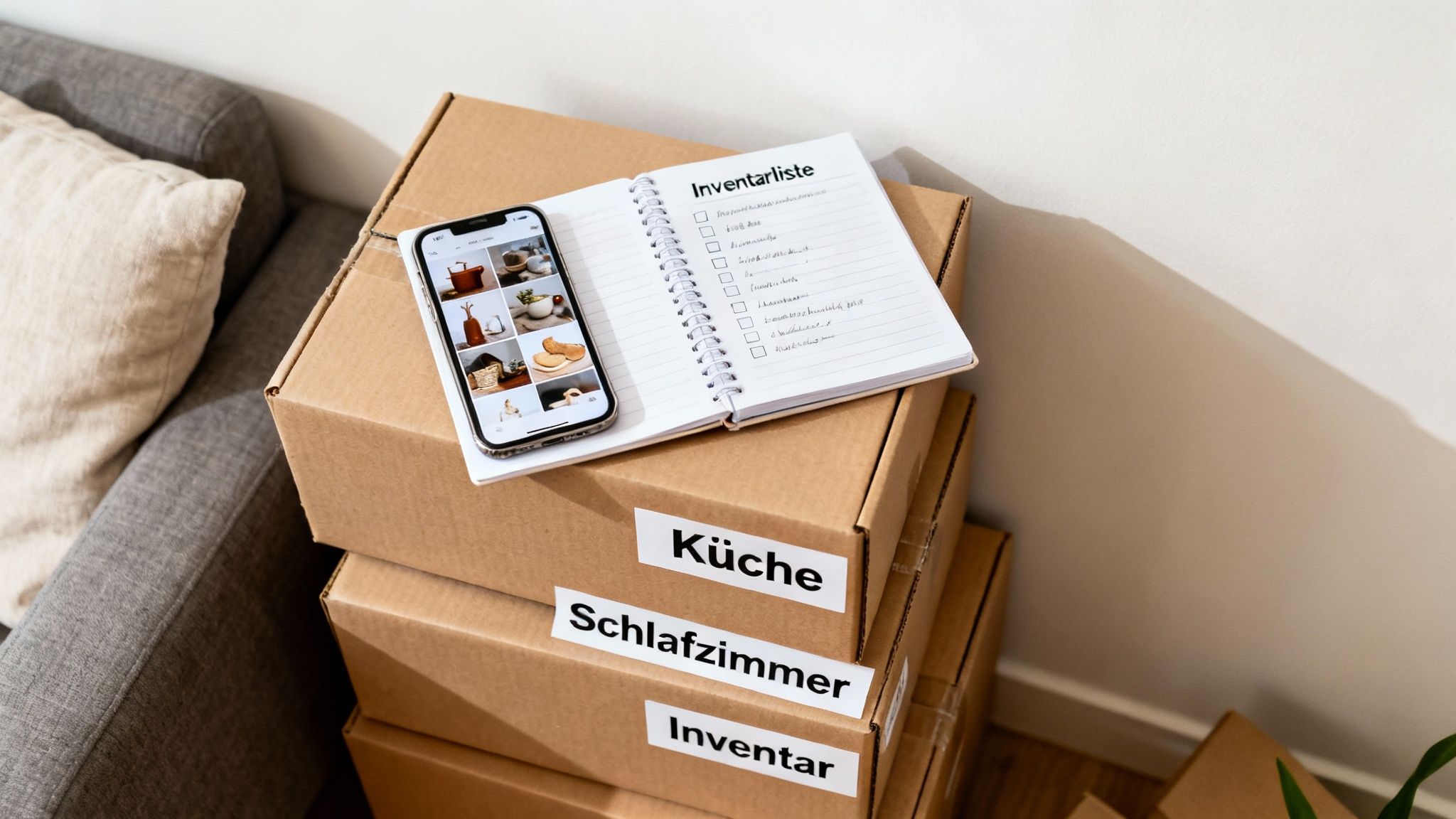
An often underestimated but crucial point on everyChecklist for moving in Switzerlandis the creation of a detailed inventory list. It is the backbone of an organized move and serves as an invaluable tool for quote accuracy, insurance and unpacking control. A well-maintained list ensures that no item gets lost and that you always have an overview.
The inventory list is the basis for a precise offer from moving companies. Instead of making rough estimates, you can get an exact price with a complete list, such as that needed for calculations on platforms like TIXPI. In addition, in the rare event of damage, it is indispensable proof for insurance.
How to proceed strategically
Start recording all items early. Proceed systematically from room to room so as not to miss anything. Digital tools such as apps or simple spreadsheets make management easier and make it possible to easily share the list with the moving partner.
Practical tips for your inventory list:
- Room-by-room method:Record all furniture, boxes and individual parts per room. Number the boxes and write the corresponding number on your list next to the contents.
- Note important details:For large pieces of furniture, add the dimensions and weight if necessary. This is particularly important when planning transport.
- Document condition:Take photos of valuable or delicate items. Note any existing wear or damage to avoid misunderstandings.
- Use digital helpers:Use apps or online tools that can often be synced directly with moving platforms. This way, your list always remains up to date and accessible.
- Share list:Send the finished inventory list to your moving company in advance. This allows for better planning and efficiency on moving day. Find out more aboutdie perfekte Packstrategie to optimally coordinate inventory and packaging.
5. Change of address: Inform important authorities
An often underestimated but critical point on everyChecklist for moving in Switzerlandis the timely notification of your new address to all relevant institutions. This administrative step ensures the seamless delivery of important mail, the continuity of contracts and prevents sensitive information from reaching the wrong address. Clean address management is the foundation for a smooth transition to your new home.
From the bank to insurance companies to the road traffic office – numerous authorities need to be informed about your change of residence. If you neglect this point, you risk reminders, contract problems or the loss of important documents. A systematic approach is the key to success here and will save you a lot of trouble after moving day.
How to proceed strategically
About two to four weeks before the move, start making a list of all the places that need to be informed. Go through your bank statements and correspondence from the last few months so that you don't forget anyone. Many changes can now be easily done online, which speeds up the process considerably.
Practical tips for changing addresses:
- Checklist create:List all institutions: banks (e.g. UBS, Credit Suisse), insurance companies (health insurance, liability insurance), employers, doctors, road traffic authorities, telephone and internet providers, subscriptions (newspapers, streaming services) and online shops.
- Set priorities:Start with the most important bodies such as employers, banks and insurance companies to ensure financial and contractual continuity.
- Set up a forwarding order:Apply for a forwarding order from Swiss Post. This intercepts mail that is sent to your old address and gives you a safety net for forgotten messages.
- Use online portals:Most large companies in Switzerland offer simple online forms or customer portals for changing addresses. This is the fastest and most efficient way.
- Retain confirmations:Save or print the confirmations of your address changes. They serve as important evidence in the event of discrepancies.
6. Registering and deregistering from pension funds
A crucial, often underestimated point on everyChecklist for moving in Switzerlandis registering and deregistering from the pension funds on time. Electricity, gas, water and internet must flow seamlessly from the old apartment to the new one. Early coordination is the be-all and end-all here to avoid being left without light or WiFi on the day you move in or continuing to pay for your old apartment.
The processes and deadlines vary considerably depending on the provider and canton. While electricity providers like the EWZ in Zurich are often flexible, gas suppliers or specialized internet providers can have lead times of up to six weeks. Therefore, take care of these administrative tasks early on to prevent gaps in supply and unnecessary stress.
How to proceed strategically
Start contacting your current and future providers at least four to six weeks before the moving date. Clear communication of the exact move-out and move-in dates is essential. This not only ensures a seamless supply, but also ensures a correct final bill.
Practical tips for re-registration:
- Observe deadlines:Contact all providers (electricity, gas, water, internet, TV) at least one month before the move. Make a note of the respective notice and registration deadlines.
- Document meter readings:Read the meter readings in the old apartment on the handover day and take a photo of them as proof. The same applies to the new apartment when moving in.
- Specify exact data:Include both the exact move-out date for the old address and the move-in date for the new one to avoid double payments or gaps in coverage.
- Request a final invoice:Make sure that your old provider knows your new address in order to send you the final bill correctly can.
- Special case of water:In many communities, the water supply is linked directly to the property management. Clarify whether you have to take care of this yourself or whether this will be handled by the administration.
7. Organize furniture delivery and assembly
The coordination of furniture deliveries and their subsequent assembly is a critical point on everyChecklist for moving in Switzerland. Whether it's beloved pieces from your old apartment or new purchases, precise scheduling ensures that your new home quickly becomes livable and functional. Good organization prevents you from having to camp between moving boxes or deliveries blocking each other.
This step requires coordination between your moving company and external suppliers such as Ikea or Möbel Pfister. Professional furniture assembly, such as the one TIXPI offers as an option, can be an enormous relief here. Instead of dealing with complex instructions and a lack of tools yourself, experienced specialists take over the setup quickly and correctly.
How to proceed strategically
The biggest challenge is timing. The transport of your existing furniture needs to be synchronized with the delivery windows for new furnishings. Ideally, plan deliveries of new, large furniture for the day after the actual move to ensure space and freedom of movement for the moving helpers.
Practical tips for furniture coordination:
- Central coordination:Bundle all delivery and assembly dates in one calendar. Coordinate the arrival times with your moving team.
- Check dimensions:Measure all doors, stairwells and corridors in advance to ensure that the pieces of furniture actually fit.
- Prioritize:Determine which furniture needs to be assembled first. The bed and kitchen table usually take precedence over shelves or side tables.
- Have assembly instructions ready:Ensure that instructions are at hand for any piece of furniture that needs to be assembled by a professional service.
- Document the condition:Take photos of your furniture before transport and after assembly. This serves as proof in the event of transport damage.
8. Organize furniture disposal and donations
Moving is the perfect opportunity to get rid of things that are no longer needed. Responsible disposal and donation of furniture are not only important from an ecological perspective, but also a central point at everyChecklist for moving in Switzerland. The strict disposal regulations and the numerous options for passing on items require early planning in order not to put unnecessary strain on the moving day.
Professional service providers such as TIXPI offer an environmentally friendly and efficient solution for this. Instead of having to worry about the tedious removal and correct disposal yourself, you can book the furniture disposal service directly. This ensures that large or bulky items are disposed of or recycled properly and in accordance with local regulations, saving you time and effort.
How to be strategic
About six to eight weeks before the move, start going through each room and deciding what to take, sell, donate or throw away. This early sorting prevents stress shortly before the move and creates clarity about the actual moving volume.
Practical tips for furniture disposal and donations:
- Sort early:Divide your items into “Keep,” “Sell,” “Donate,” and “Dispose” categories. This forms the basis for all further steps.
- Check donation options:Organizations such as Caritas or the Salvation Army are important contact points throughout Switzerland for furniture and clothing donations. Find out about their acceptance criteria and locations.
- Use online sales:Well-preserved furniture can be sold on platforms such as Tutti.ch, Ricardo or in the Facebook Marketplace. This not only creates space, but also improves the moving budget.
- Observe cantonal regulations:Inform yourself at the waste management office in your municipality or canton about the rules for bulky waste and the locations of recycling centers (disposal centers).
- Book professional disposal:For large pieces of furniture or a larger quantity For bulky waste, hiring a specialized service like TIXPI is the easiest solution. Plan collection well in advance of the moving date.
9. Hire professionals or organize the move yourself?
A central point on yourChecklist for moving in Switzerlandis the decision between a professional moving company and moving on your own. This choice affects not only the cost, but also the time required, the stress level and the security of your possessions. It's about weighing up what is more important to you personally: maximum cost savings or a smooth, professionally handled moving day.
Moving with professionals means relying on experience, efficiency and insurance coverage. Platforms like TIXPI offer flexible solutions for this, from complete moving services to hiring a professional crew by the hour for the most demanding tasks. While a DIY move can be more budget-friendly, it requires detailed planning, a lot of organizational skills, and physical commitment from you and your volunteers.
How to make the right decision
To find the best option for you, be realistic about the complexity of your move. Moving from a small apartment with few pieces of furniture is easier to do yourself than moving an entire house over a long distance. In addition to the pure transport, also take into account the assembly and dismantling of furniture, the safe transport of fragile items and the required equipment.
Practical tips for your decision:
- Full cost comparison:When doing a DIY move, add up all the costs: rental car, gasoline, packaging materials, food for helpers and the value of your own time. Compare this amount with quotes from professionals.
- Time is money:Consider how many hours or even days you will need to organize, pack and transport. A professional team often does this in a fraction of the time.
- Assess complexity:For long distances, heavy or bulky furniture (like a piano), or a busy schedule, a professional company is almost always the better choice.
- Check insurance coverage:Moving companies usually offer transportation insurance. Clarify exactly what is covered. With a DIY move, you are liable for any damage yourself. Find out more about the advantages and disadvantages in ourKosten-Nutzen-Analyse zum Thema Profi-Umzug vs. Eigenregie.
- Use hybrid model:Combine the best of both worlds. Pack boxes yourself and book an experiencedCrew for transporting the furnitureor individual furniture transport for particularly delicate pieces through TIXPI.
10. Prepare the new apartment and set up the initial equipment
A crucial point on theChecklist for moving in Switzerland that is often overlooked is the careful preparation of the new apartment before the actual moving day. Having a clean, functional home from the first minute you walk into it greatly reduces stress and ensures a pleasant start. It's about turning the empty rooms into an immediately habitable and comfortable place.
This phase is particularly important for people who are renting or buying an apartment for the first time. It's not just about placing the furniture, but also ensuring the basic infrastructure such as electricity, water and internet. Good planning makes it possible to sit back and relax on the evening of the move instead of having to search for the essentials in the chaos.
How to proceed strategically
Before the first moving boxes arrive, the new apartment should be thoroughly cleaned. It's much easier to clean empty rooms than to work around furniture. At the same time, organizing the initial equipment is central. Think about the things you will need in the first 24 hours: toiletries, some clothes, important documents and snacks.
Practical tips for furnishing:
- Document the condition:When handing over the apartment, take detailed photos of all rooms and any existing defects. This is crucial for the handover protocol and protects you when you move out later.
- Carry out basic cleaning:Clean the empty apartment thoroughly or hire a professional cleaning service before the furniture is delivered.
- Organize utilities:Take care of registering electricity, water, internet and TV early on. Make sure everything is working on move-in day.
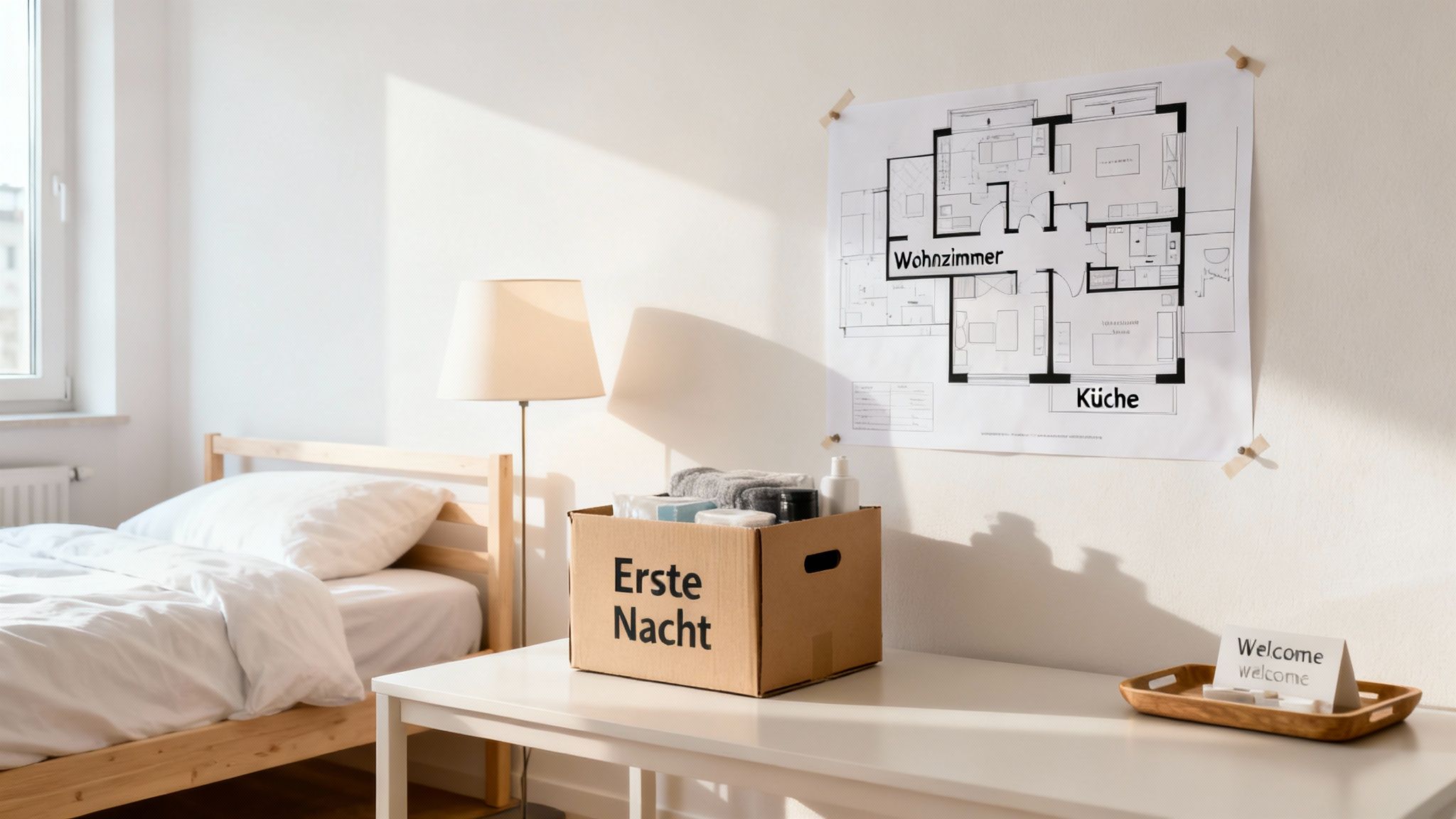
- Plan furniture placement:Use a floor plan to plan the position of large pieces of furniture in advance. This saves time and energy on moving day.
- Packing "First Night" box:Prepare a separate box with everything you need immediately: linens, towels, toiletries, medications, chargers, and a few plates and cutlery.
- Check security:Check and find smoke detectors, door locks upon arrival find out where the main tap and fuse box are located.
10-point comparison: moving checklist in Switzerland
| Task / Service | Implementation complexity 🔄 | Resources & time ⚡ | Expected results 📊 | Ideal use cases 💡 | Key benefits ⭐ |
|---|---|---|---|---|---|
| Obtain Moving Quotes and Compare Pricing | Very low 🔄 — automated, instant | Minimal — Internet, inventory list, few minutes ⚡ | ⭐⭐⭐⭐ Clear price overview, budget planning | Start moving planning, cost comparison | Transparency, time savings, savings potential |
| Register Address Change with Swiss Authorities | Medium 🔄 — depending on the canton, Formalities | Documents, if necessary, authorities, on time (≈14 days) ⚡ | ⭐⭐⭐⭐ Legal certainty, avoidance of fines | Legal obligation when changing residence | Legal compliance, automatic updates from authorities |
| Plan and Book Your Moving Date | Medium 🔄 — Coordination with providers/Date | Time for planning, advance booking 4-6 weeks (peak earlier) ⚡ | ⭐⭐⭐⭐ Assured availability, cost optimization | Summer/Peak moves, scheduled Excerpts | Date backup, possible cost advantages (off-peak) |
| Create and Manage Your Moving Inventory | Medium–high 🔄 — detailed documentation | Time-consuming, photos/apps, collaboration; possibly integrations ⚡ | ⭐⭐⭐⭐⭐ Accurate proof of damage, better planning | Valuable stocks, insurance claims, large households | Accuracy, protection in the event of damage, more efficient loading |
| Notify Important Institutions and Update Your Address | Medium 🔄 — many contacts, individual | Time expenditure, checklist, online/telephone access ⚡ | ⭐⭐⭐⭐ Continuity of Services, fewer outages | Moving within CH, business accounts, subscriptions | Avoiding payment defaults, timeliness of communication |
| Arrange Utilities Connection and Disconnection | Medium–high 🔄 — different deadlines/providers | Lead time 4–6 weeks, meter readings, Provider coordination ⚡ | ⭐⭐⭐⭐ Uninterrupted supply, correct billing | Electricity/Gas/Internet with long lead times | Continuous supply, timely processing |
| Organize Furniture Delivery and Assembly | Medium 🔄 — Coordination Dealers & Fitters | Delivery costs, assembly scheduling, special tools ⚡ | ⭐⭐⭐⭐ Professional setup, time savings | New furniture deliveries, complex assembly | Professional assembly, protection and clean installation |
| Handle Furniture Disposal and Donation | Medium 🔄 — Planning & disposal rules | Time for sorting, collection costs, research donations ⚡ | ⭐⭐⭐⭐ Environmentally friendly disposal, gain space | Decluttering before moving, sustainability goals | Reduced moving costs, donation receipts, ecologically sensible |
| Hire Professional Movers vs. DIY Decision | | Removals → Professionals; small local → DIY | Time savings, insurance coverage vs. cost control | Prepare Your New Residence and First-Time Setup | Medium 🔄 — Access, service provider coordination | Cleaning, setup, possibly early access, costs for services ⚡ | ⭐⭐⭐⭐ Immediate comfort and functional home |
| First occupancy, short-term move-in after moving | Comfort from move-in, reduced initial load, security checks | Your next step towards a stress-free move | A move in Switzerland, whether within a city like Zurich or beyond Crossing cantonal borders is much more than just transporting boxes from A to B. It is a complex project that requires careful planning, administrative precision and logistical skills. This comprehensive | showed you that a successful home move is the result of a well-orchestrated sequence of tasks. From obtaining offers in a timely manner to re-registering with the municipality on time and strategically organizing the moving day - every single point makes a decisive contribution to success and prevents typical stress factors. | Swiss moving checklist |
The most important insights that you should take away from this guide are the power of preparation and the importance of details. A detailed inventory list is not just a reminder, it is the basis for accurate offers and efficient insurance. Changing your address at banks, insurance companies and offices early not only avoids administrative gaps, but also ensures a seamless transition to your everyday life. Likewise, the decision between a DIY move and hiring professionals is a strategic decision that directly affects your resources - time, money and physical endurance.
The quintessence of a smooth moveCheckliste Umzug SchweizLet's recap the key pillars that make the difference between a chaotic and a controlled move:
Die wichtigsten Erkenntnisse, die Sie aus diesem Leitfaden mitnehmen sollten, sind die Macht der Vorbereitung und die Bedeutung von Details. Eine detaillierte Inventarliste ist nicht nur eine Gedächtnisstütze, sie ist die Grundlage für genaue Offerten und eine effiziente Versicherung. Die frühzeitige Adressänderung bei Banken, Versicherungen und Ämtern vermeidet nicht nur administrative Lücken, sondern sichert auch einen nahtlosen Übergang Ihres Alltags. Ebenso ist die Entscheidung zwischen einem DIY-Umzug und der Beauftragung von Profis eine strategische Weichenstellung, die Ihre Ressourcen – Zeit, Geld und körperliche Belastbarkeit – direkt beeinflusst.
Die Quintessenz eines reibungslosen Umzugs
Lassen Sie uns die zentralen Säulen noch einmal zusammenfassen, die den Unterschied zwischen einem chaotischen und einem kontrollierten Umzug ausmachen:
- Time management is everything:The schedule is your most important tool. Tasks that can be completed weeks in advance (e.g. obtaining offers, cancellations) take a lot of pressure off the critical phase shortly before the moving day.
- Administrative correctness:In Switzerland, reporting obligations and administrative processes are clearly regulated. Registering and deregistering at the residents' registration office on time is not an option, but a legal obligation. Failure to do so can lead to unnecessary complications and fines.
- Resources cleverly benefit:Whether it's about saving costs and CO₂ by consolidating transport or not simply disposing of old furniture but donating it or having it professionally recycled - conscious use of resources not only protects your wallet, but also the environment.
- Professional help as a strategic advantage:Working with experts is not a luxury, but an investment in efficiency and security. An experienced moving team knows the local conditions, has the right equipment and the necessary insurance to safely move your valuables to the new location.
A well-planned move is like a carefully choreographed ballet: every movement is thought out, every step builds on the previous one and the end result is a harmonious transition into a new chapter. YourMoving Switzerland Checklistis your score.
By internalizing these principles and using the checklist as your personal project plan, you transform a potentially overwhelming task into a series of manageable steps. You stay in control, minimize risks and create space to look forward to what really matters: your new home. The value lies not only in surviving the move, but in actively shaping it and remembering it as a positive experience. The key to this lies in the conscious decision to hand over responsibility in the right places and rely on proven processes.
Ready to put theory into practice and simplify the planning of your move?TIXPIoffers you the digital solution to organize your entire logistics with just a few clicks - from the transparent immediate offer to booking a qualified crew to furniture assembly. Use our platform to process yourMoving Switzerland checklistefficiently and ensure a stress-free start in your new home.
Holen Sie sich jetzt Ihr unverbindliches Sofortangebot auf TIXPI!