Moving furniture is so much more than just moving things. Regardless of whether it is a valuable heirloom or the entire household contents - behind it there is always precise planning, the right packaging and reliable logistics. Good organization is the key to ensuring that everything runs stress-free and your treasures arrive undamaged.
How to organize your furniture transport stress-free
Planning a furniture transport can quickly become overwhelming. It doesn't matter whether it's just your grandmother's inherited piano or the entire office furniture changes location. Successful transport means more than just driving from A to B - it requires a clear plan, expert packing expertise and logistics you can rely on.
This guide takes you by the hand and answers the one big question: How do I get my furniture to its destination safely, efficiently and at a fair cost? We'll guide you through everything important step by step: from a realistic cost calculation to the right preparation to deciding whether you should do it yourself or leave it to the professionals.
The current trend on the Swiss moving market
You might think that people are constantly moving in Switzerland, but the numbers paint a different picture. The relocation rate is at a historically low level. In 2024, the population moved - a value that has been stable since 2023 and marks the lowest level in the last ten years. This is a noticeable decline of around 10 percent since 2020.What's also exciting is that most Swiss people remain loyal to their region. The average moving distance in 2024 was justonly 9.3 percent
. You can find out more about these developments directly atThis trend shows one thing very clearly: When moving, it has to be efficient and reliable, especially over short distances..news.admin.ch13.4 kilometers
A well-planned furniture transport not only saves time and nerves, but also money. The biggest mistakes often happen due to a lack of preparation - be it with packaging or choosing the wrong vehicle.
What to expect in this guide
This guide is your toolbox for successful furniture transport. We provide you with in-depth knowledge and practical tips so that you are prepared for every challenge.
We highlight the core topics that really count:
How much does furniture transport really cost? We break down which factors influence the price and what you can expect for your money.
- Use our tried-and-tested instructions to safely prepare your furniture for the trip.Costs and services:
- A clear comparison of the advantages and disadvantages so that you make the right decision for your situation Preparation and packaging:
- We will show you how modern platforms likeDo it yourself or call a professional?
- Understanding the true costs of furniture transportsimplify the entire process and offer a transparent, clever solution for this complex task.TIXPISmart logistics:
How much does a
really cost? Many people hesitate to hire a professional because they fear high costs. But the calculation is often more complex than you think at first glance. The price you end up paying is made up of various factors and is much more than a simple flat rate.In order to be able to compare offers fairly and make the right decision, you have to know the building blocks of pricing. This is the only way to make it clear whether the supposedly cheap offer is actually the best solution in the end.Transportation of furniture
Um Angebote fair vergleichen und die richtige Entscheidung treffen zu können, muss man die Bausteine der Preisgestaltung kennen. Nur so wird klar, ob das vermeintlich günstige Angebot am Ende auch wirklich die beste Lösung ist.
The main factors of the cost calculation
The price for professional furniture transport is not a product of chance. It reflects the real effort that is necessary for a safe and smooth process. Four core elements determine what is on the invoice.
These are the key factors:
- Volume and weight:The most obvious size. A single sofa naturally requires less space and manpower than the entire contents of a 3-room apartment. The total weight also plays a major role in fuel consumption and in choosing the right vehicle.
- Transportation distance:The distance from the pickup location to the destination is a direct cost factor. Longer distances mean more time, more fuel and higher wage costs for the team. A transport within Zurich is logically cheaper than one from Bern to Geneva.
- On-site accessibility:A point that is often underestimated. Is the apartment on the fourth floor without an elevator? Is the stairwell narrow and winding? Such obstacles eat up time, require more staff or even special equipment such as a furniture lift - and this is reflected in the price.
- Additional services:Do you need help packing your china safely? Do massive cabinets have to be professionally dismantled and reassembled at their destination? These services save you an enormous amount of time and stress, but are of course charged separately.
Hidden costs are often the biggest budget killer with DIY transport. Renting the van is just the beginning - fuel, insurance, packaging materials and the value of your own working time add up quickly.
Specific cost scenarios at a glance
To make the theory more tangible, let's look at a few realistic examples. These price ranges serve as a guide and show how the factors mentioned impact in practice.
Scenario 1: Transporting a sofa within Zurich (approx. 10 km)A relatively simple order where the costs depend heavily on accessibility.
- Price range: CHF 150 – CHF 300
- Influencing factors:From ground floor to ground floor it is cheapest. Several floors without a lift quickly drive up the price.
Scenario 2: Moving a 3-room apartment from Bern to Geneva (approx. 160 km)The large volume and the long distance play the main roles here.
- Price range: CHF 1,800 - CHF 3,500
- Influencing factors:The price increases with the extent of the additional services such as packing service, dismantling and assembly of the furniture.
The following graphic helps with the basic decision: do it yourself or would you rather let the professionals do it?
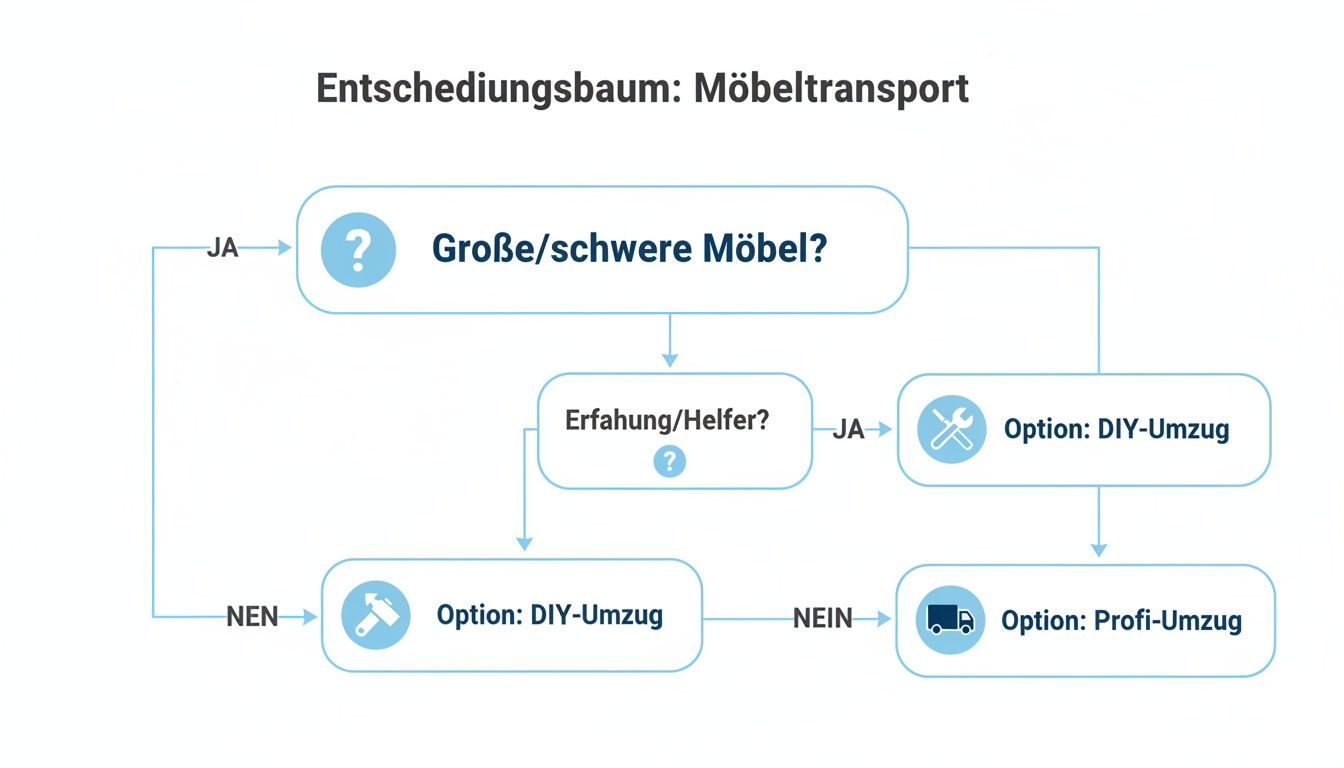
As you can see, the complexity and extent of the transport are the decisive criteria for the choice the right way.
The often overlooked costs of doing it yourself
The thought of saving money by taking theTransportation of furnitureyourself into your own hands is of course tempting. But the calculation doesn't always work out. The direct expenses are only part of the whole story.
Let's take a closer look at the actual costs of DIY transport:
- Vehicle rental:A suitable delivery van for a day can quickly costCHF 100 up to CHF 200, often with a limited number of kilometers.
- Fuel:You bear the costs entirely yourself. For longer distances, a lot adds up.
- Insurance:Standard insurance usually only covers damage to the vehicle, but not to your valuable transported goods. Additional insurance is almost always a must.
- Material:Moving blankets, sturdy straps and good packing materials must either be purchased or rented.
- Your time:This is perhaps the most valuable factor. A whole day or even a whole weekend to move means lost free time or perhaps even an unpaid vacation day.
In the end, the sum of these "hidden" costs can be surprisingly close to the price of a professional offer - but without the comfort, security and experience of a professional.
Comparison of transport options and their cost factors
This table compares the most important aspects and potential costs between self-organized furniture transport and hiring a professional service provider such as TIXPI.
| Factor | DIY transport (self-organization) | Professional service provider (e.g. TIXPI) |
|---|---|---|
| Primary costs | Delivery of vans, fuel, Material purchase | Flat price or fixed price offer |
| Hidden costs | Additional kilometers, insurance upgrades, parking fees, meals for helpers | Generally none; at TIXPI everything is included in the fixed price |
| Time expenditure | High: planning, organization, driving, carrying (often 1-2 full days) | Low: professionals take over the entire process efficiently |
| Physical effort | Very high; Risk of injury and overexertion | Minimal; the team does the heavy lifting |
| Security & Insurance | Limited; often only the vehicle is insured, goods transported at your own risk | Comprehensive; professional liability insurance for the transported goods |
| Expertise | Depending on your own experience; Risk of damage to furniture/property | High; trained staff with experience and proper equipment |
| Convenience | Low; high stress and organizational effort | Very high; relaxed process because everything comes from a single source |
The direct comparison makes it clear that the price of a professional service provider covers much more than just transport. It buys you security, time and, above all, a stress-free process.
Preparing furniture correctly for transport
A successfulTransporting furnituredoesn't just start with loading. Proper preparation is essential to prevent scratches, dents or even breaks. Not only does it protect your favorite pieces from damage, it also makes the whole process much smoother and less stressful.
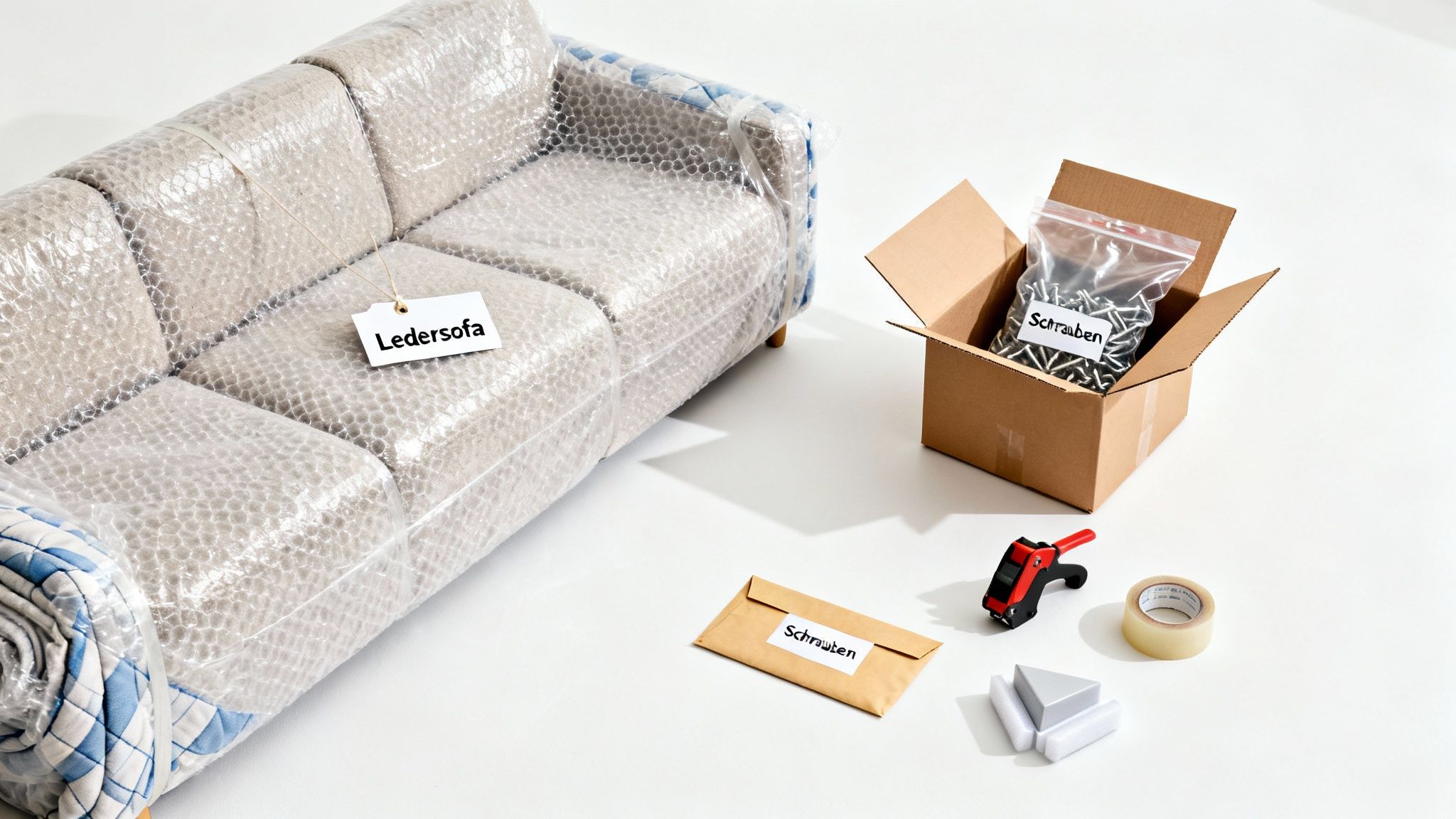
You can think of it like the foundation of a house: If it's secure, the rest will also hold. A few hours invested in disassembly and packing can make the difference between a smooth transport and an expensive hassle. Whether it's furniture or a pet, it's crucial to avoid stress and damage. Good equipment is half the battle and saves you from frustration and wobbly emergency solutions.einen Transport richtig vorbereitenHere is a checklist of the most important helpers:
Bubble film for sensitive surfaces, stretch film for fixing doors or drawers and moving blankets as a universal buffer against bumps and scratches.
Packaging material:
Special edge protection made of cardboard or foam is worth its weight in gold for tables and cupboards - exactly where defects occur most often.
- A decent set of screwdrivers, Allen keys and maybe even a cordless screwdriver make disassembling large furniture a breeze.Protection for edges and corners:
- Schutz für Kanten und Ecken:Tools for disassembly:
- Werkzeug für die Demontage:Ein anständiger Satz Schraubenzieher, Inbusschlüssel und vielleicht sogar ein Akkuschrauber machen das Zerlegen von grossen Möbeln zum Kinderspiel.
- Tape and labeling:Good packing tape that will last, and waterproof pens or labels so you can remember what goes where later.
See these materials as a little insurance for your furniture. Anyone who saves on quality here often ends up paying more.
Dismantling large pieces of furniture professionally
Large chunks such as beds, wardrobes or shelving systems are usually too bulky to transport safely in one go. Clean disassembly is the key to success here - this not only protects the piece of furniture, but also your walls and door frames.
First, take a few photos of the assembled furniture. Believe me, these pictures will be an invaluable reminder later when assembling. Then remove all loose parts such as shelves or drawers and pack them individually.
A simple but ingenious trick: All screws and small parts of a piece of furniture belong together in a labeled, resealable bag. It is best to stick this directly to one of the large parts of the piece of furniture. This guarantees that nothing will be lost.
Proceed systematically when disassembling and store the parts in an orderly manner. This keeps you organized and prevents scratches that can easily occur if you throw everything together carelessly. The small additional effort in organizing pays off twice or threefold at the destination.
Proven packaging techniques for sensitive pieces
Not all furniture is the same. A sturdy bookshelf needs different treatment than grandma's glass table or expensive leather sofa. The right technology is crucial here.
Example 1: The glass tableGlass panels are extremely delicate. If possible, dismantle the plate and wrap it generously in several layers of bubble wrap. You should also reinforce the corners and edges with cardboard. Then fix everything with packing tape and label the packaging large and clearly with “Caution Glass”.
Example 2: The antique chest of drawersThe surfaces and decorations of old pieces are often particularly sensitive. Wrap the entire piece of furniture tightly in moving blankets. With stretch film you can ensure that the blankets do not slip. It is best to secure drawers and doors with adhesive tape that leaves no marks, such as painter's tape.
Example 3: The leather sofaLeather is susceptible to scratches and pressure marks. First, wrap the sofa completely in stretch film to protect it from dirt and moisture. Then there is a thick layer of moving blankets on top, especially on the corners and armrests.
With these targeted steps you can ensure that each of your valuable pieces survives theTransportation of furniturein one piece. Also remember thatder richtige Schutz von Gegenständen, Boden und Wändengoes further than just furniture packaging.
What your transport really needs: A tailor-made solution for every case
EveryoneTransportation of furnitureis its own little world with its own rules. What works great for transporting a single sofa would be a disaster for a complex office move. The trick is to understand exactly what your project needs and then find the right solution.
Let's take a closer look at the three most common scenarios: the transport of individual favorite items, the move of an entire apartment and the specialized office move. Each of these projects has its pitfalls that require clever and efficient answers.
Single items and small transports: Flexibility is everything
Imagine you have purchased a beautiful vintage sideboard on Ricardo. Or a valuable family heirloom needs to be safely transported from one canton to the next. It's not about huge quantities, but about getting to your destination quickly, flexibly and, above all, cost-effectively.
The typical stumbling blocks with such small transports are:
- The cost trap:Many large moving companies have hefty minimum flat rates. This quickly makes transporting a single piece of furniture uneconomical.
- The deadline pressure:Collection often has to be done at short notice and within a narrow time window. This requires flexible planning, which not everyone can offer.
- Security:Especially with valuable or bulky individual items, the security has to be in the vehicle, otherwise unsightly scratches or worse can quickly occur.
This is exactly where flexible platforms like TIXPI come into their own. Instead of booking a large truck for your individual item, it simply travels as an additional load on a transport that is already planned. This is called transport consolidation, it massively reduces costs and is also good for the environment. Find out more about how you can do theTransport einzelner Möbelstücke einfach gestalten.
The complete apartment move: A logistical project
An entire apartment move is like a large puzzle with many moving parts. Here, perfect coordination of volume, schedule and manpower are the key to success. In contrast to individual items, a complete inventory must be transported from A to B safely and carefully.
The hurdles that need to be overcome:
- Estimating the volume correctly:How much space do your things really need? A misjudgment quickly leads to the wrong vehicle or too few helpers.
- Time management is everything:Often the entire move has to be completed in a single day - dismantling, transport and the initial assembly in the new location included.
- A well-rehearsed team:People who know how to maneuver a heavy sofa through a narrow stairwell without closing walls are worth their weight in gold.
A move is much more than just lugging boxes. It is a carefully planned process in which every move has to be perfect. Professional preparation ensures that everything runs like clockwork on the big day and that stress doesn't even stand a chance.
Moving dynamics are particularly high in cities. Did you know that in Switzerland it is mainly young adults who move between every fifth person? In 2022, this age group changed their place of residence. Cities like Basel-Stadt and St. Gallen have particularly high moving rates - a clear sign of the need for well-organized moving professionals.Office moves: When every minute counts26 and 35 years
An office move is the supreme discipline in
. Of course, desks and chairs have to arrive safely. But the top priority is different: to keep the interruption to operations as short as possible. Every hour that a company is paralyzed costs money.That's why completely different rules apply here:Transportation of furniture
The move often takes place on the weekend or overnight so as not to disrupt everyday work.
- Servers, computers and other sensitive technology don't just need kid gloves, but also special packaging material and real know-how during transport.Planning is the be-all and end-all:
- Detailed labeling is essential. This means that every workstation at the new location can quickly find its owner again and is ready for use straight away.Special treatment for IT:
- Ein klares System:A clear system:
- Logistics down to the minute:There needs to be an exact schedule for dismantling, transport and reconstruction, which is strictly adhered to.
Right nowbeim Transport von gebrauchten BüromöbelnThere are a lot of things to consider. Professional planning ensures that your team is not faced with chaos on Monday morning, but can start straight away in a fully functional environment.
How to transport your furniture sustainably
In a time in which sustainability is increasingly shaping our actions, an important question also arises withTransportation of furnitureAn important question arises: Isn't there a more environmentally friendly way to do this? The answer often lies in intelligent logistics that not only protect the planet, but also your wallet.
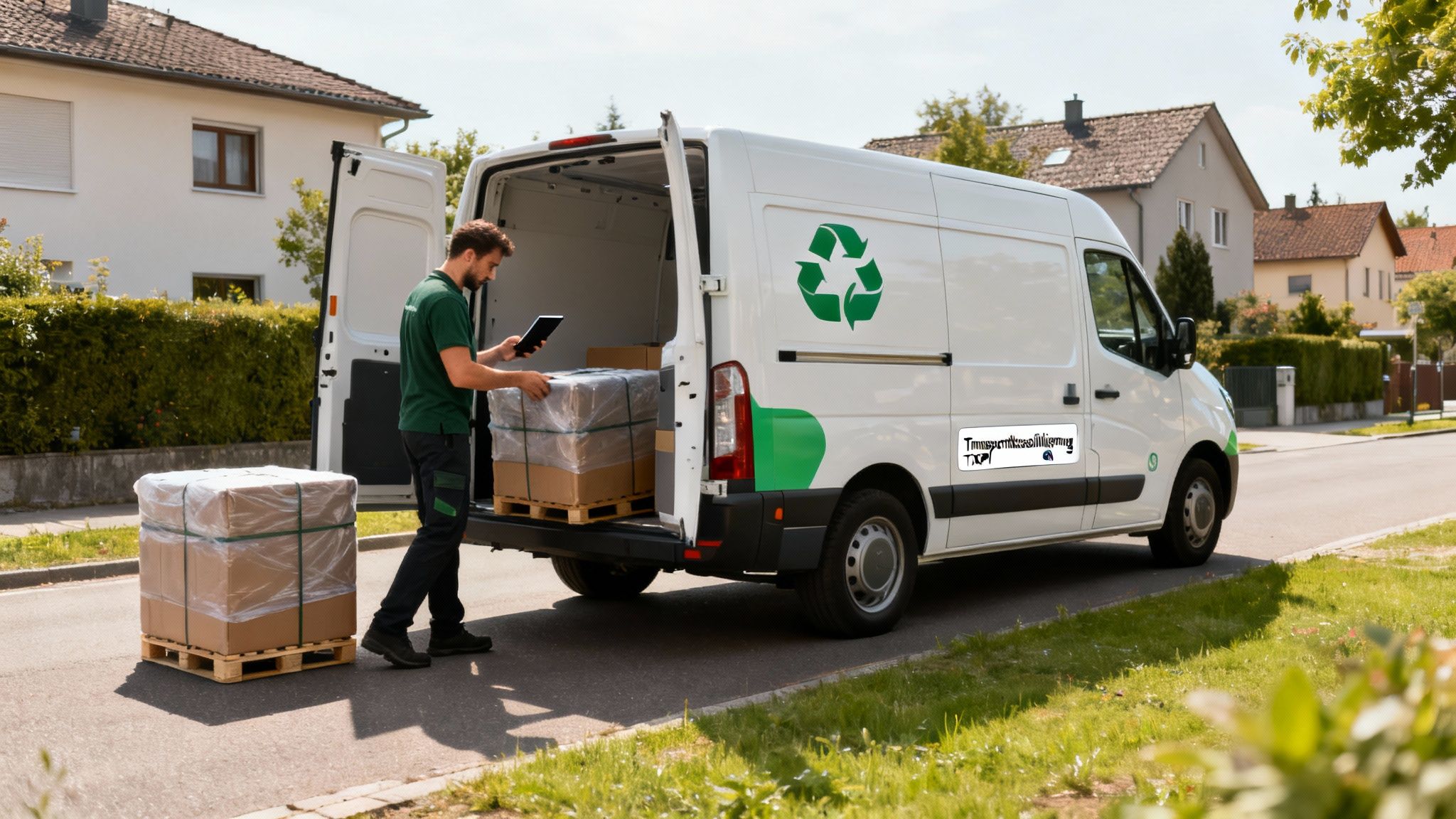
Every transport that travels on the road contributes to emissions. That is a fact. But there are clever ways to significantly reduce the ecological footprint of your furniture transport without having to forego comfort or safety.
Understanding the principle of transport consolidation
Have you ever heard of transport consolidation? The concept is much simpler than it sounds. Think of it like a furniture carpool. Instead of ten different delivery vans driving half-empty through Switzerland for ten individual customers, a smart logistics provider bundles these trips.
The result is a fully utilized van that drives an optimized route and completes several orders at once. This approach has two decisive advantages:
- Reduction in CO₂ emissions:Fewer trips directly mean less fuel consumption. The result is noticeably lower emissions of greenhouse gases per piece of furniture transported.
- Reducing costs:Increasing efficiency saves the transporter personnel, time and fuel - and these savings are often passed on directly to you as the customer.
This turns many small, inefficient trips into a single, highly efficient tour.
The ecological and economic double win
Sustainability and economic efficiency are no longer opposites. On the contrary: an environmentally friendlyTransportation of furnitureis often the most cost-effective option. If a transport company optimally utilizes its vehicles, the operating costs per order drop noticeably.
Intelligent, bundled transport is a classic win-win situation. You benefit from a more attractive price and the environment is relieved by less traffic and lower emissions.
This topic is particularly hot in Switzerland. Transport contributes overall to CO₂ emissions, and freight transport – which also includes furniture transport – has stagnated at a high level for 20 years. At the same time, the Swiss furniture market is growing steadily and is expected to reach a value creation of almost one billion euros in 2025. These numbers show: Smart logistics like transport consolidation is a huge opportunity to make a real difference. You can find more insights into this in theHow TIXPI puts sustainability into practice.Schweizer Möbelmarkt auf de.statista.com43 percent
Platforms like TIXPI have made this very principle the basis of their business model. Instead of looking at each order in isolation, the system analyzes all pending transports and looks for ways to intelligently combine routes.
And this is how it works in practice:
You simply enter the details of your transport - for example a sofa from Zurich to Bern.
- The system immediately identifies other orders on a similar route. Maybe a chest of drawers has to go from Zurich to Friborg or an armchair has to go to Solothurn.Order entry:
- Route bundling:Das System identifiziert sofort andere Aufträge auf einer ähnlichen Strecke. Vielleicht muss eine Kommode von Zürich nach Fribourg oder ein Sessel nach Solothurn.
- Efficient planning:TIXPI plans a single, optimized trip that covers these orders and makes best use of the vehicle's capacity.
This approach is ideal for more than just individual pieces. Even during larger moves, empty trips can be avoided by cleverly using the return journey of the van for another order in the opposite direction.
With this clear focus on efficiency and resource conservation, TIXPI offers a responsible and future-oriented transport solution. Especially if youSecond-Hand-Möbel transportieren, können Sie durch nachhaltiges Umziehen Geld sparenand do something good for the environment at the same time.
Protection and insurance for your transport
What actually happens if something breaks duringFurniture transport Who is liable? This question often makes you feel uneasy. But don't worry, there are clear rules to protect your belongings. The most important thing is to understand the difference between basic legal liability and proper transport insurance.
Every reputable transport company in Switzerland has legal liability. This means that it is liable for damage caused by its fault during transport. But be careful: This basic liability is often limited and does not always cover the full new value of your furniture, but is usually based on the current value.
Basic legal liability versus transport insurance
Legal liability is a good basis, but it has its pitfalls. For example, it does not apply to “unavoidable events” – think of an unpredictable lightning strike or a natural disaster. In addition, the liability amount is often limited per cubic meter or kilogram. This can quickly become a problem with light but very valuable items.
This is exactly where the optional transport insurance comes into play. It is additional protection that goes far beyond the legal minimum and comprehensively protects your furniture.
You can imagine transport insurance like fully comprehensive car insurance, but for your furniture. It often covers damage up to the full replacement value and comes into play even if the transport company would not be legally liable.
This additional protection is actually indispensable, especially for particularly valuable items.
- Antiques:The ideal and financial value of an old heirloom can hardly be covered by basic liability.
- Designer furniture:An unsightly scratch on one An expensive designer piece can massively reduce its value. Good insurance also covers such impairments.
- Art objects:Paintings or sculptures need very special protection that only a tailor-made insurance policy can really offer.
Practical steps for protection
The best insurance is good preparation. With a few simple steps you can prepare yourself for an emergency and make dealing with damage much easier.
1. Document everything preciselyTake photos of your furniture before loading. Above all, take very close photos of existing small flaws or scratches. These pictures will be worth their weight in gold later to prove the condition of your belongings before transport.
2. Read the fine printTake a moment to read the general terms and conditions (GTC) of the transport company. Look carefully at the liability and insurance sections. If something is unclear, be sure to ask before placing the order.
3. Report damage correctlyIf something does happen, record the damage in writing on the handover protocol immediately upon delivery. Then report the damage immediately and in writing to the transport company - ideally with photos.
With this knowledge in your luggage, you are well prepared and can look forward to your furniture transport relaxed and with a feeling of security.
Frequently asked questions about furniture transport
Even with the best planning, small questions often arise shortly before the big day. So that you have a good feeling until the end, we have collected the most frequently unclear questions here and answered them in a practical way for you.
How far in advance should I book a furniture transport?
The rule of thumb is: plan a transport at leasttwo to four weeks in advance. Especially in the popular moving months in summer or around the turn of the month, the transport companies' calendars quickly fill up. If you book early, you not only secure your desired date, but often also a better price.
If it's just a single sofa or a chest of drawers, it often works at short notice, sometimes within a few days. In general, the more flexible you are with the date, the easier and faster it is to find a suitable offer for your furniture transport.
Plan ahead, but remain realistic. An honest inventory of your furniture helps the transport company to accurately estimate the effort and make you a fair, binding offer.
Do I have to be present during loading and unloading?
Yes, absolutely! It is crucial that you or someone you trust is present at both the pickup and delivery locations. There are several good reasons for this.
Firstly, you make sure that the right pieces of furniture are taken with you. On the other hand, you and the team can record any previous damage to the furniture in the handover protocol - this protects both sides. At your destination you can then instruct exactly where everything should be placed. At the end, you confirm with your signature that everything was done to your satisfaction.
What happens if my furniture doesn't fit through the stairwell?
This is the classic moving problem and should definitely be clarified in advance to avoid expensive surprises on the day of transport. The first step is always: get out the tape measure and carefully measure narrow spaces such as doors, hallways and especially the stairwell. Then compare this measurement with the largest pieces of furniture.
If it is tight, be sure to inform the transport company in advance. Professionals usually have a solution ready for such cases. Often a piece of furniture can be dismantled professionally. If this is not an option, a furniture lift can be used to lift the item from outside through a window or over the balcony.
A well-planned furniture transport does not have to be a stress factor. WithTIXPIyou not only receive a transparent fixed price immediately, but you also leave the entire organization to the professionals - from planning to transport to assembly. This way, your belongings arrive safely and relaxed at the new location. Find out more and book your stress-free transport onhttps://tixpi.ch.