
When it comes to terminating an apartment in Switzerland, one central question immediately arises: How long is the notice period? Fortunately, the answer is clearly regulated: for a rental apartment the SPLIT is |||. This is the golden rule that gives tenants and landlords equal security and scope for planning.The important thing is not when you post the letter, but when it arrives at the landlord. This is a small but crucial detail.Legal minimum notice period of three months
The basics of the notice period for your apartment
You can think of the notice period like a fairness rule. It gives both sides – you as the tenant and the landlord – enough time to adjust to the new situation. This gives you time to look for an apartment and move, while the landlord can look for a suitable new tenant without the apartment being empty.
This rule ensures stability on the housing market. Without them, an orderly transition would hardly be conceivable and would cause unnecessary hectic on both sides.
Legal minimum deadline as a protective mechanism
The Swiss Code of Obligations (OR) clearly sets the pace here. The
are not chosen arbitrarily, but are a proven protective mechanism that has been anchored in tenancy law for decades. This deadline protects tenants and landlords from hasty decisions.The rule applies throughout Switzerland and is a strong tenant protection law. Your rental agreement may not be shorter than this period, but it can certainly provide for a longer period.three months
What does that mean for you specifically?
If there is a longer period in your contract, for example four months, then this applies.
- If you find a clause in your contract with only two months' notice, it is invalid. In this case, the statutory three-month period automatically applies.Your rental agreement is crucial:
- Shorter statutory periods may apply to other rental properties such as furnished rooms or parking spaces.Shorter periods are invalid:
- If you want to delve even deeper into the legal details, you will findAttention in special cases:
a good one Overview.in diesem Ratgeber zu Kündigungsterminen und Fristen von flatfox.chAlways send the cancellation by registered mail and plan enough buffer. To ensure that the letter arrives before the deadline, you should send it at least a week in advance. The decisive date is always the day of arrival at your landlord.
The most important deadlines in direct comparisonMy tip from practice:
To make the whole thing even more tangible, here is a quick overview of the legal minimum deadlines. Remember: This is the basis, your rental agreement can deviate from it (but only in your favor in terms of the length of the period).
This table shows the legally required minimum periods for various rental properties in Switzerland.
Rental propertyLegal minimum notice periods at a glance
| Legal minimum notice period (according to OR) | Typical Contractual regulation | Unfurnished apartments & shared rooms |
|---|---|---|
| 3 months | Often 3 to 6 months, depending on the contract | Furnished single rooms & parking spaces |
| 2 weeks | The statutory deadline is usually the case taken over | Business premises |
| 6 months | Can be contractually extended | With this overview you can quickly classify your own situation. Next, we'll look at how to calculate the deadline correctly and what the often confusing "local termination dates" are all about. |
The legal basis for your apartment termination
Das rechtliche Fundament Ihrer Wohnungskündigung
Every termination of an apartment in Switzerland is based on a solid legal foundation: the Swiss Code of Obligations (OR). That may sound dry at first, but it is precisely these laws that are your most important ally when it comes to termination.
You can imagine the OR as the rules of the game for fair cooperation on the housing market. The articles266a to 266oin particular clearly define the rights and obligations for tenants and landlords. These regulations ensure a balance and prevent one side from taking advantage of the other.
The core of these regulations is the protection of both parties. As a tenant, you are protected against arbitrary or short-term terminations. At the same time, your landlord has the security that his property will not be empty overnight.
Legal minimum period versus contractual agreement
A key point that is important to understand is the difference between the legal minimum period and what is written in your rental agreement. The law sets an inviolable lower limit that protects you as a tenant.
For apartments, this isLegal minimum notice period of three months. This is the absolute basis that must not be undercut under any circumstances.
However, your rental agreement may well stipulate a longer period. Such an agreement is completely legal as long as it is in writing and applies to both parties. These contractual details are crucial because they take precedence over the usual local deadlines, but never over the statutory minimum notice period.
- Example 1 (Invalid):Your rental agreement only states a notice period of two months. This clause is invalid because it violates mandatory law. The statutory period of three months automatically applies.
- Example 2 (Valid):Your contract provides for a period of four or even six months. This agreement is valid and you must comply with it.
A close look at your contract is therefore the be-all and end-all. It is worth understandingdas Kleingedruckte bei Umzugsangeboten und Verträgenin detail in order to avoid unpleasant surprises.
The law of obligations forms a protective shield for tenants. It ensures that fundamental rights cannot be undermined through individual contracts. This knowledge gives you the security to approach your termination correctly and confidently.
Why your rental agreement is the Bible
See your rental agreement as the most important document that regulates your tenancy. It specifies the general legal requirements for your very personal situation - a personalized addition to the legal code, so to speak.
What is written in the contract is binding as long as it does not contradict the law. This means that theNotice period for your apartment in Switzerlandis defined by the clauses in this document.
Therefore, the first step is always the same whenever you intend to terminate your contract: take your rental agreement to hand and read the relevant sections carefully. Search specifically for terms such as "termination period", "termination date" or "rental period".
Reading this will immediately give you clarity on two crucial questions:
- Which period applies to me?Does the statutory three-month period apply or has a longer, contractual period been agreed?
- On which dates can I terminate?Are there specific termination dates (e.g. the end of March, June, September), or is termination possible at the end of each month?
By understanding your contract, you take control of the process. You will then know exactly when your letter of termination must be received by the landlord. This knowledge is the basis for a smooth termination and a stress-free start to the move.
Understanding local termination dates in your canton

If your rental agreement does not specify specific termination dates, immerse yourself in the world of “local termination dates”. That sounds complicated at first, but it is essentially a traditional regulation that differs from canton to canton, sometimes even from municipality to municipality.
Imagine these dates like local holidays: what is common in Zurich does not necessarily apply in Bern. It is precisely these cantonal peculiarities that are one of the biggest stumbling blocks in Swiss tenancy law. Anyone who ignores them risks an invalid termination - and the rental agreement is inadvertently extended by months. A correctNotice period for an apartment in Switzerlanddoes not only depend on the duration, but often also on the correct date.
Why are there these cantonal differences?
The whole thing has historical reasons. The dates reflect old moving dates on which most moves traditionally took place. While our working lives are much more flexible today, many cantons stick to these fixed dates in order to maintain a certain order on the housing market.
So if there are no clear regulations in your contract, these local “rules of the game” automatically apply. This is crucial because termination on an incorrect date is invalid. It is then automatically postponed to the next possible local date.
A common mistake is the assumption that you can simply cancel at the end of each month. This is only the case in cantons with modern regulations or with corresponding contractual clauses. Always check the contract first and then the local customs.
This federalist approach makes Switzerland unique, but also requires tenants to take a closer look. The differences can have a significant impact on your moving plans. When you are preparing your move, it is worth knowing not only the notice periods, but also otherkantonale Besonderheiten und Vorschriften beim Umzug in der SchweizA look at the most important cantons
The best way to show this variety is with examples. In many classic rental regions, the quarterly dates still apply. The most common termination dates here are the
. This regulation can be found, for example, in the cantons of Aargau, Zug, Freiburg or in the rural areas of the canton of Zurich.In the city of Zurich, the situation is even more special: Here, only the31. March, June 30th and September 30th
and the30. Septemberare often considered official moving dates. However, modern contracts are increasingly softening these rigid rules and allowing termination at the end of every month, with the exception of December 31st. This more flexible handling is already the norm in cantons such as Appenzell Innerrhoden, Glarus, Schaffhausen, Schwyz and St. Gallen.Comparison of termination dates in selected cantons31. March
The following table gives you a quick overview of the regulations in some of the largest cantons - in case your rental agreement does not specify its own dates.
Canton
| Local Termination dates | Special features | Zurich (city) |
|---|---|---|
| 31. March, September 30th | Very restrictive, often only two dates per year. | Zurich (country) |
| 31. March, June 30th, September 30th | The classic quarterly dates are still widespread here. | Bern |
| Every month end, except December 31st | Jedes Monatsende, ausser 31. Dezember | Very tenant-friendly and modern arrangement. |
| Geneva | No fixed dates, termination at the end of the month is usual | Flexible, but the rental agreement almost always takes priority. |
| Aargau | 31. March, June 30th, September 30th | Sticks to the traditional quarterly dates. |
| Luzern | No fixed dates by law, often regulated by contract | If nothing is stated in the contract, every month end applies. |
This overview makes it clear how important it is to know the local conditions. A wrong assumption can quickly result in you having to pay rent for three more months. If you are unsure, it is best to ask the relevant arbitration authority or a tenants' association.
Termination: What applies to special cases and exceptions
Not every rental agreement ends according to scheme F. Life writes its own rules, and Swiss tenancy law also knows some special situations that deviate from the standard procedure. It is precisely these exceptions that are important because they can give both tenants and landlords completely different rights and obligations in special circumstances.
It is important to be aware of these special cases. Whether it is a drastic measure such as termination without notice or the much simpler rules for a furnished room - this knowledge protects you from expensive mistakes and gives you security when things get complicated.
Termination without notice: The emergency brake for extreme cases
A termination without notice is the sharpest sword in tenancy law and is really only used in extreme emergencies. You end the rental agreement immediately without waiting for the usual SPLIT. You can imagine it like an emergency brake that is only pulled when living together has become absolutely unreasonable.This is an option for tenants if the apartment has such serious defects that living in it becomes impossible or even dangerous to their health.Notice period for an apartment in Switzerland
A large-scale mold infestation that the landlord simply removes despite a written request and a deadline ignored.
- The tenant still does not pay his rent even after a written reminder with a threat of termination and a payment deadline ofExample for tenants:
- 30 days Serious violations of the house rules or the intentional destruction of property can also be a reason.Very important: The terminating party must first warn the other side in writing and give them a final deadline to solve the problem. Only if this period passes without being used is the way clear for termination without notice.Example for landlords:
Termination due to renovation or demolition
A common and often emotionally charged special case is termination by the landlord because he is planning major renovation work or even demolition. Worlds collide here: the owner's interest in improving the value of his property and the tenant's need for a safe home.
Especially in times of housing shortage, the legislature has built in a number of hurdles to better protect tenants. Although such a termination is generally permitted, it must be well justified and must not be abusive - i.e. not just an excuse to get rid of an unpleasant tenant.
Statistics show that
Statistiken zeigen, dass80 percent of empty terminationsin Switzerland affect buildings that are older than 40 years. This illustrates the enormous pressure to renovate. Since May 2022, stricter rules have even applied in the event of an official housing shortage (less than 1.5 percent vacancy in a region). Terminations for renovations then require official approval, rent increases after renovations are limited and affected tenants often have the right to return. You can find out more about this complex topic in theInformationen zur Kündigung vom HEV Schweiz.
A well-known example is the Neugasse case in Zurich, where 105 parties received a termination notice with just three months' notice until March 31, 2025. Such mass terminations regularly lead to major legal and public debates.
Shorter deadlines for furnished rooms and subletting
Not every rental agreement is subject to the strict three-month deadlines. For certain constellations, the law has deliberately created more flexible and shorter regulations that simply fit the situation better.
Furnished rooms:If you rent a single furnished room that is part of the landlord's apartment, everything becomes much easier and faster.
- Legal Minimum period:Here the notice period is justtwo weeks.
- Termination date:The termination can take place at the end of a one-month rental period. So if you rent the room on the 15th of a month, you can also terminate it on the 14th of the following month.
Subleases:When it comes to subletting, it all depends on what exactly is being sublet.
- Unfurnished room/apartment:The normal statutory period ofthree months applies here, if in Sublease agreement does not state otherwise.
- Furnished rooms:If only one furnished room is sublet, the shortened period of two weeks applies again.
These simplified rules take into account the often shorter and more flexible nature of such tenancies. However, it is always a good idea to take a look at the respective rental or sublease agreement to be on the safe side.
Cancel your apartment correctly step by step
A termination of your apartment is more than just a letter. It is a formal act in which small mistakes can have major and, above all, expensive consequences. To ensure that everything runs smoothly for you, it is worth approaching the process in a well-structured and careful manner. This guide will guide you safely through all the necessary steps.
The be-all and end-all of a valid termination is adhering to the correct deadlines and dates. As we have already clarified, your rental agreement and local customs set the pace here. As soon as you have this clarity, it's time to put it into practice.
The correct calculation of the deadline and the decisive delivery day
The most common stumbling block when terminating an apartment is an incorrect calculation of the date on which the landlord must receive the notice. Remember this golden rule: It's not the postmark that counts, but the day on which your landlord actually has the letter in his hands or could pick it up at the post office.
A simple example makes it crystal clear:
- Cancellation date:30. September
- Cancellation period:3 months
- Start of the period:1. July
- Last possible delivery day:30. June
Your termination letter must thereforeno later than June 30thbe with your landlord. To be on the safe side and avoid stress, it's best to send it a few working days earlier by registered mail.
The following graphic shows what the process looks like for some special cases that deviate from the standard procedure.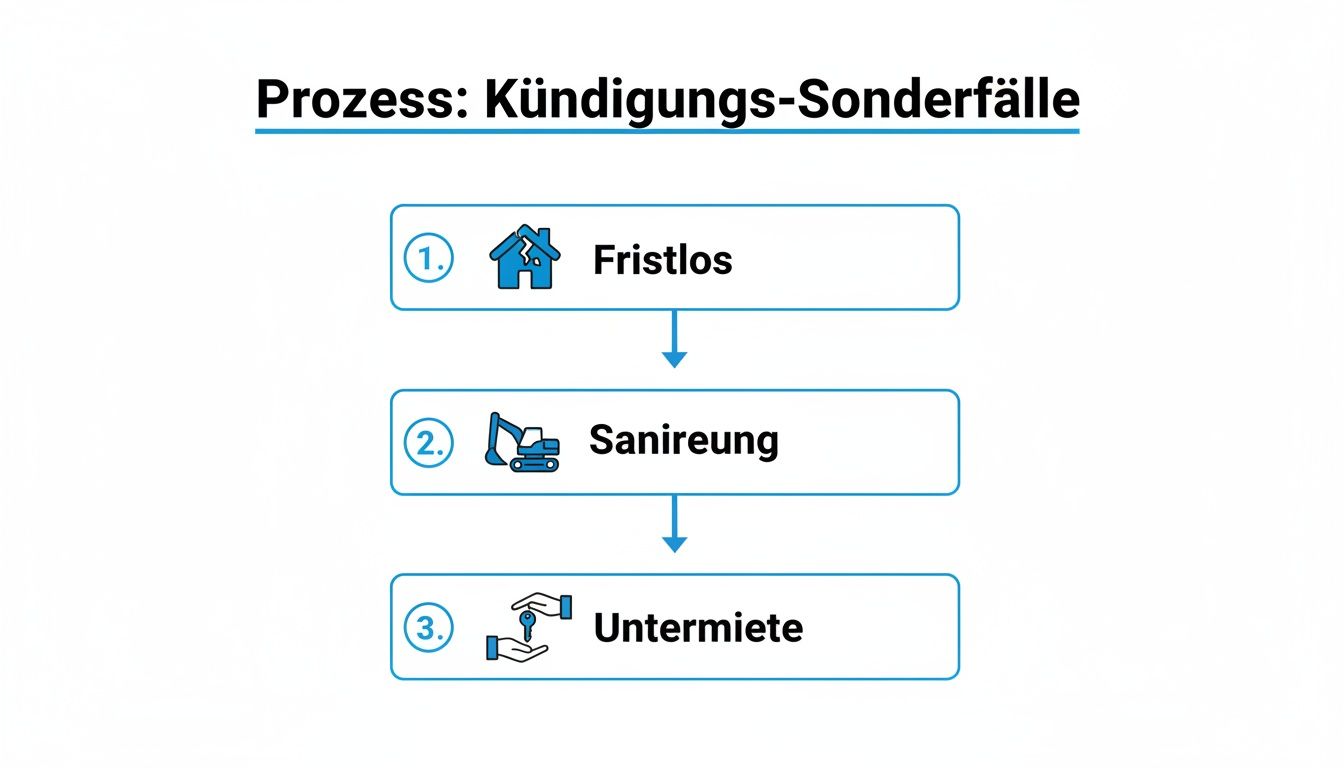 As the diagram makes clear, each of these cases - whether termination without notice, an upcoming renovation or a sublease - requires a specific approach with its own legal rules.
Why registered mail is the gold standard
A termination by shout or email? Forget it, this is legally ineffective. The termination must be madein writingand should always be sent by registered mail. This costs a few francs more, but gives you the decisive legal security that is worth its weight in gold.
The postal receipt with the tracking number is your tangible proof that you have initiated the termination on time. If the landlord ever claims that he hasn't received anything, you can easily prove the opposite by tracking the shipment.
Important note:If the recipient doesn't pick up the registered letter at the post office, that's his problem, not yours. The letter is deemed to have been delivered on the last day of the seven-day collection period. This protects you from a landlord deliberately refusing acceptance in order to artificially extend the deadline.
The checklist for a complete termination letter
A formally correct termination letter is the heart of your termination. If you forget any important information here, in the worst case scenario the termination could be declared invalid. Use this checklist to be on the safe side:
- Full addresses:Your address as sender and the complete address of the landlord or management.
- Date:The date on which you write the letter.
- Subject line:A crystal clear subject line like "Termination of the rental agreement for the apartment [Address, floor, apartment number]".
- Clear cancellation text:State clearly that you are terminating the rental agreement. State the exact date on which you are canceling (e.g. "as of March 31, 202X").
- Please confirm:Ask for written confirmation and directly suggest dates for handing over the apartment. That shows initiative.
- Signatures of all tenants:An absolutely critical point! All people who are listed as main tenants in the rental agreement must sign the letterby hand. For married couples or registered partnerships, both partners must always sign - even if only one originally signed the contract. This serves to protect the family apartment.
After the notice has been given out, the handover of the apartment is getting closer. Unexpected hurdles often lurk here. Therefore, find out aboutdie Tücken des Abgabeprotokolls und wie Sie sich schützen as early as possible so that you are well prepared.
Sample template for terminating your apartment
To make things easier for you, you can simply use the following template and adapt it to your situation:
[Your first name and surname] [Your street and house number] [Your zip code and city]
[Name of the landlord/administration] [Street and house number] [Zip code and city]
[City], [Date]
Subject: Termination of the rental agreement for the apartment [your address including floor]
Dear Sir or Madam
I hereby terminate the rental agreement for the above-mentioned apartment in a timely and timely manner to the next possible date, the [date of Termination date].
Please confirm receipt of this termination and the end of the contract in writing.
I would be happy to assist you with the handover of the apartment and suggest the following dates: [Date 1], [Date 2]. You are also welcome to make other suggestions for dates.
I would like to thank you for the pleasant tenancy.
Kind regards
[Handwritten signature from tenant 1] [First name and last name of tenant 1 in block letters]
[Handwritten signature of Tenant 2, if applicable] [First name and last name of tenant 2 in block letters]
With this template, all formal requirements are met. Now just remember to send it as registered mail in order to complete the whole process cleanly and verifiably.
Questions and answers about terminating an apartment
Canceling an apartment seems easy at first glance. But there are often uncertainties lurking in the details that can cause headaches. In practice, the same questions arise again and again, which we clarify for you here.
Consider this section as your personal cheat sheet for all the “what if” scenarios that can arise duringCancellation period for an apartment in Switzerland. This is how you can master the process without any unpleasant surprises.
Can I simply cancel my apartment by email?
An obvious question in the digital age, but the answer is a clear and unmistakableNo. Termination by email, SMS or even WhatsApp is legally invalid in Switzerland. The law requires it to be in writing with your original signature.
The reason behind it is simple: it's about evidentiary value and security. An email can end up in the spam folder, be missed, or be sent by someone else. Only the signed document makes it unmistakably clear that the termination really comes from you.
The registered letter is and remains the only legally secure way. It provides you with solid proof of shipping and delivery. Anything else is an unnecessary risk that, in the worst case scenario, will invalidate your cancellation.
What happens if my registered letter arrives late?
Punctuality is everything here. If your letter of termination arrives at the administration even a single day late, the desired termination date has been canceled.
But don't worry, the termination is not completely invalid. It is simply automatically postponed to thenext possible date.
- An example from practice:You would like to move out on September 30th and have three months' notice. Your letter must be received by the landlord by June 30th at the latest. If it doesn't arrive until July 1st, the termination is only valid for the next official date - depending on the contract and location, for example December 31st.
This can be expensive, because you quickly end up paying three more months' rent for an apartment that you may no longer need. Therefore, always plan a generous buffer for the postal service.
What if the landlord simply doesn't pick up the registered letter?
A common concern, but for which the law fortunately has a very tenant-friendly regulation: If your landlord doesn't pick up the letter, that's his problem, not yours. The termination is still legally considered to have been delivered.
This is referred to as the so-calledDelivery fiction. The law assumes that the recipient had the chance to receive the letter.
- The decisive moment:Your notice of termination is considered delivered on the day on which the landlord could have picked up the letter from the post office for the first time. This is usually the day after the delivery attempt.
- Seven-day period:Even if the collection period of seven days passes without being used, the letter is deemed to have been delivered on the last day of this period at the latest.
You are therefore protected against a landlord deliberately refusing acceptance in order to delay the termination. Keep the receipt of the registered letter in a safe place - it is your joker.
Do special rules apply to family apartments?
Yes, absolutely! This is an extremely important point that is often overlooked and can immediately invalidate a termination. The law protects the so-called family apartment, i.e. the apartment that serves as a common center of life for married or registered couples.
This has very concrete consequences for the termination:
- Termination by the tenant:Even if only one person has signed the rental agreement,both partnersThe termination letter must be signed by hand. If a signature is missing, the termination is ineffective.
- Termination by the landlord:Conversely, the landlord must serve the termination separately on both partners, even if only one is in the contract.
This regulation is intended to prevent one partner from basically putting the roof over the other's head pulls away. So check this point carefully before sending the letter.
Moving is more than just terminating the old apartment. If you are planning a smooth transition to your new home, TIXPI is at your side as a reliable partner. We organize your entire move, from planning to assembling the furniture - transparently, efficiently and at a fair price that you can see immediately online. Book your stress-free move easily onhttps://tixpi.ch.
Article created usingOutrank