
If you want theCalculate transport costs in Switzerland, a realistic assessment is the first but also the most important step. A simple transport within the city may only cost youCHF 150, but a complete change of residence over a longer distance can quickly add up toover CHF 2,000. You can see straight away: The price range is huge and depends heavily on volume, distance and the desired service.
What does transport in Switzerland really cost
Flat prices? Unfortunately, this is a rarity in transport. The final price is rather a mosaic made up of many small parts, because every order is unique. We'll take a closer look at the exact factors that come into play later.
But to give you a tangible idea, we've put together an overview of typical price ranges for different scenarios. These numbers are a good starting point for realistically planning your budget - regardless of whether you just want to buy a single sofa or the entire household contents.

An initial overview of the price landscape
The costs vary enormously, depending on the scope and complexity of the job. A smaller transport requires fewer staff and a smaller transporter. A large move, on the other hand, requires detailed planning and significantly more resources.
Take the following table as an initial guide.
Overview of typical transport costs in Switzerland
This table offers an initial orientation to average price ranges for various transport and Types of moving.
| Transport type | Distance | Estimated price range (CHF) |
|---|---|---|
| Single piece of furniture (e.g. sofa) | Local (up to 25 km) | 150 – 350 |
| Moving 1-room apartment (approx. 15 m³) | Cantonal (up to 75 km) | 600 – 1'200 |
| Moving 3-room apartment (approx. 35 m³) | Intercantonal (150+ km) | 1'800 - 3'500+ |
| Small office move (2-4 workplaces) | Local (up to 25 km) | 800 - 1'600 |
These numbers are of course only guidelines. But they show well the direction in which things can go.
Why an accurate calculation is so crucial
The numbers make it clear: There is no general answer to the cost question. This is exactly where modern tools come into play. Instead of having to rely on vague estimates, platforms like TIXPI enable an instant price calculation that immediately takes all relevant variables into account.
The decisive advantage of a precise calculation lies not only in cost certainty. It also makes it possible to compare offers fairly and ensure that there are no hidden fees for additional services such as dismantling or floor surcharges.
Later in this guide we will look at the individual cost factors in detail and show you how you can calculate your personal transport costs. It is also helpful to understand theUmzugsfirma Kosten pro Stunde in der Schweizin order to better assess hour-based offers. So you are well prepared for your planning.
What really determines your transport price
The final price on your offer is not magic. Every reputable transport company in Switzerland calculates their prices based on a handful of clear factors. If you know these, you can not only compare offers better, but also make the right adjustments yourself to save costs.
Let's take a closer look at these cost drivers. We go beyond the obvious points like distance and take a look at the details that are often overlooked - and ultimately make the difference between fair and overpriced transport.
The core of the calculation: distance and volume
Two of the biggest chunks on every transport invoice are clearly theDistanceand theVolumeof your transported goods. These two determine the basic expenditure for fuel, the size of the vehicle and the required manpower.
The distance is self-explanatory: A transport from Zurich to Geneva logically costs more than a move within Bern. Transport companies not only take into account the pure petrol costs, but also the performance-related heavy vehicle tax (LSVA) and of course the crew's working hours during the journey.
The volume, measured in cubic meters (m³), is just as important. It decides which vehicle is actually needed. A small sprinter for a single sofa has completely different operating costs than a large truck for a complete household contents of40 m³.
A typical mistake that I often see: one's own volume is massively underestimated. However, precise information is the be-all and end-all for a reliable offer. If you're completely wrong, you'll suddenly find a vehicle that's too small at your door on moving day - and that leads to expensive second trips or annoying delays.
The situation on site: An often underestimated variable
This is where the offers often separate the wheat from the chaff. The conditions at the loading and unloading point have a huge impact on the time required and therefore directly on your costs.
Imagine moving from a ground floor apartment where you can park right in front of the door. The crew is quick and efficient. Now compare that to moving from the fourth floor of an old building with no elevator where the nearest parking space is down the street. The effort per piece of furniture literally explodes.This all falls under accessibility:100 meters
Every floor without an elevator means more time and sweat. Many companies add floor surcharges here. A large, easily accessible goods lift, on the other hand, can noticeably reduce costs.
- How far is it from the vehicle to the front door? Long or winding paths, for example through backyards or over outside stairs, take longer to load and unload.Floor and lift:
- Can the truck stop directly in front of the house? Or do you have to have a special no-parking zone set up? The organization and the fees for this may cause additional costs.Walking paths:
- Additional services and special requestsParking situation:
Not every transport is a standard case. It is often the additional services that increase the price, but are essential for a smooth process. A professional provider lists these items transparently in the offer.
Typical extras are:
A large wardrobe or a complex bed frame often has to be dismantled. That takes time and know-how. If you are planning the
- Do you need boxes, bubble wrap or adhesive tape? Should the company even take over the packing? Such services are usually billed separately.you should always clarify this in advance.Transport von MöbelnDismantling and assembling furniture:
- Transporting a piano, a heavy safe or valuable works of art is a different matter. This requires special equipment and trained personnel, which is of course reflected in the price.Packaging materials and services:
- The type of goods also plays a role. For example,Special transport:
requires completely different arrangements, which logically also affects the transport costs.die fachgerechte Lagerung von GefahrstoffenThe time factor: choice of date and flexibility
Der Faktor Zeit: Terminwahl und Flexibilität
Yes, your desired date can also influence the price. Moves on weekends, and especially at the end of the month, are in great demand. During these peak times, transport companies' capacity is at capacity and prices rise.
If you are flexible and can arrange your transport on a normal weekday, you often have a better negotiating position and can benefit from cheaper tariffs. My tip: Book early, preferably four to six weeks in advance. This not only ensures you the desired date, but often also a better price.
So you can see: an accurate calculation of the transport costs depends on an honest and detailed analysis of all of these points. The more information you give the provider, the more accurate and reliable the offer will be in the end.
How to calculate your transport costs in practice
Theory is all well and good, but now it gets concrete. Let's calculate together what the costs of transport in Switzerland are. I'll show you how a professional thinks - without any dry mathematics, but with three typical examples from everyday life.
You'll quickly notice: the logic behind it is actually always the same. You just have to put together the right building blocks for your own situation.
This graphic gets to the heart of the thought process. Every transport is essentially determined by three factors: distance, volume and accessibility on site.
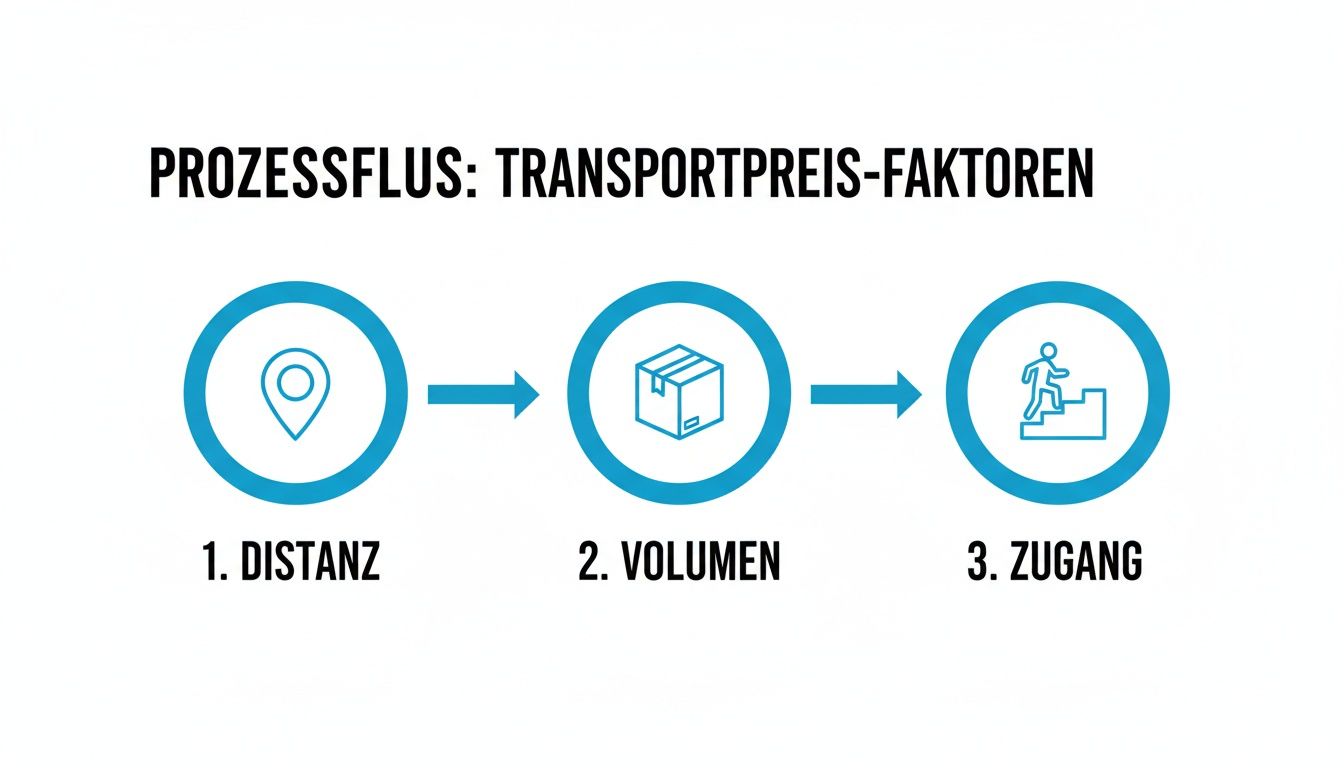
Exactly these three elements form the basis of every serious calculation. Only then do the details such as additional services come into play.
Scenario 1: A sofa from Bern to Ostermundigen
Let's start with a simple case. You have bought a beautiful three-seater sofa online and now have to bring it from the Länggassquartier in Bern to your new apartment in Ostermundigen.
The distance is negligible witharound 6 kilometers. We estimate the volume of the sofa to be about 2.5 cubic meters (m³). Two helpers and a small delivery truck are enough for a job like this. The real sticking point here lies somewhere else: The good piece is on the 3rd floor without a lift and is supposed to go to the 1st floor with a lift.
This is what the calculation could look like:
- Basic flat rate (vehicle + 2 helpers):There is usually a minimum booking time for such small transports, let's say 2 hours. At an hourly rate of CHF 120 we come toCHF 240.
- Floor surcharge (pickup):There is a surcharge for the 3rd floor without a lift, because this is really back-breaking work. Here you could calculate a flat rate ofCHF 40.
- Journey/kilometer:For such short distances, this is often already included in the basic flat rate.
So we end up with an estimated total cost byaround CHF 280. You can see straight away: It's not the distance, but the effort on site - the stairs without a lift - that is the biggest cost driver here.
Scenario 2: Moving a 3-room apartment from Basel to Lucerne
Now it's getting more demanding. A complete life is packed up - the entire household contents of a 70 m² 3-room apartment are moving from Basel to Lucerne. That's just under100 kilometers.
First about the volume. A good rule of thumb is 0.5 m³ per square meterLiving space. So that's about 35 m³. This requires a large truck and a team of three, maybe even four people to ensure that things move quickly.
The situation on site: In Basel, loading takes place from the 2nd floor with a small lift, in Lucerne it goes to the 4th floor, also with a lift.
The calculation is more complex:
- Working time on site:For 35 m³, a professional expects it to take around 4-5 hours to load and 3-4 hours to unload. For a team of three, that's around 8 hours of pure working time.
- Travel time:The Basel-Lucerne route takes a good 1.5 hours. Added to this is the return journey. So that's around 3 hours of pure travel time.
- Kilometer costs/LSVA:For the200 km(there and back) there are costs for diesel and the performance-related heavy vehicle tax (LSVA).
One offer bundles the total working time (approx. 11 hours for 3 people) with the vehicle costs. Such moves often range in price from CHF 2,200 to CHF 2,800. The exact price obviously depends on the hourly rate and the efficiency of the team.
My tip from experience: The key to an accurate calculation when moving is a detailed inventory list. This is the only way the transport company can correctly assess the volume and plan the right team and the right truck. This will save you from unpleasant surprises in the end.
Scenario 3: Small office move with furniture assembly
Third example: A start-up is moving within Zurich. Out of the co-working space and into your first office with three workstations. The distance fromFor the 12 m³ you expect 2 helpers, a transporter and around 3 hours for loading, driving and unloading.hardly matters. The volume is also manageable at approx. The three large desks must be professionally dismantled in the old location and reassembled in the new one. In addition, the IT should be safely packaged.Basic transport costs:The focus of the calculation is clearly on the additional service:
The dismantling and assembly of the three tables is also estimated to take around 2 hours. This requires someone with technical skills.
Additional effort for assembly:
- Special packaging:The monitors require special protective covers, which appear as a small amount of material.
- are therefore heavily influenced by the assembly service. Instead of a pure transport price, there is an offer for the entire service. A realistic price range here isIn this case, the
- Transportation costs in Switzerland.
CHF 750 to CHF 950Your transport costs ≈ (estimated time spent in hours × hourly rate of the crew) + vehicle/distance flat rate + surchargesThe core formula for your own estimateThese three examples show what is important: Identify the specific challenges of your transport. If you compare your situation with these scenarios, you can make a pretty good estimate and be well prepared when you get a quote from a professional.Although every order is different, there is a simple formula that you can keep in mind for a quick rough estimate. It is not exact to the franc, but gives a good feeling for the dimension.
Why transport prices aren't just diced up
Anyone who gets different offers for a transport sometimes wonders: Why are there such different prices for the same order? This is no coincidence and has nothing to do with the luck of the dice. Behind this lies a complex structure of laws, economic realities and operational needs that every reputable transport company in Switzerland must take into account when calculating.
Ihre Transportkosten ≈ (Geschätzter Zeitaufwand in Stunden × Stundensatz der Crew) + Fahrzeug-/Distanzpauschale + Zuschläge
Diese drei Beispiele zeigen, worauf es ankommt: Identifizieren Sie die spezifischen Herausforderungen Ihres Transports. Wenn Sie Ihre Situation mit diesen Szenarien vergleichen, können Sie schon eine ziemlich gute Schätzung abgeben und sind bestens vorbereitet, wenn Sie eine Offerte bei einem Profi einholen.
Warum Transportpreise nicht einfach gewürfelt werden
Wer verschiedene Offerten für einen Transport einholt, wundert sich manchmal: Warum gibt es für denselben Auftrag so unterschiedliche Preise? Das ist kein Zufall und hat nichts mit Würfelglück zu tun. Dahinter steckt ein komplexes Gefüge aus Gesetzen, wirtschaftlichen Realitäten und betrieblichen Notwendigkeiten, das jede seriöse Transportfirma in der Schweiz bei der Kalkulation berücksichtigen muss.
The pricing is anything but arbitrary. It is the result of a tough calculation that takes into account external, unchangeable cost points as well as internal business factors. Anyone who understands these backgrounds can not only better assess offers, but also quickly recognize whether a service provider calculates professionally and fairly.
The LSVA: A fixed cost block that no one can ignore
A central and absolutely non-negotiable cost factor in Swiss freight transport is thePerformance-related heavy vehicle tax (LSVA). The federal government charges this tax for all heavy motor vehicles with a total weight of over 3.5 tons. The amount depends on the kilometers driven, the total weight and the emission class of the vehicle.
In plain language: The LSVA is a direct tax for the use of Swiss roads and flows directly into the federal treasury. Transport companies have to pay them and logically factor them into their prices. If the Federal Council adjusts the LSVA rates, this will have an almost one-to-one impact on transport prices.
A transport company can neither avoid the LSVA nor give a discount on it. It is an integral part of the operating costs, just like diesel. If the tax increases, the transport costs for the customer inevitably also rise.
The transport costs in Switzerland are adjusted regularly, which is due to various legal and economic developments. For example, the Federal Council has decided to increase the LSVA by5 percentfrom January 1, 2025. In response, the Swiss Commercial Vehicle Association (ASTAG) predicted an increase in freight rates by 1.5 percent. This is intended to cushion not only the LSVA, but also other cost drivers such as rising personnel costs or new, legally required device adjustments. Such systematic adjustments are the reason why companies like TIXPI have to keep their calculations transparent. If you want to know more about it, you can find it heredie Hintergründe der Transportkosten-Anpassungen für 2025.
Operating costs and strict rules: What else is included in the price
In addition to the LSVA, there are a whole range of other costs that a transport company has to bear and which have a direct impact on the final price. These can be roughly divided into two areas.
Economic factors:
- Personnel costs:Wages and social security contributions are known to be high in Switzerland. The shortage of skilled workers and new legal regulations, such as paternity leave, are putting additional pressure on personnel costs.
- Vehicle costs:The purchase, maintenance and insurance of modern, environmentally friendly trucks are a huge investment. Added to this are the often highly fluctuating fuel prices, which represent a significant cost factor.
Legal regulations:
- Working and rest times:The legally prescribed driving and rest times for chauffeurs must be strictly adhered to. This has a direct impact on route planning and can require a second driver or an overnight stay on long routes, which in turn causes costs.
- Technical equipment:Regulations for new tachographs or LSVA recording devices force companies to undertake expensive retrofitting and training for staff.
All these puzzle pieces flow into the hourly rate or flat rate that is offered to you. So the next time you see an offer, know that it's not just pure work performance, but also a piece of Switzerland's complex economic and regulatory reality.
Practical tips for reducing your transport costs
Calculating transport costs in Switzerland is one thing. Actively lowering them is another. With a few clever strategies, you can noticeably save your budget without having to compromise on quality. Let’s forget the well-known advice like “book early” and look at what really makes a difference in practice.

Use the power of consolidation
One of the biggest levers for reducing costs is theTransport consolidation. The principle is simple but ingenious: Instead of sending a truck just for your order, several small transports with similar routes are bundled into a single, efficient route.
Imagine you want to transport a single sideboard from Zurich to Bern. At the same time, someone near you is planning a similar transport on almost the same route. Instead of sending two half-empty delivery trucks on their way, a clever platform like TIXPI bundles these orders.
The result? The costs for vehicle, fuel and personnel are divided among several customers. So the price drops for each individual. This not only protects your wallet, but also reduces CO₂ emissions because empty trips are avoided. A classic win-win situation.
Be flexible when choosing dates
In the transport industry, flexibility is worth money. Demand fluctuates extremely. Weekends, especially around the turn of the month, are the absolute peak times. Here the companies' capacities are at their limit, which of course drives up prices.
If your schedule somehow allows it, schedule your transport on a weekday, preferably in the middle of the week.
- Cheapest days:Tuesday to Thursday
- Most expensive Days:Friday and Saturday
- Peak times:End and beginning of month
A move on a Wednesday can easily cost you15–20%less than the identical job on the last Saturday of the month. It is therefore worth actively asking for cheaper dates when making your enquiry.
Minimize the workload through preparation
Every minute that the transport team saves on site is a direct savings for you - especially if billing is based on the hour. With good preparation, you can massively speed up the entire process.
One hour less working time for a team of three often means a saving of overCHF 150. Your own advance payment pays off directly in cash.
What does that mean specifically? Dismantle large furniture such as beds or cupboards before the team arrives. Make sure all boxes are fully packed, labeled and easily accessible. Create clear walking paths by unhooking doors or putting aside carpets. Every step that the professionals no longer have to do shortens the loading time.
And if you need to make space in the meantime: Knowing how to do the rightEinlagern von Möbelnapproach can further optimize the process.
Optimize routes and logistics
Efficient route planning is another key to reducing costs. Modern logistics software no longer just takes the shortest route into account. It also takes into account current traffic situations, construction sites and even the best loading times to avoid traffic jams.
For a deeper insight into innovative approaches, it is worth taking a look at theEffizienzsteigerung durch KI in der Logistik. Such technologies help to minimize empty trips and maximize vehicle utilization, which ultimately translates into a better price for you.
Unanswered questions? Here are the answers to the cost calculation
When planning a transport, the same questions often arise. So that you have clarity and security right from the start when calculating your costs in Switzerland, we have answered the most common uncertainties for you.
What do I have to pay attention to when making offers in order to avoid hidden costs?
A price that seems cheap at first glance can quickly become a cost trap if you overlook the small print. When making offers, pay close attention to possible additional items that often only appear on the final invoice.
Typical candidates for hidden costs are:
- Fees for parking zones:Does a temporary no-parking zone have to be set up for the van? These costs are often charged separately.
- Floor surcharges:Each floor that has to be managed without a lift means more sweat and time - and is often charged separately.
- Packaging material:If the company provides boxes, foil or blankets, this is rarely included in the basic price included.
- Long walking distances:An unexpectedly long walk from the front door to the vehicle can quickly become an expensive walk.
A reputable provider lists such eventualities transparently. If in doubt, it's better to ask too much and ask clearly whether the offer reallyallcovers conceivable costs.
Do I really need additional transport insurance?
In the vast majority of cases the answer is: Yes, absolutely. Although the transport company's standard liability is required by law, it often only covers the current value of your items and has an upper limit. If something breaks, you will not be reimbursed for the new value.
Exactly this gap is closed by additional transport insurance. It is worth its weight in gold, especially when it comes to valuable furniture, expensive electronics or simply things with high emotional value. The price of the insurance is negligible compared to the possible financial loss - and above all gives you one thing: a peace of mind.
Standard liability is only basic insurance. Additional insurance is your personal safety net for the things that are really important to you.
Which is better: fixed price or hourly billing?
The question cannot be answered in general, because both models have their place, depending on the situation.
AFixed pricegives you absolute cost security. It is the perfect choice for larger moves or transports where the effort can be easily estimated. You know where you stand from the first moment - no unpleasant surprises.
ABilling by the hourcan be the cheaper option for very small, quick orders. The catch: You bear the risk of unforeseen delays. A traffic jam, a complicated disassembly or a blocked elevator can quickly increase the bill.
How do I estimate the volume of my household goods as accurately as possible?
A precise volume estimate is the be-all and end-all for a reliable offer. If you estimate too low, you'll end up with a van that's too small at the door on moving day - and that will lead to expensive and nerve-wracking additional trips.
It's best to use an online volume calculator. There you can enter your pieces of furniture and the number of boxes in detail and get a fairly precise indication.
As a very rough rule of thumb: calculateabout 0.5 to 0.7 cubic meters (m³)per square meter of living space. For a 50 m² apartment that would be around 25 to 35 m³. The more precise your list is, the fairer and more accurate the offer will be.
With this knowledge, you are well equipped to realistically estimate your transport costs in Switzerland. If you want to save yourself all the hassle and immediately have a transparent price, TIXPIis the ideal solution. Simply enter your details, see your instant price and book your transport - completely stress-free and online.